
If you’ve followed my writing for any length of time, you’ll know that I’ve never been comfortable with step-kumite. I don’t want to reopen that debate here. Some people value it as tradition; others, myself included, take a more pragmatic view and question its usefulness. This article isn’t about winning that argument.
.
What is worth discussing is an alternative approach to movement and control that shaped my training as my understanding developed, and which I believe addresses many of the problems people attempt to solve with step-based drills.
.
During the 1970s and into the 1980s, I trained in several Japanese disciplines that included step-style practice only in a limited way. The greater emphasis was placed on a method of movement known as ‘sabaki’.
.
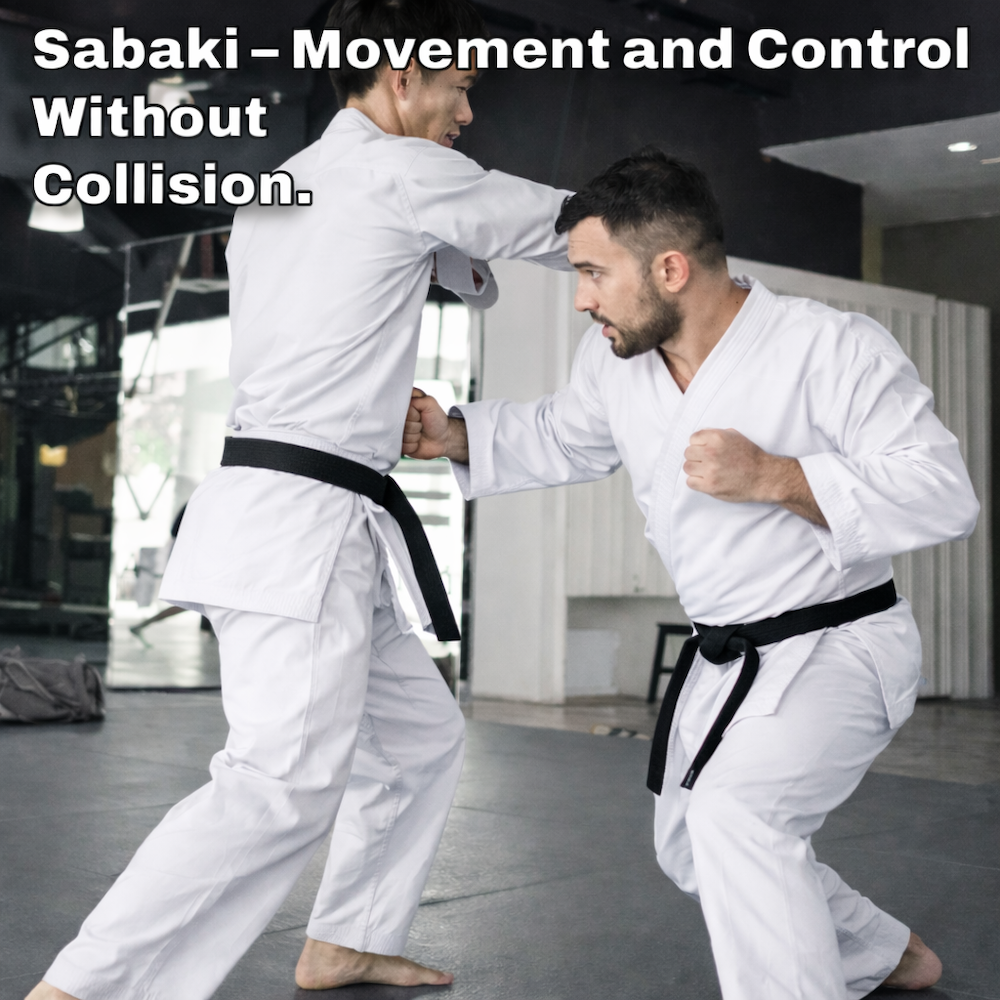
Sabaki roughly translates as handling, maneuvering, or control. In practical terms, it describes how you move your body to manage an attack rather than collide with it. The aim is not to overpower an opponent, but to reposition yourself, redirect incoming force, and create advantage through timing, angle, and balance rather than strength.
.
Coming from boxing in my youth, I initially struggled to understand karate’s insistence on remaining on the line of attack. At the beginning of my karate journey, this straight-line approach felt at odds with what I already understood about movement and positioning. That view began to change as I was exposed to styles and methods that prioritized angling, repositioning, and control rather than linear exchange.
.
Many formal drills are built around stepping straight in and out, meeting force head-on. From a pragmatic standpoint, this makes little sense. Advantage is gained by moving off the attack line, removing yourself from where the opponent is strongest, and placing yourself where they are weakest.
.
Linked to this is another deeply ingrained misunderstanding – the idea that blocks are meant to be stopping actions. This is where things begin to fall apart. If you meet force with force and halt it completely, even successfully, you have usually achieved very little.
.
The attacker remains upright, mobile, and free to try again.
.
In any real physical assault, assuming escape is not immediately possible, the priority should be control, of the opponent’s limbs, body, and balance, without relying on strength. You will not always be bigger, younger, or stronger. Betting your safety on force is a poor strategy.
.
Many movements traditionally labelled as “blocks” have been stripped of their original context. Attempting to use the full, formal motion of a block as a reaction to a fast, committed strike will fail. Action will always beat reaction.
.
This is why, in most cases, they were never intended to be blocks in the first place.
.
When sabaki is properly understood, the focus shifts away from stopping a punch at the wrist or forearm. Instead, attention is placed on moving the body, changing position, creating angles, and gaining a more dominant relationship to the attacker. The defensive action becomes less about impact and far more about blending, guiding, and repositioning.
.
Seen this way, so-called blocks are tools for placing an opponent where you want them, not methods for colliding force against force. Using blocks purely as stopping techniques depends on knowing in advance what attack is coming. That assumption does not hold up in the real world, you never truly know what someone is about to do.
.
The bottom line is simple. Certain movements are ineffective when demonstrated as blocks, yet highly effective when applied as strikes, grips, joint controls, throws, and other forms of physical manipulation, particularly when integrated with sabaki. The movement itself isn’t the problem. The interpretation is.
.
Sabaki is not a sequence or a response. It’s how you move to maintain control when the attack doesn’t follow a script.
.
.
– Adam Carter