
(Approx 2 minute 30 second read)
As martial artists, we all have a style in which we feel comfortable. Karate, however, has been unbelievably dumbed down over the years.
.
Sadly, a number of individuals overlook karate’s true significance. They are not interested in its history, its influences, or where and why it was conceived. Instead, techniques are learned in a superficial manner, detached from context and purpose.
.
Many people react by judging only from their own perspective and level of understanding, rather than embracing the opportunity to learn something beyond what they already know.
.
Kata is a good example. I am often asked why we need it. It is strange how kata is viewed by some people. All they see is the modern solo performance, completely missing the point and ignoring why kata is embedded in karate in the first place.
.
Why kata were created is often debated. My own view is that they were designed as a memory tool, a way to remember drills and principles that had already been practiced with a partner, particularly when training alone.
.
If you believe kata is of no use, I will not be able to convince you otherwise. And to be honest, I do not need to.
.
But let me ask this. Are soccer players criticized for practicing alone? No, they are encouraged. Are tennis players ridiculed for training on their own? No, they are motivated to do so. Are boxers mocked for shadow boxing or hitting the heavy bag alone? No, their coach demands it.
.
This is just the sporting arena. Practicing alone is something we all do in countless ways. Why then is kata sneered at and derided by so many people?
.
Misunderstanding.
.
People do not understand kata because all they have ever seen is the solo representation – the performance, the mnemonic. And when bunkai is shown, it is often the unrealistic theatre that reinforces this misunderstanding.
.
If you only watched shadow boxing, without knowing there was more to it, would your perspective be the same?
.
Unfortunately, today most schools and most dojo teach kata as a performance, as a means to pass a test. That is not its origin.
.
Another common comment I receive is that “practical karate people are looking to modern combat sports to justify their kata”.
.
Stop for a moment and think about that. You have it the wrong way around. The movements seen in modern sporting arenas are already contained within karate’s methods. They are embedded in kata.
.
Which came first? You already know the answer.
.
The real problem arises when people believe kata is something you fight with, following the sequence from beginning to end. That is what they see – the solo performance followed by the theatre.
.
Kata does not teach anyone how to fight, nor does it prepare you to fight on its own. It is a learning device, a way to retain principles and movement. Techniques come later.
.
Kata is trying to show us what we ‘could’ do, not what we ‘should’ do.
.
Why throw it away? If I taught you advanced driving skills, how to make progress safely and under control, skills developed for high-risk situations, would you discard them because they have no value in everyday driving? You would be missing the point.
.
If you strip kata of its function and history, then yes, it becomes meaningless. But that is not a flaw in kata. It is a failure of how it is taught and understood.
.
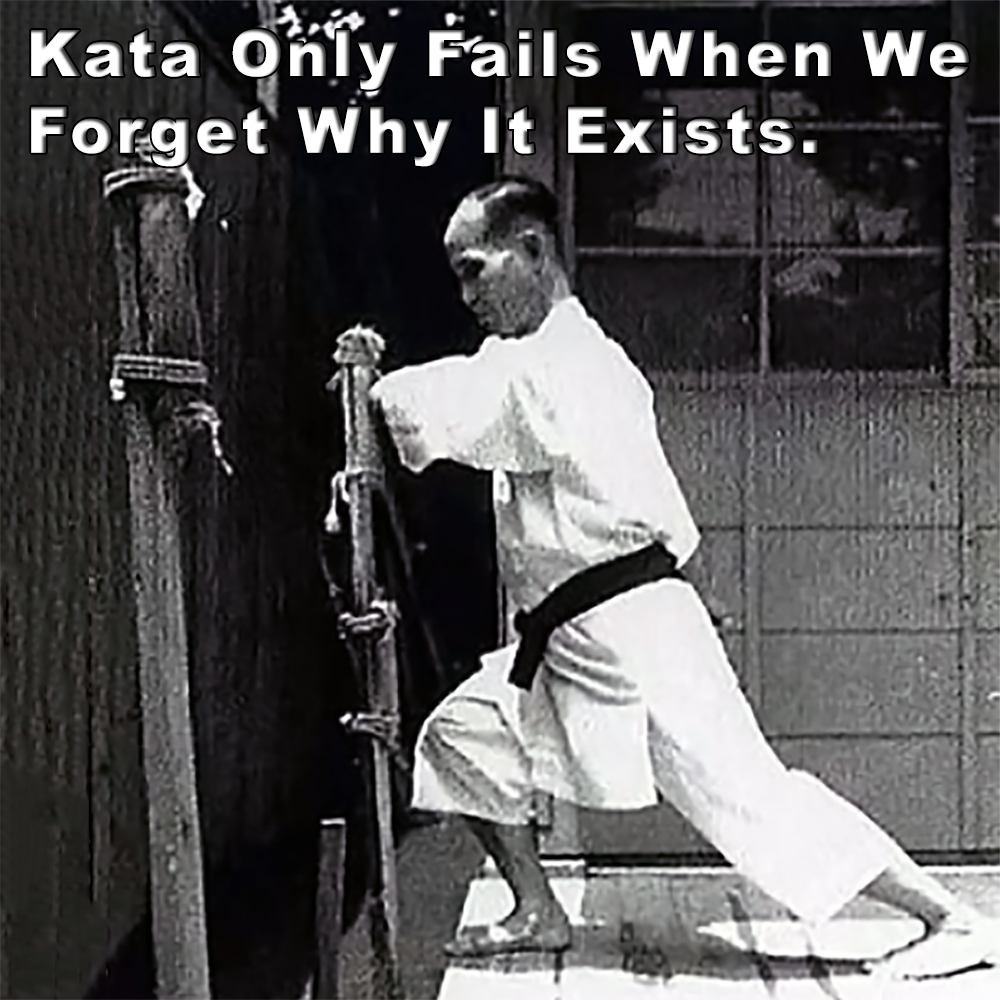
Kata only loses its value when you forget why it exists.
.
Training existed first. Kata came later.
.
.
Written by Adam Carter – Shuri Dojo
.
.
Photo Credit: Kanken Toyama (1888-1966) founder of Shudokan