
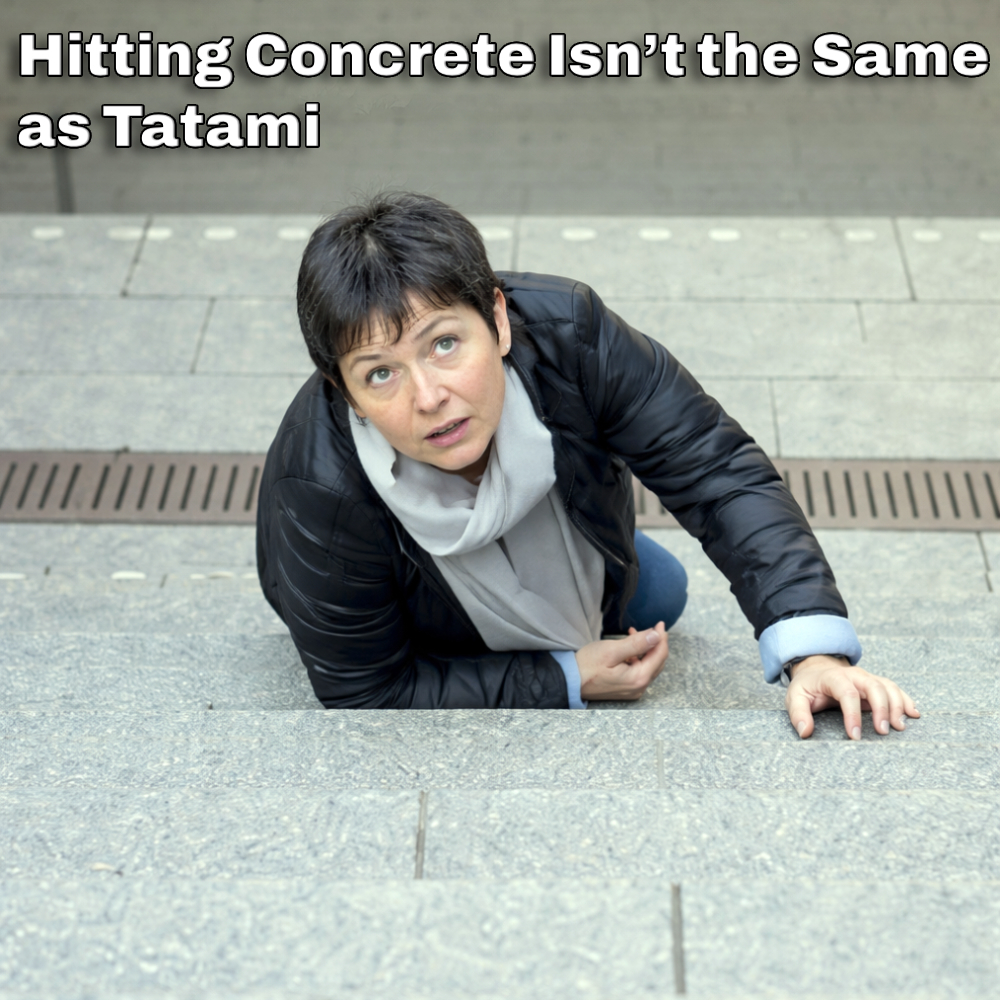
How many times, as a karate-ka, are we told, “Take it to the ground”? “You have to fight on the ground”?
Quite a lot, if the comments I receive are anything to go by.
Have you ever fallen on concrete – the sidewalk, the pavement? It hurts, right?
A senior instructor from my dojo fell last week after being knocked over on the way to the train station. She was pretty roughed up – scrapes on her hands, arms, elbows. Her whole body hurt afterward. She may not be in her salad days of youth, but she is strong and agile.
That’s without a fight even taking place.
Going to the ground in the real world is not the same as going to the ground on soft tatami mats in the dojo.
And I want to stress this clearly – you should be doing everything you can to avoid a physical altercation in the first place. De-escalation must come before fighting.
There are obvious dangers in any fight – weapons, accomplices, and so on. But there are also environmental dangers. The impact of hitting concrete, for example. A head bouncing off a hard surface can lead to concussion, unconsciousness, or even death – and it will almost certainly involve legal consequences.
A street fight is not worth someone’s life. Not because you’re angry. Not because you feel insulted. Not because you think you can handle yourself.
If your default response to confrontation is to fight, then there is a problem.
A true martial artist should know how to avoid dangerous situations, not just fight their way out of them. Too many let ego lead the decision. Avoiding a fight doesn’t look “cool” to them. But neither does a hospital bed, or worse.
Training for tournaments – perfecting spinning kicks or flashy techniques – has very little relevance here. A plastic trophy is not worth your life, or anyone else’s.
Just because you can do something doesn’t mean you should. That applies to fighting as much as anything else – self-defense being the obvious exception.
A street fight is not sparring. It is not sport. The objective is not to win. It is to survive.
Escaping is not cowardice. It is the smartest outcome.
Your mind is your primary weapon. Fighting is not your only option.
Throws in karate are secondary. Yes, you may end up in a situation where a throw happens, or you are forced to the ground. But it is not where you want to be. Striking, unbalancing, and destabilizing an attacker should come first.
You do not voluntarily go to the ground in a self-defense situation.
Think about that.
For anything to be effective, it must be applied in the correct context – sport, self-defense, or simply enjoyment. Training must reflect that. If you study something like judo and want to apply it to self-defense, then your training must address those realities.
In the end, effective self-defense comes down to context, adaptability, and judgment – knowing when something applies, and when it doesn’t.
Tatami is forgiving. Concrete is not.
There is a world of difference between training for sport, for fun, and for self-protection. Understanding that difference is where real progress begins.
Ultimately, it comes back to common sense.
Because in a real situation, the last thing you want to throw away… is that.