
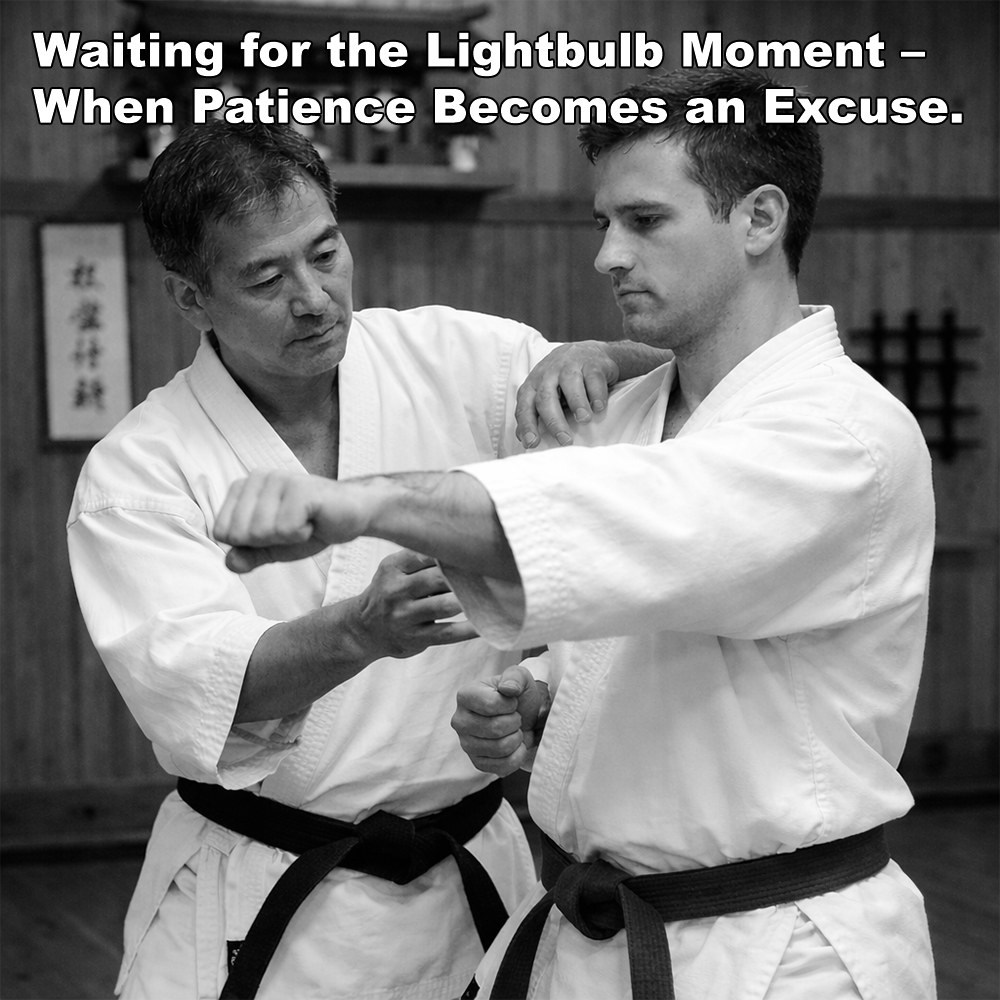
A comment on one of my articles suggested that Western students want answers immediately, whereas the Japanese are prepared to wait patiently for a ‘lightbulb moment’.
.
In other words, understanding should come to us in its own time, and until then we simply repeat.
.
There is some truth in this, but it is often misunderstood. While patience and repetition were valued, function was not always explicitly explained, and understanding was expected to emerge through guided experience within a close teaching environment that no longer exists.
.
While I agree that in the West we can be impatient, I believe the simplified version of this idea is precisely how misconceptions get passed from generation to generation.
.
As an example. It is how, for decades, practitioners have been taught to see many techniques as nothing more than ‘blocks’. Movements are misread so badly that they only make sense within choreography, disconnected from purpose, context, or function.
.
I dislike this way of teaching. It isn’t deep, and it certainly isn’t wise. It’s lazy, and it does nothing to help the student.
.
Of course there are stages to learning. Each stage matters, and understanding develops over time. But deliberately withholding explanations under the excuse that the student must wait for a ‘lightbulb moment’ is absurd.
.
Would you teach someone to drive forward only, until one day the ‘lightbulb moment’ magically tells them that reversing is also an option?
.
This example is obviously ridiculous. Yet the same logic is regularly defended in martial arts instruction.
.
Yes, genuine moments of insight happen. They always have, and always will. But those moments come from guided practice, not from enforced ignorance. Repeating something without understanding does not lead to clarity. It simply hardens misunderstanding.
.
Practice matters. Time matters. Experience matters.
.
But so does teaching.
.
Karate is no different. Kata, drills, and repetition are not puzzles designed to be endured until enlightenment arrives. They are teaching tools, created to transmit understanding, not obscure it.
.
Insight comes through informed practice, correction, and context, not silence. When explanations are withheld in the name of tradition, the student does not gain depth. They inherit confusion, dressed up as wisdom.
.
And when ideas like this are repeated without examination, they stop being insight and start becoming excuses.
.
.
Written by Adam Carter – Shuri Dojo