
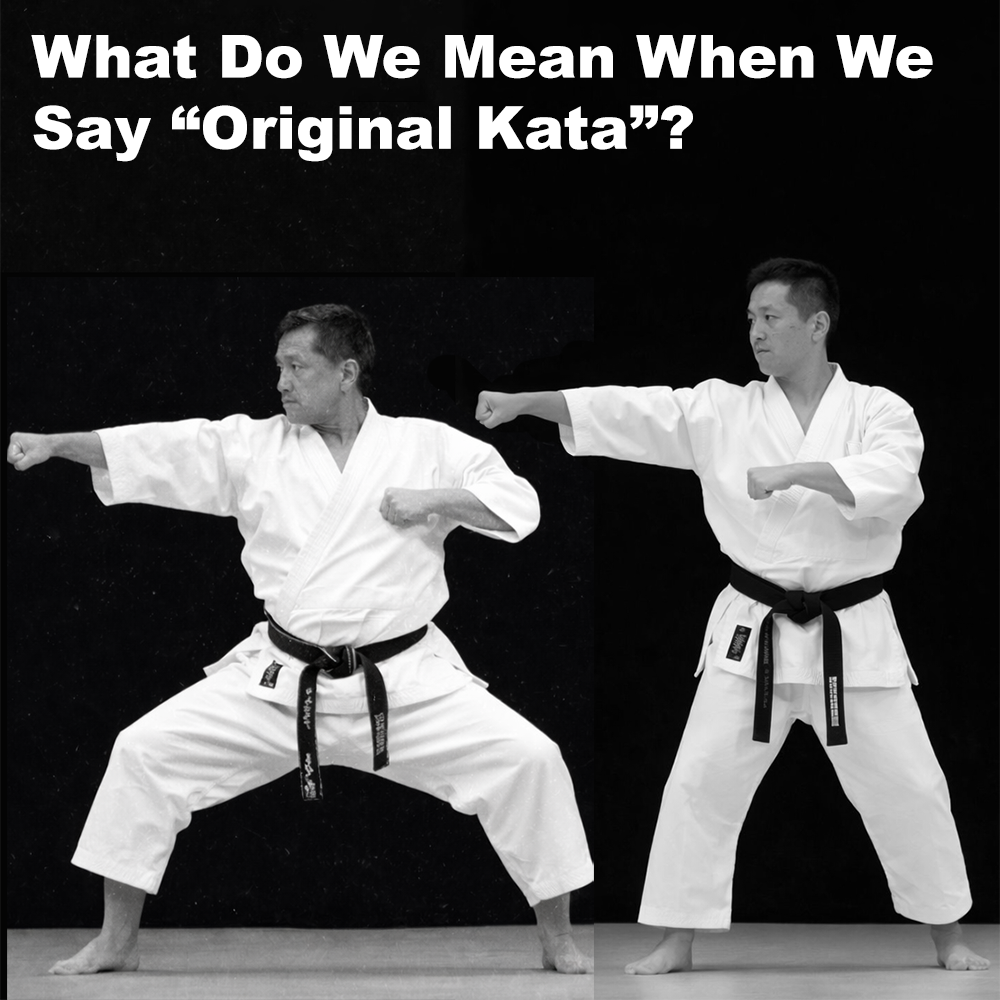
This question comes up again and again in karate, usually after a video is shared or a book is mentioned. Someone performs a kata and the discussion quickly turns into claims about what is “original”, who learned from whom, and who was closest to the source. Before long, the kata itself is almost forgotten, replaced by arguments about authority.
.
This isn’t about criticizing teachers, lineages, or personal experience. It’s about questioning an idea that doesn’t hold up once you look at it closely.
.
People often say they have the ‘original’ version of a kata. The reasoning is usually about closeness. They trained with the source. They were an uchi-deshi. They were told directly, “this is how it was originally done”.
.
On the surface, that sounds convincing. Why wouldn’t it be?
.
But if you really think about it, the idea starts to fall apart.
.
We know kata have changed within a single generation. Not over hundreds of years, within one lifetime. In some cases, even between members of the same family. If that happens, then “original” can’t mean one kata that stayed the same just because someone was close to the source.
.
I believe that the pioneers never treated kata as finished objects. They weren’t something to be locked down and preserved unchanged. They were working material, ways of remembering and passing on ideas, shaped by the teacher’s experience, and the situation they were teaching in at the time.
.
Being taught by the source doesn’t lock a kata in place. It gives you access to a person. And people change.
.
This is usually where the conversation shifts to authority. Someone will say they were told directly that this is how it was done.
.
This tells us about the relationship. Not that the kata stayed the same.
.
When a teacher says, “this is how it is”, what they really mean is, “this is how I understand it now, and this is what I’m passing on to you”. That doesn’t erase what they taught earlier, or what they showed differently to other students, or how their own understanding developed over time.
.
What’s left isn’t an original kata. It’s a last snapshot of something that had already been changing.
.
Photographs, books, and video complicate this even further. Once a kata is recorded, often late in a master’s life, that version starts to carry extra weight. It gets copied. Repeated. Taught. Before long, it becomes the version people point to and say, “this is the real one”.
.
But recordings don’t preserve understanding. They preserve how something looked at that moment.
.
A photograph freezes a single instant. A book arranges positions. A video shows a performance shaped by age, purpose, and physical condition. Earlier versions disappear simply because no one filmed them. Over time, that absence gets mistaken for consistency.
.
Recording a kata doesn’t stop it changing. What survives isn’t necessarily what mattered most, it’s what was easiest to copy.
.
You can see the effect of this in practice. Two people may perform the same kata and argue fiercely about which version is older or purer, yet when pressure is applied, both default to the same handful of actions. Range collapses. Timing matters more than shape. The body solves the problem in familiar ways, regardless of which version was memorized.
.
That tells us something important. The value of the kata was never in the exact movements. It was in the ideas it carried and the problems it was meant to address.
.
None of this means close students are misguided. It simply means closeness on its own can’t prove originality.
.
So when someone says, “this is the original”, the sensible response isn’t ‘who taught you?’ It’s ‘when’, and ‘under what conditions’?
.
Arguing about which version is the original rarely leads anywhere useful.
.
The more practical question is whether the kata, as you practice it, still solves the problems it’s supposed to solve. If it does, it’s doing its job. If it doesn’t, its age won’t save it. After all, the solo performance is just that – a performance. It’s what’s under the skin that matters.
.
.
– Adam Carter