
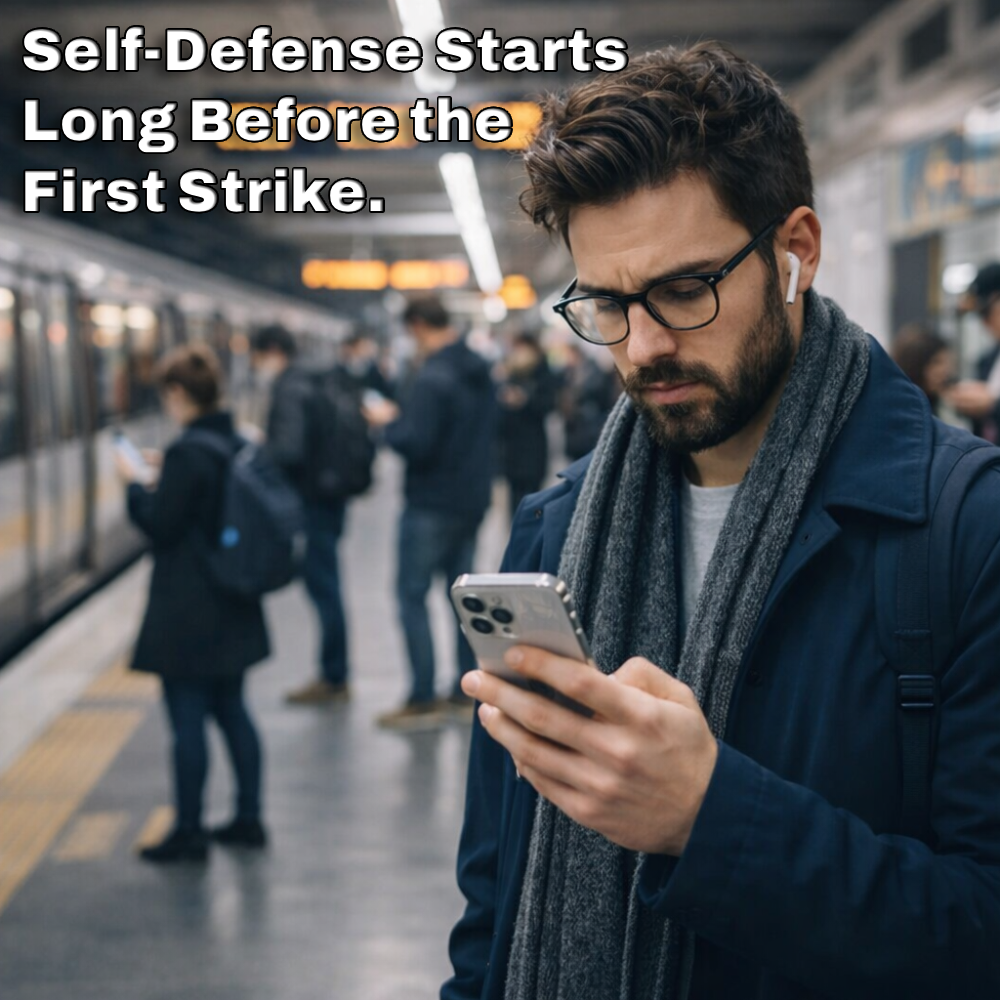
Self-defense. It’s mostly about the fight, right? After all, that’s what the vast majority of training in the dojo is geared toward.
.
But when I speak of self-defense, I’m not talking about kumite drills or sparring. I’m talking about what happens in the real world, where the possibility of actual physical harm exists.
.
I was sent a video this week – I get a lot of them – showing several attacks on an underground train platform. The attacker walked along the platform, randomly striking people. The last attack was particularly vicious.
.
So what would have helped those people? Learning to fight?
.
No. Awareness.
.
Here’s an uncomfortable truth: none of us really know how we’ll react until the moment arrives. That’s not a flaw. It’s simply how the human nervous system works.
.
The goal of self-defense is not to learn what to do in every possible situation. That’s impossible. The goal is to train the parts of ourselves that are actually needed most of the time.
.
A dojo can help with this, but not by piling on more techniques. It starts from training that develops awareness – learning to notice small changes in your environment and in yourself.
.
Even if you’re not training for self-defense and are focused on competition, awareness still matters. Those tell-tale signs of movement from your opponent can give you the slightest edge you’re looking for.
.
Outside the dojo, the same principle applies. If your head is buried in your phone, you won’t notice anything. In the video, that’s exactly what most of the people on the platform were doing.
.
That’s why the final attack was so severe. There were warning signs. Everyone missed them. The attacker walked the length of the platform, striking people at random. Had anyone been paying attention – even after the first attack – other options could have been used: avoidance, retreat, moving to another area, getting help. None of these require fighting. All of them require awareness.
.
None of this guarantees a perfect response. Nothing does. But it dramatically increases the chance that you remain functional long enough for any training to matter. If you’re not aware, how can you respond appropriately?
.
This is not a difficult skill to practice. Start by putting your phone down in public places. If your attention is elsewhere, you will miss the things that matter most.
.
Self-defense doesn’t begin with a technique. It begins with noticing that something is wrong. If you miss that moment, everything you trained for may already be too late.
.
If you didn’t see it coming, you didn’t fail to fight. You failed to notice. Self-defense starts long before the first strike.
.
.
– Adam Carter