
(Approx 2 minute 40 second read)
It is one thing to argue that kata is misunderstood as a concept, but it is another entirely to witness how that misunderstanding manifests in the daily reality of the modern dojo.
.
Following my previous article, a reader shared a reflection that perfectly captures the frustration felt by so many who go looking for a form of self-defense and find something entirely different.
.
He described a cycle where training is dominated by what he called “foot fencing” and point-scoring, interrupted only by a frantic, temporary focus on kata when a belt test looms.
.
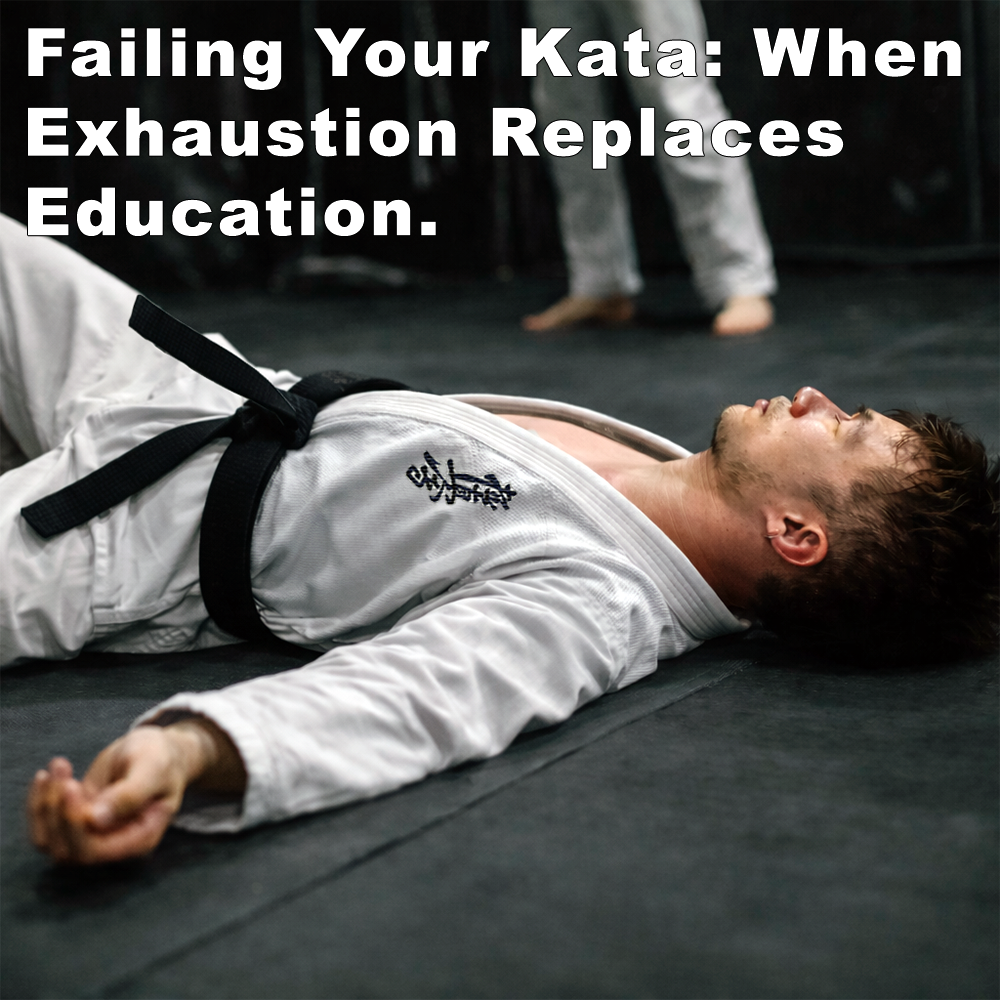
This observation serves as a stark confirmation of the modern problem: we have turned our primary learning tool into a periodic chore and replaced technical depth with physical exhaustion.
.
The commenter noted that many sessions begin with a warmup that would put a military boot camp to shame, leaving students exhausted before the technical work even begins.
.
And while physical conditioning is a vital component of any martial pursuit, there is a recurring danger in using sweat as a substitute for value.
.
It’s far easier for an instructor to run a grueling fitness circuit than it is to teach the subtle mechanics of ‘muchimi’, or structural alignment, or the intricacies of effective bunkai.
.
When a student leaves the mat gasping for air, they often feel they have done something useful. But if that exhaustion is not a byproduct of learning in any depth, it is merely a workout in a white suit.
.
This often masks a lack of instructional depth, replacing learning with a sense of accomplishment that vanishes as soon as the heart rate slows.
.
And this lack of depth is most visible in how kata is treated as a check-box for rank. As the reader pointed out, students often memorize a sequence just to pass the test, only to return immediately to the world of consensual sparring once the new belt is tied.
.
This confirms that kata is no longer functioning as a mnemonic for partner-based drills. Instead, it has become a dead language.
.
When kata is relegated to a grading requirement rather than a daily training manual, it loses its purpose as a tool for memory and becomes a hollow performance for the eyes of an examiner.
.
The inevitable result of this approach is the “foot fencing” the commenter talked about. When we optimize our training solely for the ruleset of modern karate, we naturally discard anything that does not help us score a quick point or knockdown. In doing so, we ignore the vast library of close-quarters strikes, limb-clearing, throws, and joint manipulation that kata was designed to preserve.
.
These are the “useful techniques and concepts” the reader felt were being wasted. By reducing the art to a game of high-speed tag, we lose the internal aspect of the practice – the intent that turns a motion into a martial application.
.
Without these elements, the art is indeed reduced to a mere “kick and punch”, and kata remains a misunderstood dance.
.
Ultimately, the disillusionment expressed by the reader is a warning to many practitioners. We cannot blame students for being “put off” by a club or dojo when the training feels disconnected from the history and function of the art.
.
If the kata we perform on the mat never informs the way we move or the way we fight, then we are not practicing a martial science. We are engaging in a historical re-enactment.
.
To reclaim the value of kata, we must move beyond the theatre and the sport and return to the grit of the original drills. We must stop using exhaustion as a substitute for education and start ensuring that the mnemonic of kata is backed by the reality of application.
.
Only then will we stop failing the kata, and start remembering why it exists.
.
.
Written by Adam Carter – Shuri Dojo