
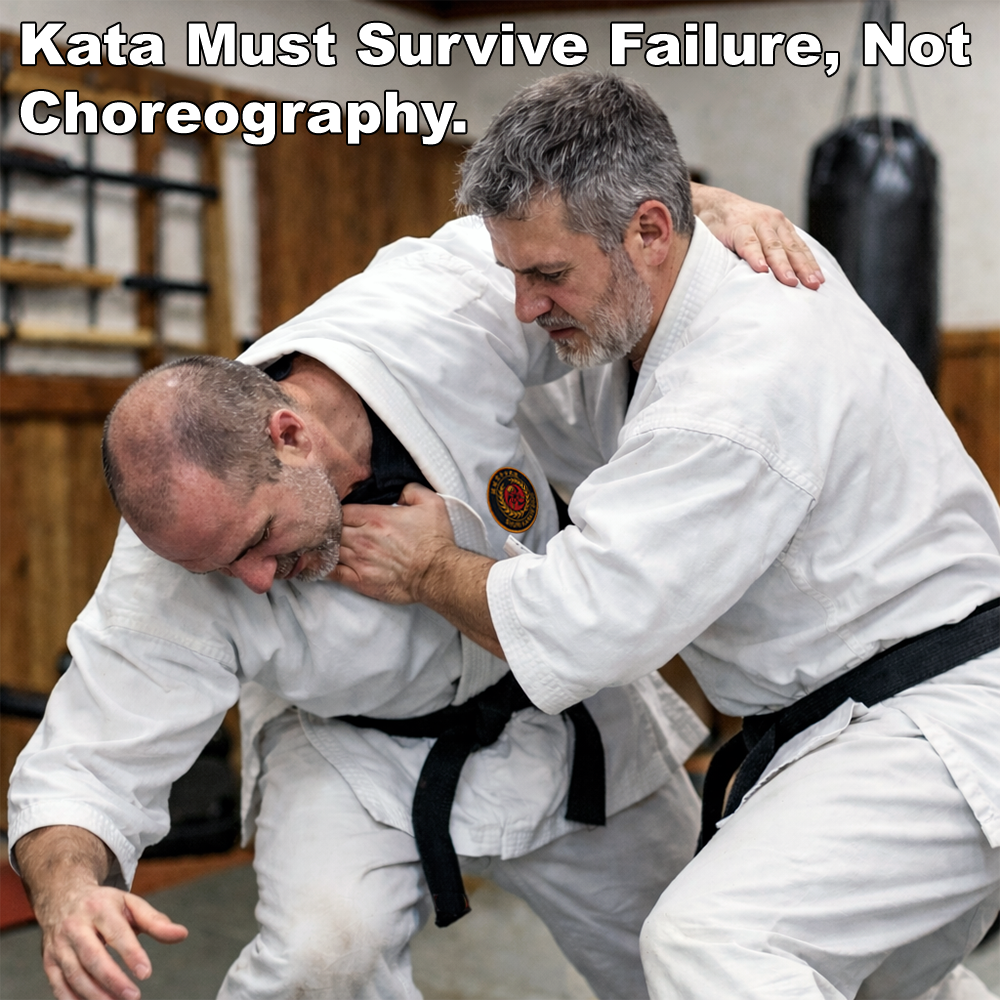
In my last couple of articles I wrote about sequences in kata. Yes, of course they exist, but relying on them like a script is simply not feasible. No one knows what an attacker is likely to do. However, we do have clues.
.
Any form of martial art requires an instructor to demonstrate principles, movement, or technique to their students. Obvious, really.
.
However, there is often a component missing from these demonstrations, and I believe this is one of the reasons so many people still misunderstand kata, and in some cases karate as a whole.
.
Let me explain. When I demonstrate to my students, I always incorporate some level of failure. Why? Because real-life violence is unpredictable and chaotic, and no two encounters are ever the same. Techniques do not unfold neatly. Things go wrong. You may have to reset, recover, and retake the initiative.
.
In the dojo, the success of most demonstrations is dependent on having predetermined knowledge of the attack. The attacker is often compliant and unresisting, allowing the technique to succeed for demonstration purposes.
.
That is all well and good if you are simply illustrating a sequence.
.
But here is the problem that is often missed. Failure must be taken into account. I have seen countless demonstrations where an exchange works perfectly, with no consideration given to what happens when it does not.
.
Assuming that an opponent will perform a series of actions that conveniently fit your application is unrealistic. It is not how violence works.
.
That said, we can move the odds back in our favor by understanding the body.
.
We have what are sometimes called “known responses”, although a better term would be “likely responses”. For example, if you strike someone forcefully in the abdomen, there is a likely reaction that can be reasonably anticipated.
.
Any demonstration or interpretation of an application, especially one that includes failure, must factor in how the opponent responds to being hit, pushed, pulled, or disrupted. Natural human reactions can change the entire situation.
.
There are other physical responses as well. The flinch response, or startle response, is an autonomic reaction, outside of conscious control, and it must be taken into account.
.
When things fall apart, and they will, this is where training is tested. You quickly learn that adaptability matters more than choreography. Your attacker will react to your actions, and you must be able to show what happens when they are no longer in the position they started in.
.
What matters, in my opinion, is understanding how these responses affect your application. Following kata strictly in order, applying movements verbatim as they appear in solo practice, is not correct interpretation. You must account for your opponent’s reactions, which may take you away from the sequence you originally intended to use.
.
So, to recap from earlier articles on this subject. A sequence may exist within kata, but it is not a script to be followed word for word.
.
Kata may encode common patterns of response, but they are not scripts and must survive failure.
.
Perhaps the creators of our kata took these likely responses into account. And maybe this is why some techniques make little sense in isolation, but become clearer once a human reaction is introduced.
.
It’s a cliché, but you must learn from failure, and from the reactions your actions provoke.
.
Consider failure. Adapt accordingly. Be a rebel. Don’t follow the script.
.
.
Written by Adam Carter – Shuri Dojo