
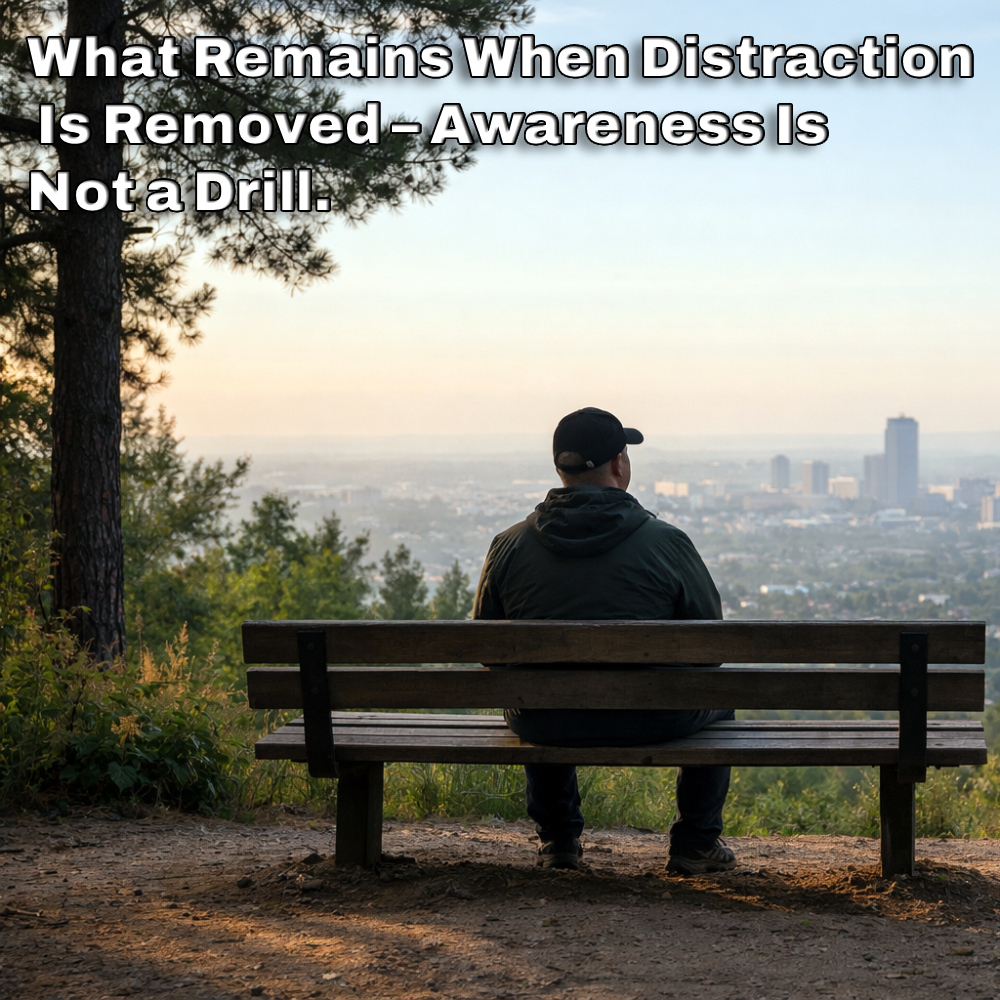
In my recent article I talked about awareness – something everyone should be thinking about in relation to self-defense. Even if your goals are elsewhere, such as competition, awareness still matters.
.
But the question that always follows is this: how do you train it?
.
Awareness isn’t trained by adding content. It’s trained by removing interference.
.
People want a drill, a method, something that can be slotted neatly into a curriculum. Awareness isn’t lost because people forgot how to notice. It’s lost because they stop paying attention.
.
So the honest answer to “how do you train awareness?”.
.
You stop suppressing it.
.
The mistake people make is expecting drills, exercises, and step-by-step instruction, as if awareness is something you apply once danger appears. It isn’t.
.
Awareness isn’t a drill. It’s what remains when you stop distracting yourself. Most people already know how to notice – they just don’t.
.
The dojo can support awareness, but it isn’t trained in the same way techniques are. It develops through attention. Awareness comes before methods, not after them.
.
Whether people call it situational, environmental, emotional, or self-awareness, they are all expressions of the same thing – attention that hasn’t been pulled elsewhere.
.
Start by noticing how often your attention isn’t where your body is.
.
The question itself assumes awareness needs to be added, rather than acknowledging that it is already present and being suppressed. Awareness hasn’t vanished because people forgot how to notice. It has been pushed aside by modern life, modern training, and habits that reward distraction, fixation, and reassurance.
.
So let’s bring this back to the dojo. Not through drills, but through interference. Kata, bunkai, drills, sparring, they can either sharpen awareness or degrade it, depending on whether attention is narrow, performative, or obedient to the drill – in other words, the practitioner isn’t noticing so much as complying.
.
You don’t need a list of methods to understand this. You need to recognize the difference between training that demands presence and training that encourages autopilot.
.
Step outside the dojo for a moment. Phones. Headphones. Endless scrolling. The constant urge to fill silence. Awareness doesn’t need to be trained so much as allowed back in.
.
Awareness isn’t difficult. But it is uncomfortable – because once you notice more, you also have to take responsibility for what you’ve noticed.
.
.
– Adam Carter