
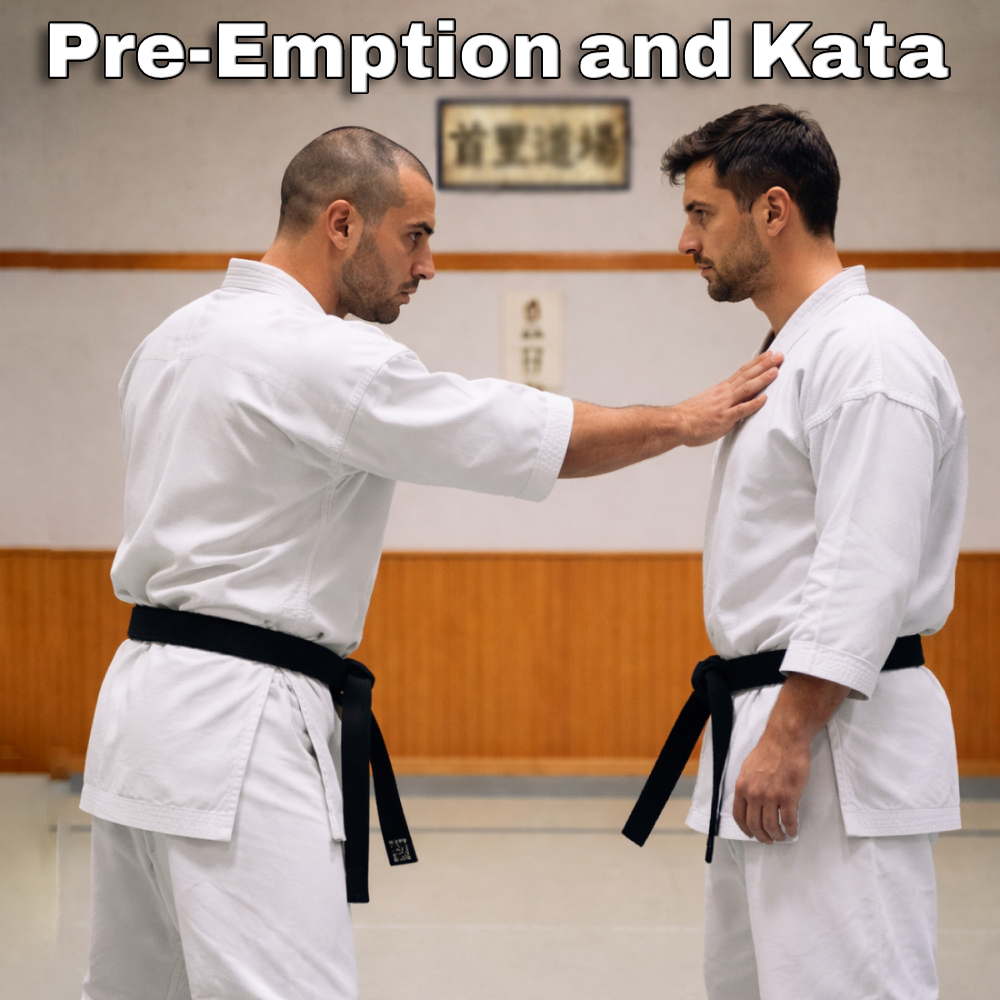
There’s a question that came up after I wrote about kata not showing the setup.
What about pre-emption?
If it’s often better to act first – to move before the attacker commits – then where does that fit? Because kata doesn’t show that either.
And that’s the point.
Kata doesn’t try to show the moment of decision. It doesn’t show awareness, escalation, or the choice to act. It doesn’t show the conversation, the shift in intent, or the instant you realize something is about to happen.
Those things exist before the movement. They are part of the setup.
Kata records the physics of the struggle once the moment of decision has passed.
As with everything else in that space, these moments are too fluid, too dependent on context to be fixed into a sequence. Instead, kata captures what happens once contact has been made and control is being taken.
Once the situation is already in motion, the movement begins.
Pre-emption doesn’t sit inside kata. It sits just before it.
It’s not a technique.
It’s a decision.
And that decision can’t be standardized in the same way a movement can. It depends on timing, judgment, environment, legality, and the ability to read another person. Two situations may look identical, yet the correct decision in each could be completely different.
That’s why kata doesn’t try to show it.
People tend to divide techniques into rigid categories. They say: “This is a reaction. That is a pre-emption. This only works if you go second. That only works if you go first.”
In practice, it doesn’t work like that.
The same movement can often serve both roles. What changes is not the technique, but when it’s applied.
- You can enter early and take control before the situation fully unfolds.
- Or you can find yourself late, already dealing with contact, and apply the same movement as a response.
The mechanics don’t care which role it plays.
And that’s what kata preserves. Not the timing of the decision, but the method of dealing with the problem once it exists.
If you only ever train from fixed starting points, you never develop the judgment to decide when to act.
You learn movement, but not timing. You become good at responding to agreed cues, but not at recognizing when a situation is about to turn.
That gap sits outside kata. It has to be trained deliberately through scenario work and live drilling.
Most people try to solve that gap by inventing better starting points inside kata.
But the gap isn’t in the kata. It’s in the training.
In the moment that matters, the movement alone won’t save you. What matters is whether you recognized the situation early enough to use the tool.
Kata gives you the tools. But it’s up to you to recognize when they need to be used.