
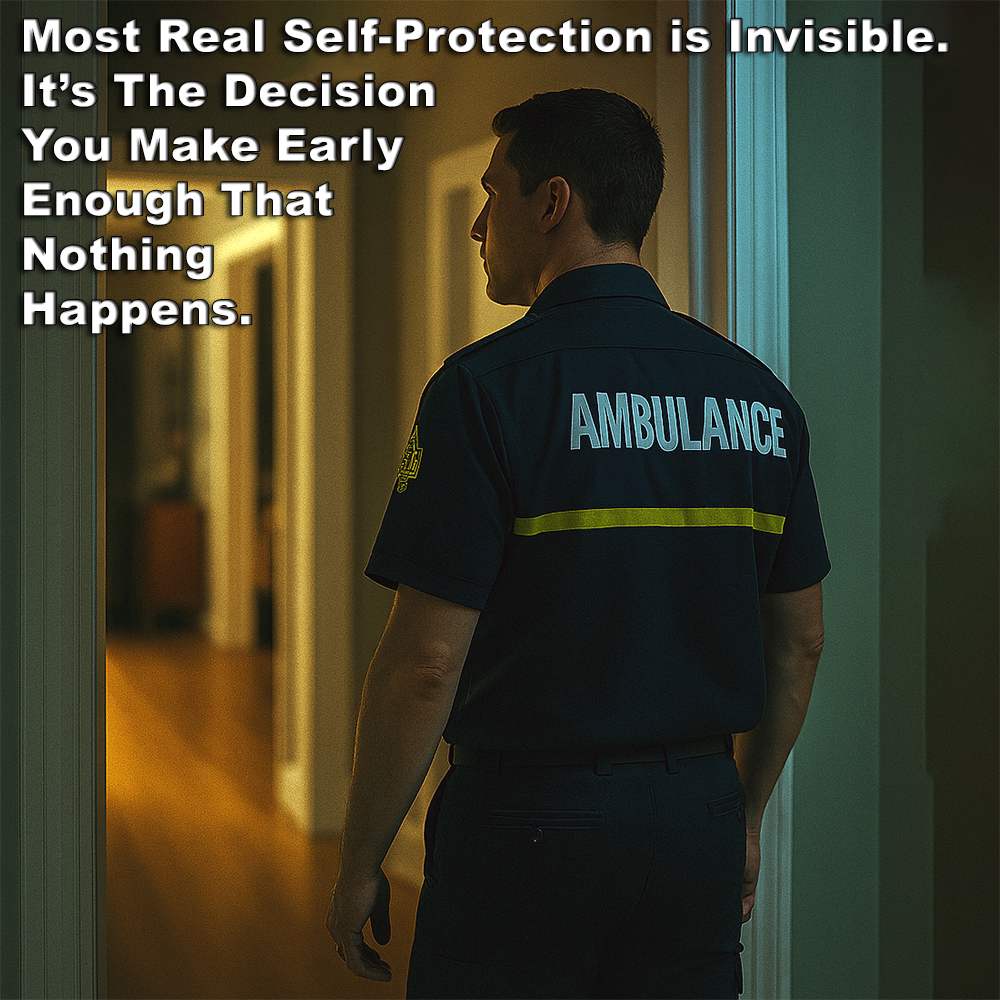
If you are like most people, you probably hope you will never have to face real violence.
.
Recently I wrote about awareness, because the best self-defense decisions often happen long before anything physical begins. The earlier you notice a problem, the more options you have. Sometimes the best outcome is simply stepping off the tracks before the train arrives.
.
During my time working as an EMT, I was often paired with a crew-mate who had no background in physical self-defense. That was normal. We had conflict management training, but not quite the same.
.
One call in particular stands out, although situations like it were not uncommon, and attacks on personnel are becoming more frequent. We were called to a man who was intoxicated and had multiple head wounds. He didn’t want help, but with police assistance we managed to get him back to his home so we could at least assess and treat him there.
.
We cleaned him up, dressed his wounds, and tried to evaluate him for possible head injury. As we worked, his behavior began to shift. He became more agitated, more unpredictable. At the same time, he was absolutely refusing transport to the hospital.
.
Then he stood up and walked with clear intent toward the kitchen.
.
While I was still talking to him, both my partner and I followed. My partner was slightly ahead of me, focused on conversation.
.
As I watched the patient move, something felt wrong. Not dramatic. Just wrong.
.
I noticed him glance toward a butcher’s block on the counter. His movement shifted toward it. My partner did not see it at all.
.
I moved forward and positioned myself between him, my partner, and the knives. I didn’t announce it. I just changed the physical picture of the room.
.
The patient himself seemed to notice something had changed, and we were able to slow things down, calm him, and eventually persuade him to come with us to the hospital.
.
Nothing physical happened. And that was the success.
.
People have asked what technique I would have used if he had grabbed a knife. That is the wrong question.
.
The moment that mattered was before that. It was noticing the change in intent.
.
There was no checklist running in my head. No step by step process. Just a small shift in behavior that signaled risk.
.
That is what awareness actually looks like. Not mystical instinct. Not guessing. Trained perception, even with the probability of distraction.
.
In that room, both my partner and I had access to the same information. Same patient. Same environment. Same moment. The difference was interpretation.
.
This is why awareness is not trained by adding more content. It is trained by removing interference.
.
In self-defense, early options matter just as much as physical ones. Distance. Positioning. Tone of voice. Body language. The ability to read intent before action. These things often decide outcomes before force is ever considered.
.
This was more than just a feeling. It was pattern recognition built over years. Small signals. Changes in movement. Shifts in attention. None of them dramatic alone, but meaningful together.
.
I remember a similar moment in the dojo when a student was becoming frustrated while trying a technique. Again, I noticed a shift in body language and intent, and stopped them ‘kicking off’ before they even realized they were about to. The student later said to me, “You were right – but how did you know?”
.
Responsible preparation is not just learning how to fight. It’s learning how to notice.
.
The goal is not to win confrontations. The goal is to get out of danger. Either you manage the threat early, or you deal with it later under worse conditions.
.
Your safety has always been your responsibility. And very often, the best outcomes happen when nothing physical happens at all.
.
Self-defense does not start with a technique. It starts with noticing that something is wrong.
.
Awareness isn’t something you add. It’s what remains when you stop ignoring what is right in front of you.
.
.
– Adam Carter