
(Approx 1 minute 50 second read)
I wrote an article recently saying, as I’ve long believed, that the two-person drills came before kata.
.
Kata was the record, something to memorize, a mnemonic, something to preserve the lessons when you were training alone. But I also pointed out that practicing kata on your own isn’t enough. The movements only reveal their purpose when there’s another body in front of you, when something is pushing back, resisting, grabbing, or moving unpredictably.
.
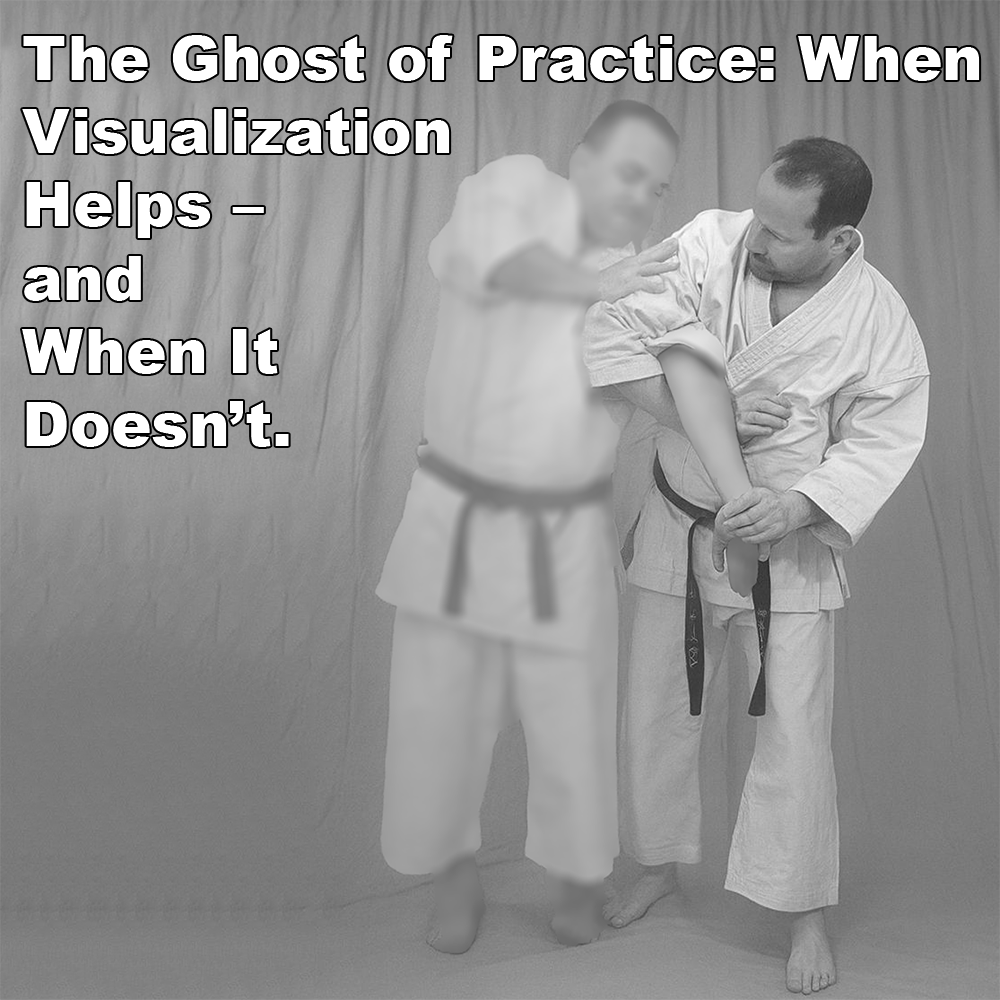
Some people took that to mean I was talking about visualizing an opponent. I wasn’t. But it’s worth addressing, because visualization is used by some of the best athletes in the world.
.
Olympians, fighters, sprinters, Formula 1 drivers, they mentally rehearse situations, feel the pressure, imagine the timing, and walk themselves through a scenario long before they physically do it. There is a huge body of sports psychology showing that mental rehearsal can sharpen reactions, improve timing, and reduce hesitation.
.
But karate isn’t quite the same as those sports, is it? You can’t visualize the unpredictable. You can’t imagine the weight of someone grabbing your clothing, the shock of being pulled off balance, or the chaos of a genuine assault. You can only visualize patterns. And patterns aren’t reality.
.
Still, there is a place for it, as long as you understand its limits. If used properly, it can help you move with intent. When you perform a technique, imagining the angle of an arm, the direction of a limb, or the position of someone’s head can give the movement purpose rather than it being empty choreography.
.
It won’t replace partner work, not even close, but it stops you drifting into performance mode. It keeps the mind anchored in application rather than aesthetics.
.
In the old days, I believe they knew exactly what each movement referred to because they had drilled it repeatedly with a partner before they ever performed it alone. The visualization came from memory, real memory, of the tactile, sensory experience. Not imagination. Not fantasy. It was rooted in something that had already happened.
.
That’s where modern karate often loses its way. Too many people visualize techniques they’ve never actually applied. It becomes guesswork, or worse, storytelling. It only has value if it’s tied to something real.
.
And that’s my point. Use visualization, absolutely, but build it on top of honest, hands-on training.
.
Kata without context goes nowhere. Visualization without experience is fiction. But combine the two, and suddenly the kata makes sense. They become reminders of something you’ve felt before, not something you’re hoping might work one day.
.
.
Written by Adam Carter – Shuri Dojo