
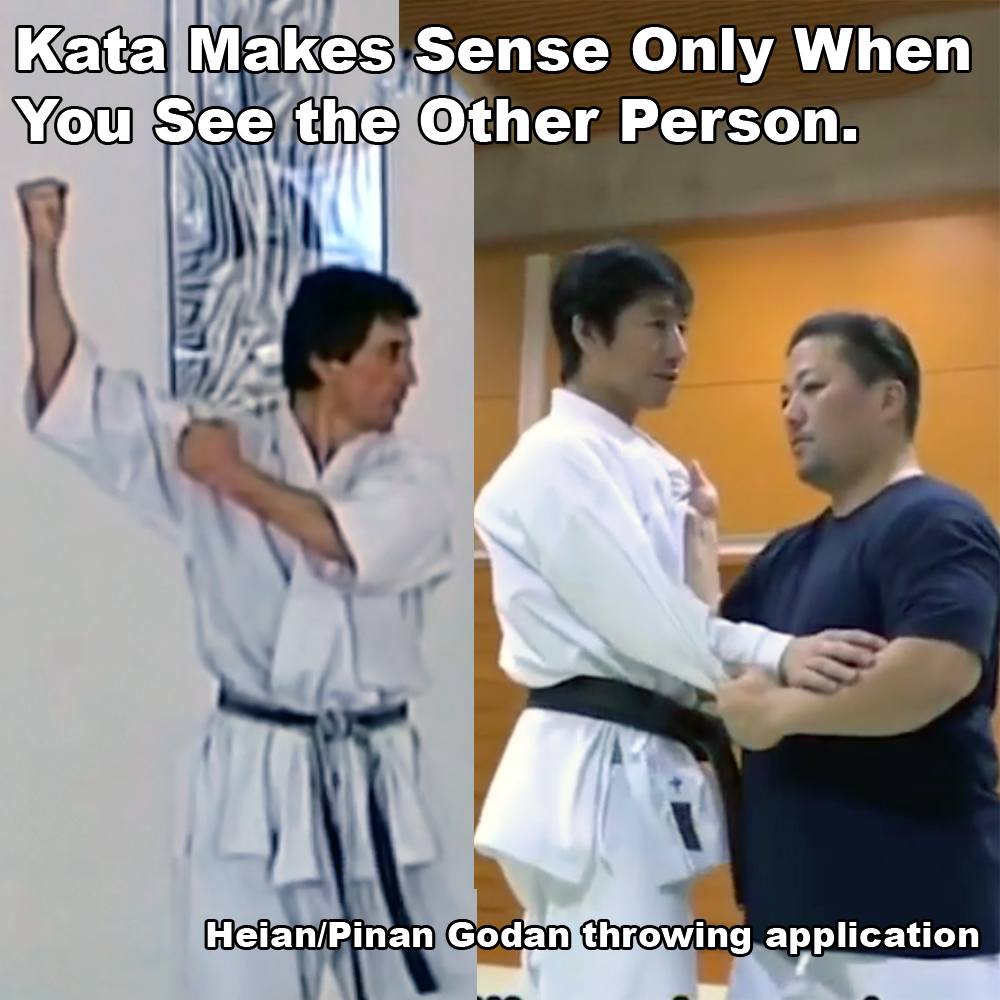
(Approx 2 minute 50 second read)
The question of evidence has popped up again from a personal message: “How do we know the creators of kata built them on two-person drills?”
.
A fair question.
.
But before we get into it, let me make it clear, and I mean no disrespect, I don’t have time for private back-and-forth messages or phone calls.
.
My writing is simply my opinion, based on over 50 years of practice, real-world conflicts, and a career outside the dojo which often involved conflict. If you disagree, that’s fine – just move on. I’m happy with what I do, what I teach, and the context my students and I choose.
.
When I write, I research, consider what others think, and add a sprinkle of common sense, logic, and my own experience.
.
So, with that out of the way, back to the question.
.
As Patrick McCarthy Hanshi, founder of the International Ryukyu Karate Research Society, researcher and author, often explains, kata function as mnemonic devices – summaries of lessons that were originally learned through two-person drills.
.
Similarly, Iain Abernethy, a leading exponent of applied karate, pragmatic bunkai and author of several books on the subject, frequently describes kata as a repository of combative principles: the solo form acting as the textbook, with the bunkai drills providing the lessons contained within it.
.
Both perspectives reinforce the view that kata were constructed from paired drills, serving as repositories of combative principles rather than just solo routines.
.
Think of it this way. Many kata techniques make little sense on their own, often analyzed as simple blocks and counters. But they become functional when interpreted as grabs, locks, or throws, against an opponent.
.
We also have documentary evidence in translations of the Bubishi and references to ‘kaisai no genri’ (rules for decoding kata), which assume kata began as paired drills.
.
Early Okinawan masters also gave us many interesting clues to their function.
.
In his ‘Ten Precepts of Karate’ (1908), Itosu Anko wrote that karate was not intended for use against a single opponent, but as a way to defend oneself when confronted by a violent aggressor.
.
He emphasized that kata contained practical methods that students must learn to apply. This clearly implies that kata were rooted in combative drills.
.
Motobu Choki criticized kata performed in a fixed or lifeless way. He emphasized that the techniques of kata were meant to be applied in actual fighting, not repeated as dead patterns. His insistence on paired practice as the measure of kata’s value shows he saw kata as encoding drills, not dance.
.
Mabuni Kenwa, wrote that kata forms the heart of karate, and that practicing kata without understanding its applications renders it of little value. He viewed bunkai and kata as inseparable, reinforcing the idea that kata were built from two-person methods.
.
This is another angle I have often thought about. For centuries, Okinawa has had its own rich dance traditions. While some people speculate that movements in traditional Okinawan dance may resemble combative actions, there is no evidence kata grew out of dance traditions. Kata were created to record combative methods, not to entertain.
.
As Motobu Choki warned, treating kata as dance strips it of meaning. As Patrick McCarthy reminds us, without understanding bunkai, kata becomes little more than meaningless choreography.
.
It is also worth noting the structural language of the kata themselves. Many movements, when performed in isolation (such as a ‘block’ executed while stepping forward), appear illogical for simple defense. Their true logic is only unlocked when they are viewed as part of an aggressive, paired sequence, a grab, a controlling grip, or a setup for a takedown.
.
From the old masters to modern researchers, the evidence points in one direction: kata did not start as solo routines, but living records of two-person drills – combative principles preserved for us to study, apply, and keep alive. It makes sense to me.
.
Why would anyone create something supposedly containing self-defense principles and techniques but not knowing whether any of it would actually work?
.
That doesn’t make much sense.
.
.
Written by Adam Carter – Shuri Dojo
.
.
Photo Credit: From left to right – Efthimios Karamitsos sensei – Tatsuya Naka sensei – Yoshitomo Yamashiro sensei