
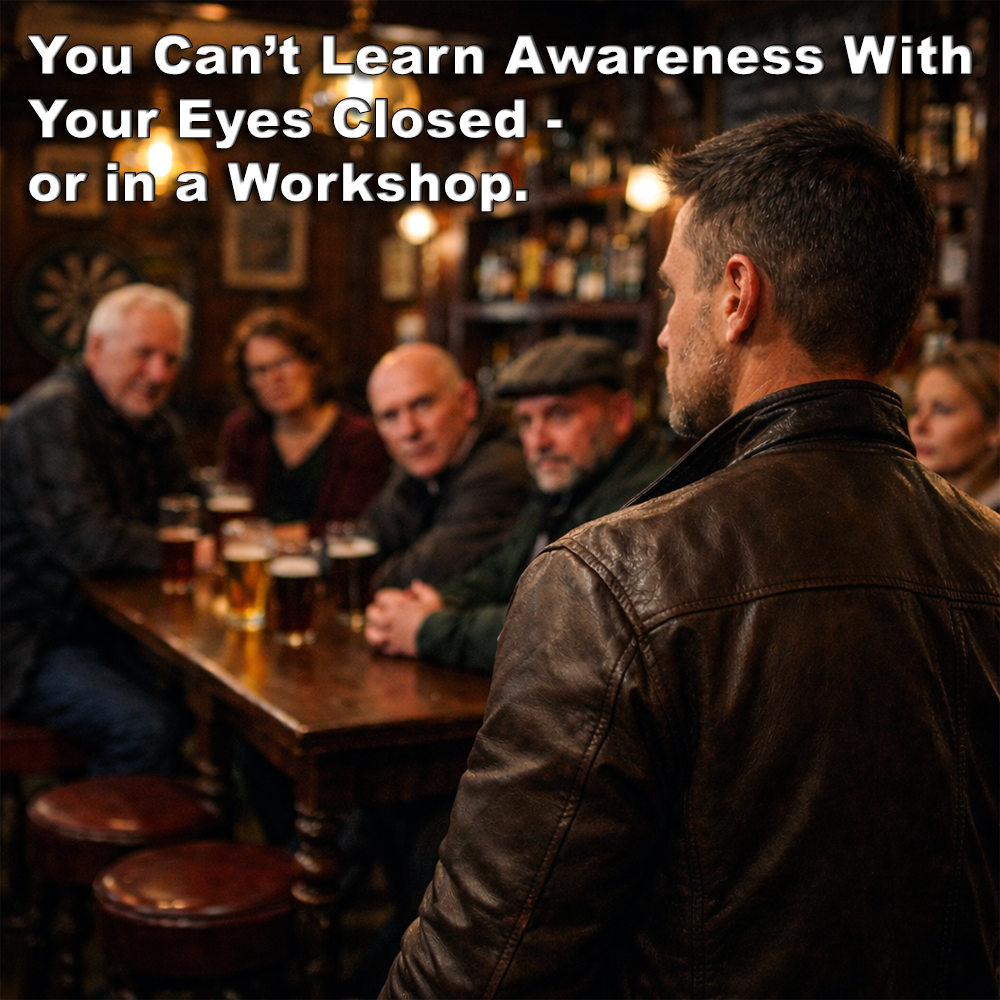
I’ve written extensively about awareness in my recent articles, and some of the comments have been quite illuminating. I keep returning to this subject, which should tell you something: the misunderstandings around it are persistent. One in particular stood out.
.
People often talk about “learning awareness” as if it’s a checklist or a memory exercise. After I posted my last article, someone commented that in a workshop she attended, they were taught awareness drills and one of those drills was “close your eyes and picture where the doors are.”
.
It’s a common idea. It’s also not what awareness is.
.
Remembering the layout of a room is a useful skill. It’s just not the same as recognizing a shift in human behavior. One is static. The other is dynamic. One is about objects. The other is about intent.
.
Real awareness is not built by imagining exits. It’s built by noticing changes.
.
When I talk about awareness, I’m not talking about a mental snapshot of a room. I’m talking about the moment when someone’s tone changes, or their movement shifts, or their attention flicks somewhere it didn’t before. I’m talking about the small signals that tell you something is about to happen, long before it does.
.
That kind of awareness isn’t taught in a few hours. It’s developed over years of exposure, reflection, and pattern recognition. It’s the same reason you can’t teach someone to drive well in a classroom. You can teach rules. You can’t teach judgement – or the “what if” – without mileage on the road.
.
People sometimes ask if this can be taught quickly. The honest answer is that it can be explained quickly, if you’re paying attention, but it cannot be built quickly. Real awareness comes from exposure to situations where behavior matters, where decisions have consequences, and where mistakes teach you something you don’t forget. It’s shaped over time, not learned in a session.
.
This leads to another problem I see far too often: an instructor attends a weekend course or “workshop” and suddenly becomes an expert, teaching classes on that subject. Superficial at best. Quite dodgy at worst.
.
Awareness is not about remembering where the doors are. It’s about noticing when the person between you and the door suddenly changes their intent.
.
Workshops and seminars can introduce the idea. They can give people a framework. But the real skill – the one that keeps you safe – is not a trick, a game, or a guided visualization. It’s the quiet ability to see the moment before the moment.
.
And that is not learned with your eyes closed. It is learned by paying attention.
.
.
– Adam Carter
If you value these insights, you can support my work here: buymeacoffee.com/shuridojo – Thank you – every contribution is appreciated.