Tradition

Most Real Self‑Protection is Invisible. It’s The Decision You Make Early Enough That Nothing Happens.

If you are like most people, you probably hope you will never have to face real violence. . Recently I wrote about awareness, because the best self-defense decisions often happen long before anything physical begins. The earlier you notice a problem, the more options you have. Sometimes the best outcome is simply stepping off the […]

Most Real Self‑Protection is Invisible. It’s The Decision You Make Early Enough That Nothing Happens. Read More »

More Than One Thing: What Training Was Supposed to Be.

I was fourteen years old when I began practicing karate. At the time, I had no clear idea of what I was looking for. . Behind the repetition, the discipline, and the physical effort, I was told that there was a path concerned with understanding oneself as much as learning technique. . The karate available

More Than One Thing: What Training Was Supposed to Be. Read More »

Issho Kenmei: Training as if This Moment Matters.

In karate we often hear ‘ganbaru’ – do your best, keep going, push through. It’s a useful sentiment, but it doesn’t quite reach the depth of what older martial traditions expected from a practitioner. For that, there is a sterner, more honest practice. It’s called ‘Issho Kenmei’. . It’s not about effort in theory. It

Issho Kenmei: Training as if This Moment Matters. Read More »

What Remains When Distraction Is Removed – Awareness Is Not a Drill.

In my recent article I talked about awareness – something everyone should be thinking about in relation to self-defense. Even if your goals are elsewhere, such as competition, awareness still matters. . But the question that always follows is this: how do you train it? . Awareness isn’t trained by adding content. It’s trained by

What Remains When Distraction Is Removed – Awareness Is Not a Drill. Read More »

Karate-Do Is Not the Opposite of Practical Karate.

Someone said to me the other day, ‘Why don’t you give up practical karate, as you call it, and just do karate-do?’ . It’s an interesting comment, but one built on a misunderstanding. . What sat beneath the comment was the assumption that karate itself cannot be pragmatic. That once effectiveness and real-world purpose are

Karate-Do Is Not the Opposite of Practical Karate. Read More »

What Makes a Great Teacher – and What Students Carry Forward.

I have been fortunate in my karate journey to have had some truly great teachers. I would say that though, wouldn’t I? No disrespect intended, but I imagine most people feel the same about those who have guided them. . But that raises an important question – what actually makes a great teacher? . A

What Makes a Great Teacher – and What Students Carry Forward. Read More »

When a Black Belt Stops Meaning Anything – and the Outcome Is Already Decided.

There are so many clichés about becoming a black belt, being a black belt, and how you should behave once you eventually get one. . But the problem is that for some people, it doesn’t stop there. One black belt isn’t enough. They want another grade, then another. More stripes on the belt. . When

When a Black Belt Stops Meaning Anything – and the Outcome Is Already Decided. Read More »

When Purpose Isn’t Clear – Context Is Everything.

Self-defense and karate – two words that can be the difference between chalk and cheese, or, if trained within the correct context, can comfortably coexist. . Some people believe combative skill, that is, self-defense, will somehow emerge despite never training to develop it, even while calling what they do “self-defense”. . That assumption sits at

When Purpose Isn’t Clear – Context Is Everything. Read More »

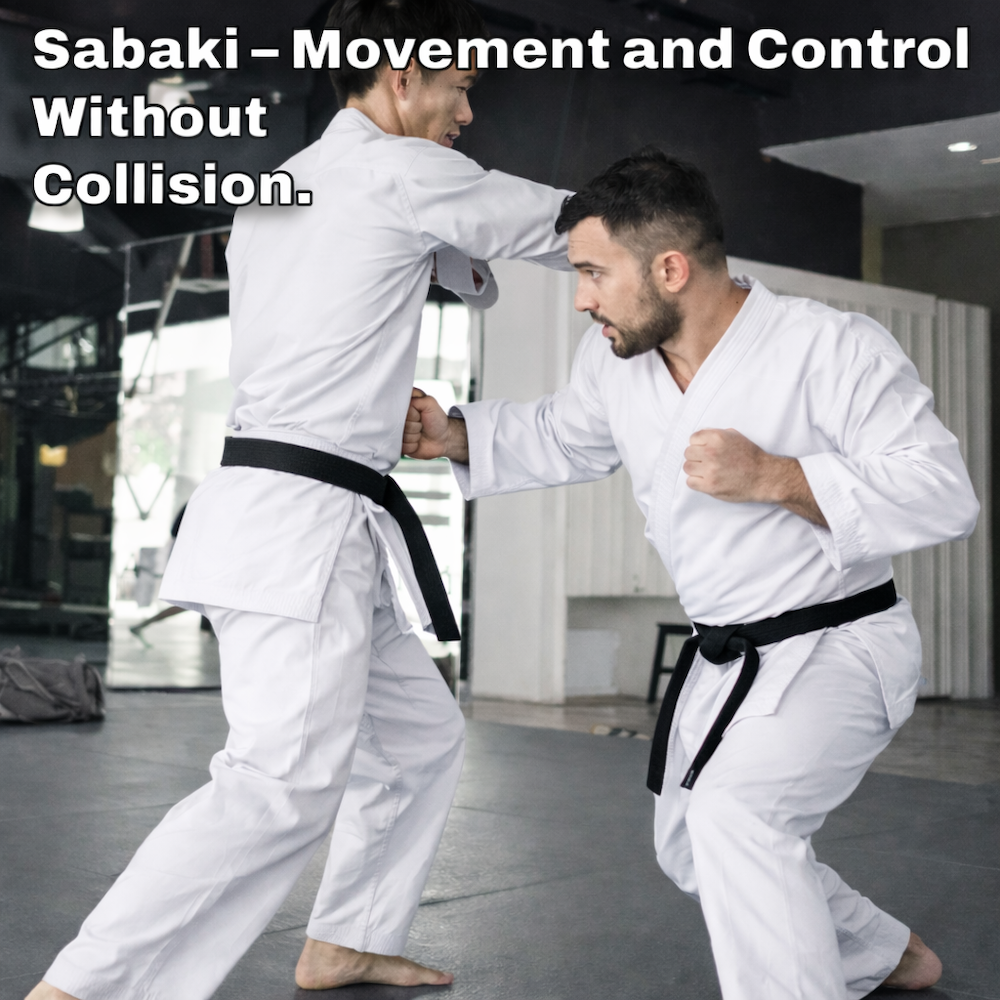
Sabaki – Movement and Control Without Collision.

If you’ve followed my writing for any length of time, you’ll know that I’ve never been comfortable with step-kumite. I don’t want to reopen that debate here. Some people value it as tradition; others, myself included, take a more pragmatic view and question its usefulness. This article isn’t about winning that argument. . What is

Sabaki – Movement and Control Without Collision. Read More »

Learning Isn’t the Hard Part – When Experience Gets in the Way.

We all want to be acknowledged for our work, our performance, our dedication. It’s a natural human desire to know that we are doing a good job. . Praise is one of those small things that can mean a great deal. Positive reinforcement feels good, and there’s nothing wrong with that. But it can also

Learning Isn’t the Hard Part – When Experience Gets in the Way. Read More »

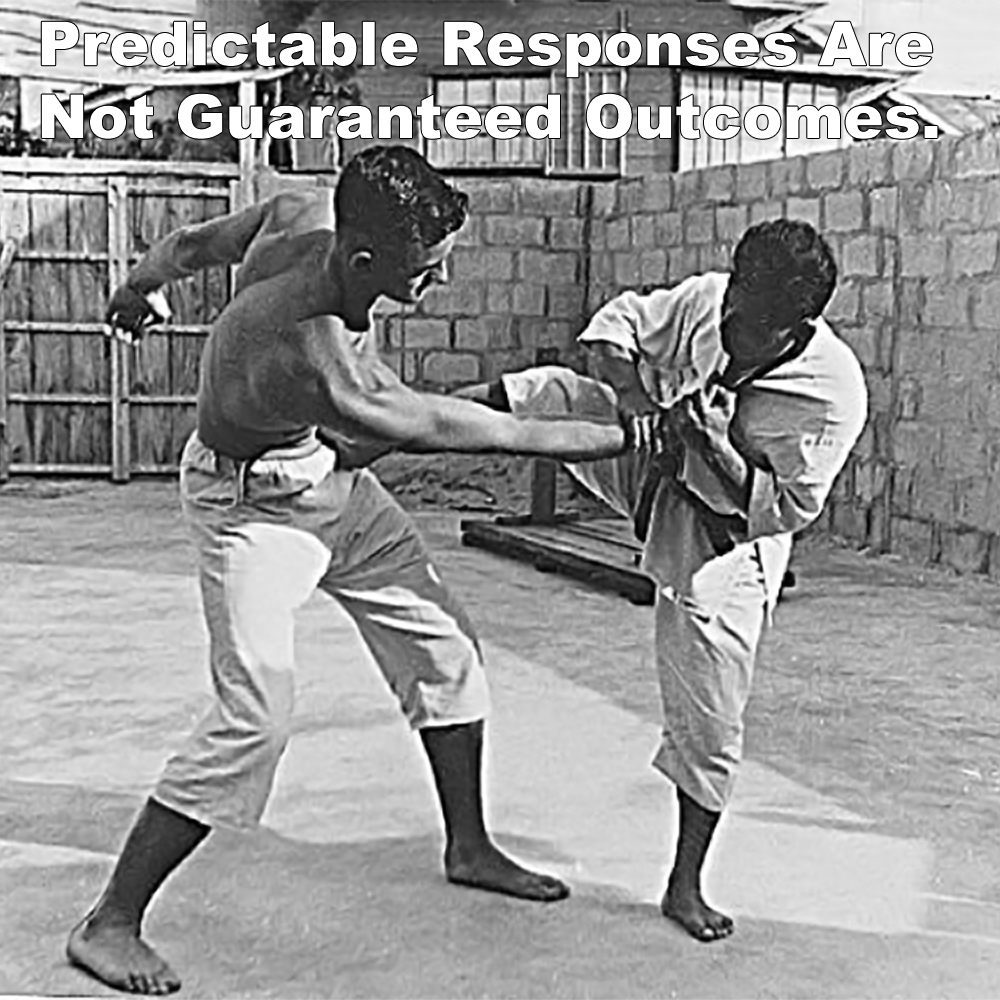
Predictable Responses Are Not Guaranteed Outcomes.

Following my recent article on bunkai and choreography, I found myself returning to the idea of “predictable responses”. It’s a familiar concept, and on the surface it makes sense. Certain actions often provoke certain reactions. . But often isn’t always. Nothing is guaranteed. . Yes, bodies respond to input. Strike, pull, disrupt balance – something

Predictable Responses Are Not Guaranteed Outcomes. Read More »

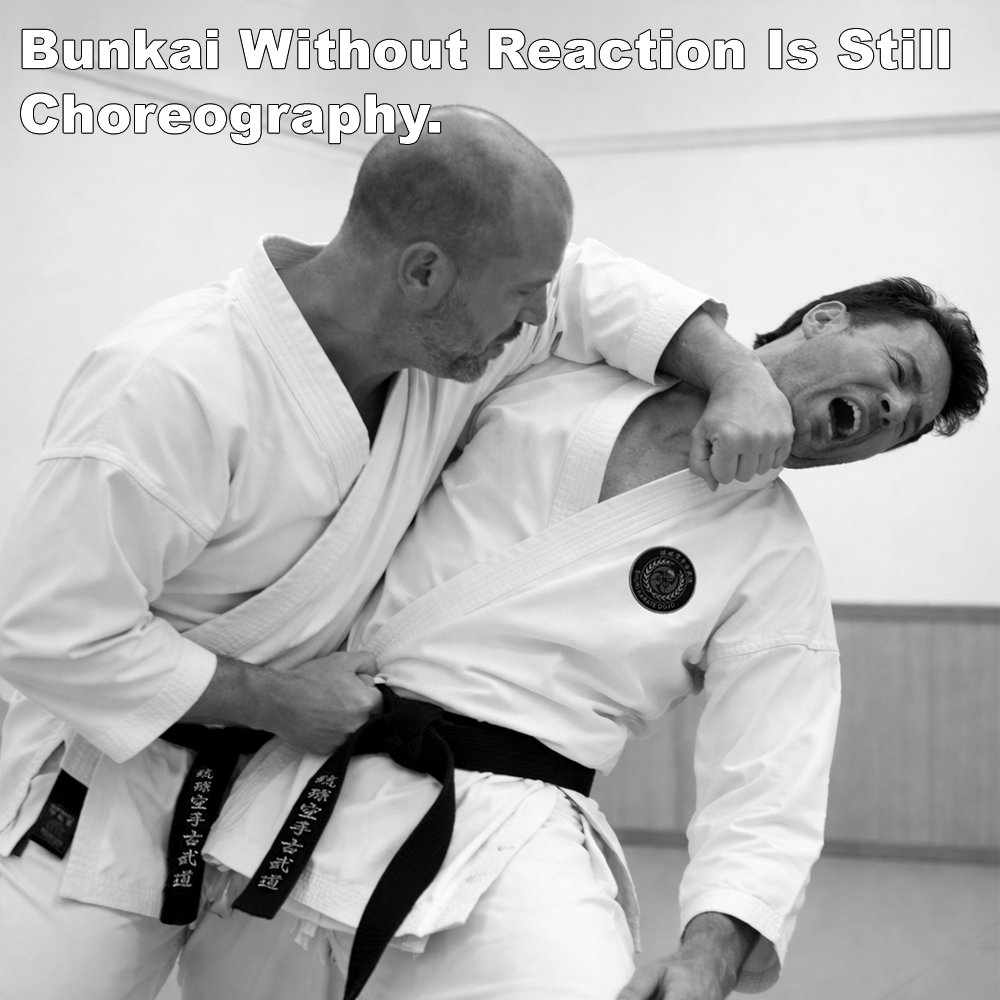
Bunkai Without Reaction Is Still Choreography.

Bunkai – in some circles it is getting better. Practitioners and instructors are beginning to understand the reality of violence rather than relying on the familiar, stylized karate-type attacks. Intent, distance, and targets are improving. In others, however, there is still a long way to go. . But something fundamental is still missing in many

Bunkai Without Reaction Is Still Choreography. Read More »