
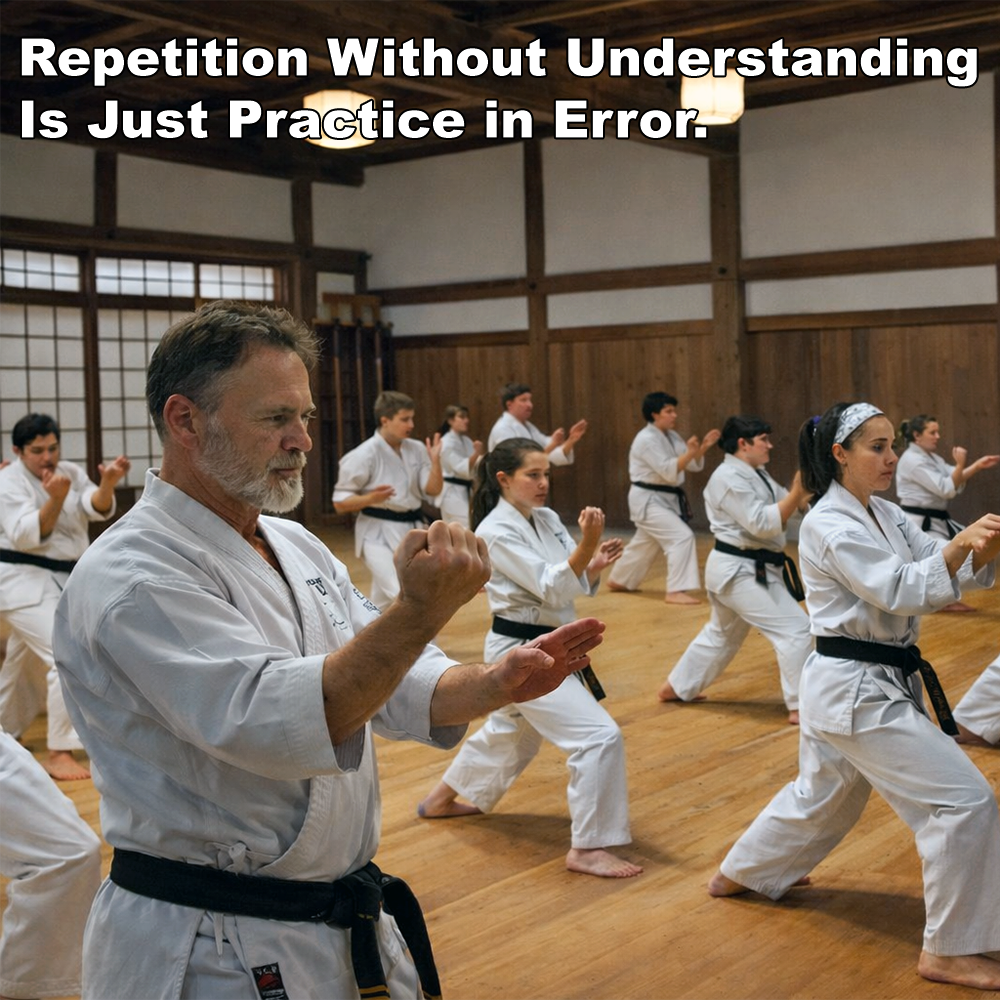
Repetition. You must perform a movement hundreds of times for it to become automatic, instinctive.
.
Students need repeated exposure over time for skills and understanding to settle into long-term memory.
.
But there’s an obvious problem that rarely gets addressed.
.
What happens if you’re repeating something the wrong way hundreds of times?
.
We all tell students, “You need to practice more”, or “Just keep practicing that technique”. And repetition is central to karate. But repetition alone doesn’t guarantee improvement. If the underlying understanding is wrong, repetition won’t fix it.
.
So before repetition has any value, there must be understanding.
.
If you misunderstand a movement or its purpose, repeating it simply makes the misunderstanding more permanent.
.
The discipline of repetition sits at the heart of karate, but repetition is not mindless motion. It’s not copying techniques over and over. It’s understanding what a movement is capable of, how it adapts, and how it functions under pressure. This is the ‘why’ over the ‘how’.
.
The purpose of repetition is to build instinctive reactions when you actually need them. But it’s not rigid automation. It’s adaptability. When something becomes instinctive, it should be able to change without conscious effort. If repetition locks movement into a single, inflexible response, it may do more harm than good.
.
Repetition does matter. It strengthens neural connections and moves learning from short-term to long-term memory. Skills become subconscious, freeing the mind to deal with decision-making under pressure.
.
But complex skills benefit from more than repetition alone. They require discussion, variation, resistance, and application in different contexts.
.
That’s why it’s important to pause and reassess. To verify rather than assume. To question rather than automatically accept what has simply been repeated.
.
The goal is to improve, and to think less about technique. But only if what has been ingrained is sound in the first place.
.
There is one more uncomfortable truth.
.
Genuine progress requires desire. If you don’t enjoy what you’re practicing, or don’t understand it, repetition alone won’t take you very far.
.
Learning anything meaningful takes time, attention, and acceptance of mistakes. Errors are not failures. They’re feedback. Knowing that in advance makes learning more honest and far more effective.
.
So don’t just keep repeating mistakes. Always test.
.
Practice does not make perfect. Only correct, thoughtful practice does.
.
.
Written by Adam Carter – Shuri Dojo