Ojigi (お辞儀) – Bowing in Japan is the act of lowering your head or the upper part of the torso, commonly used as a sign of salutation, reverence, apology or gratitude in social or religious situations. . Bowing is extremely important in Japan, children normally begin learning how to bow at a very young age,…
Tag: Humility
Be Happy!
Buddhism and happiness are complementary to each other. There is a lot to be learnt about happiness from Buddhist philosophies. . Buddha taught that happiness is one of the seven factors of Enlightenment. . Life Involves Suffering – Accept It. . According to Buddhist philosophy, acceptance to the truth of Life involving suffering is crucial…
What is it you want out of the martial arts?
What is it you want out of the martial arts? What is the one thing that will get you to where you want to be? . Many people look to motivation to push them toward their destination. But what happens when that motivation wears off, when the excitement declines? How can you stay committed on…
Martial arts and Mathematics…. Connected art forms.
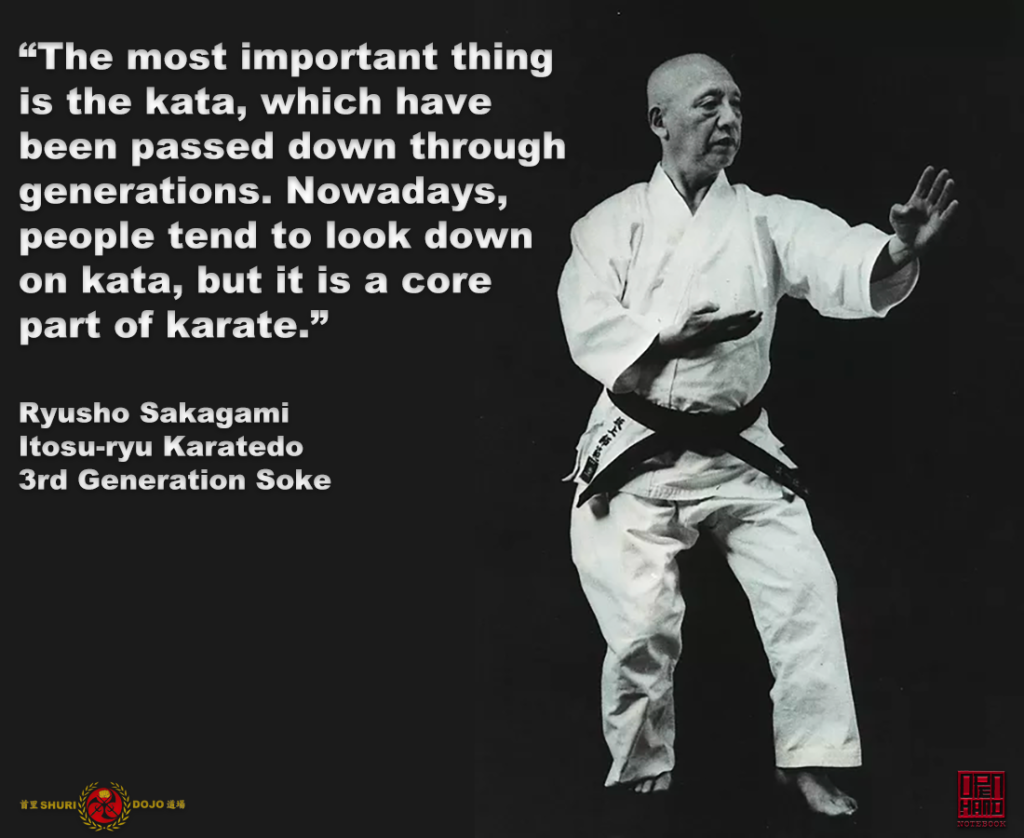
“A student well versed in even one technique will naturally see corresponding points in other techniques. A upper level punch, a lower punch, a front punch and a reverse punch are all essentially the same. Looking over thirty-odd kata, he should be able to see that they are essentially variations on just a handful.” –…
What is tradition, or traditional, in the martial arts?
What is tradition, or traditional, in the martial arts? Who decides what it is? . Tradition can be described as; “an inherited, established or customary pattern of thought, action or behavior”. But what we refer to as “traditional” in the martial arts often isn’t traditional at all. . All of the past masters were…
Where modern karate goes wrong…..
Where modern karate goes wrong in self-defense is where fighting comes first. . Street fighting and self-defense are two different things. Most people think about this as the same, even martial artists. They are not. In street fighting you are basically a fool that lets your ego expose you to danger. Street fighting is for…
“Eyes that look are common; eyes that see are rare.”
If you have seen The Karate Kid movie, you will undoubtedly remember the wise old karate master, Mr. Miyagi, telling his student Daniel-san to; “Look eye! Always look eye”. . Well, not necessarily. At least not in the martial arts. . In fact, in Japanese culture, excessive eye contact is considered rude. And being rude…
My karate is SUPERIOR to yours.
My karate is stronger, tougher, more athletic…. it’s superior to yours! . Really? It’s superior in all things?….. . You have to define what you mean by “superior”. I’m assuming that when people say a “superior karate style”, they mean the best in terms of effectiveness and practicality…… But superior, WHERE? In the dojo? In…
So don’t cheat. Don’t pretend you did it. Don’t lie….. WORK FOR IT.
I am often asked for answers to questions from people online that I have never met, without knowing who these people are, or what they are doing, or where they come from. There are no introductions, or any form of politeness, it’s just…. “I want information, give it to me NOW!” . Sharing knowledge is…
It’s all about priorities, right?
Martial arts training is about training both the body and the mind. Part of training the mind is discipline. The discipline to do what is necessary. . It’s all about priorities, right? After all, you only practice a couple of times a week. . When I started karate almost five decades ago, I decided to…
What is Zen Buddhism?
What is Zen Buddhism? . Trying to explain or define Zen Buddhism, by reducing it to an article, to a post on a website is almost impossible, it weakens its meaning. . Defining Zen (禅) is like trying to describe the taste of honey to someone who has never tasted it before. You can try…
Mushin no shin
The word ‘mushin’ is comprised of two kanji characters: 無 (mu), meaning ‘nothingness’, and 心 (shin), meaning ‘heart’, ‘spirit’, or, in this case, ‘mind’. In this way, mushin can be roughly translated to ‘nothing mind’ or ‘no mind’. It comes from a longer phrase used in Zen Buddhism, ‘無心の心’ (mushin no shin), or ‘mind of…