
I’ve been watching this for years. Someone takes a piece of kata and immediately tries to turn it into a neat sequence. This is the attack, this is the defense, this is what comes next. It all lines up nicely, and on the surface it makes sense.
But the more you look at it, the more something doesn’t quite sit right, because kata never actually shows how any of that begins.
I’m not suggesting we can know exactly what was intended in every case. What we can do is look at what the kata actually shows – and what it consistently leaves out.
It just starts. And that’s the part that tends to get missed.
And when people try to fix that, they usually end up inventing something that was never there.
Kata doesn’t show how the situation begins – it assumes you’re already in it.
Kata does not show the setup, but it reflects the kind of problems that have already occurred.
Given what’s in front of us, this is the most consistent and functional way to understand it.
Once you see that, trying to bolt a clean setup onto the movement starts to feel forced. We stand at a distance, agree on the attack, then step in and play it out. Of course it works – we’ve designed it that way. But that isn’t what the kata is showing.
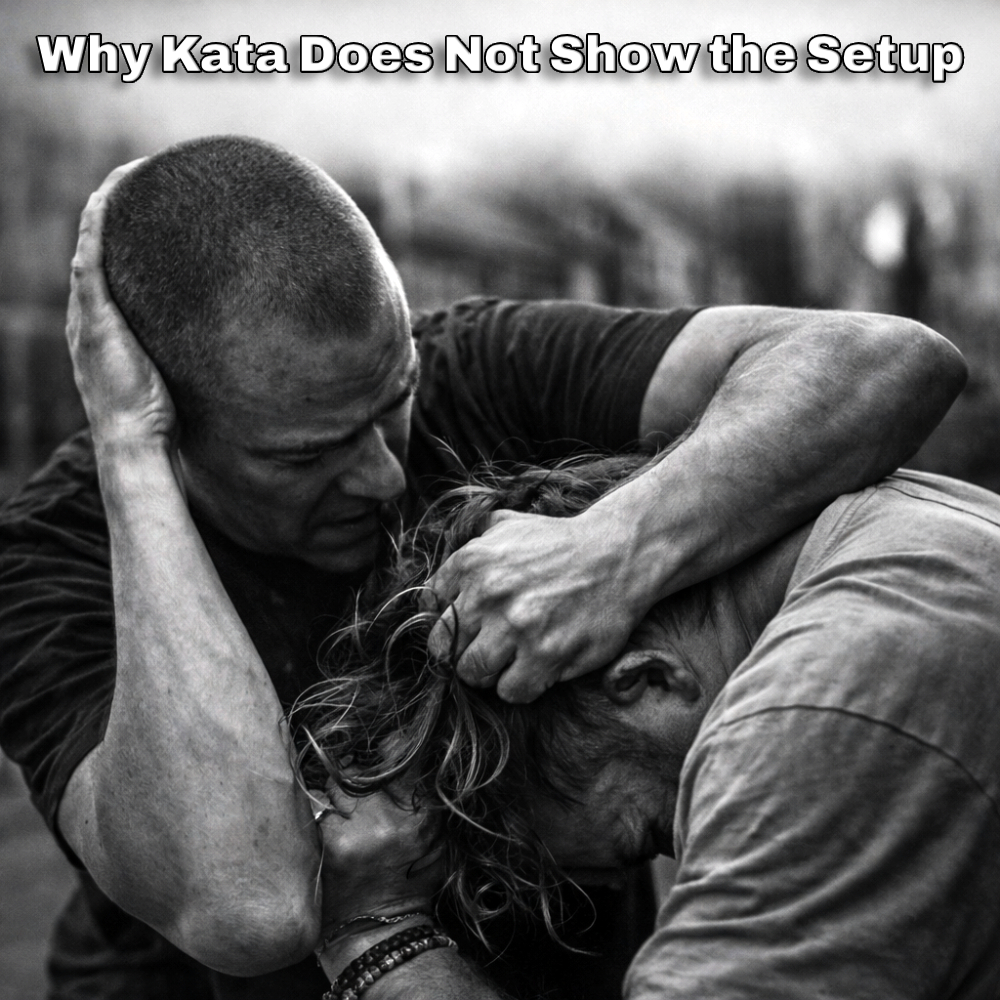
By the time the movement appears, something has already happened. You’ve already been grabbed, already been shoved, already lost the space you thought you had. You’re not preparing at that point, you’re dealing with something that’s already in motion. That’s a very different place to be.
If you keep that in mind, a lot of things start to shift. Instead of looking for the attack that matches the movement, you begin to ask where you are when that movement actually makes sense. Not at long range, not waiting your turn, but somewhere much closer, where things are already happening whether you like it or not.
This is also why so many applications feel artificial. They rely on a beginning that the kata never gives you. A clean step-in punch, a clear line of attack, enough space and time to see what’s coming. Remove that, and a lot of those interpretations start to fall apart.
But the kata itself doesn’t fall apart. It becomes clearer.
The distances are shorter. The movements are tighter. There’s no need for anything exaggerated, because there isn’t the room for it. You start to see the actions less as reactions and more as attempts to regain control of a situation that’s already underway.
The old practitioners didn’t need to record how these situations started. They lived close enough to that reality. What they needed was a way to remember what to do once they were already in it, and that’s what the kata holds.
Not the setup. The response to being caught inside it.
It’s a small shift in thinking, but it changes how you look at everything that follows. Once you stop trying to add the beginning back in, the movements start to make sense on their own terms, and the idea of kata as a series of neat, pre-arranged defenses becomes harder to hold onto.
Because it was never that neat to begin with.