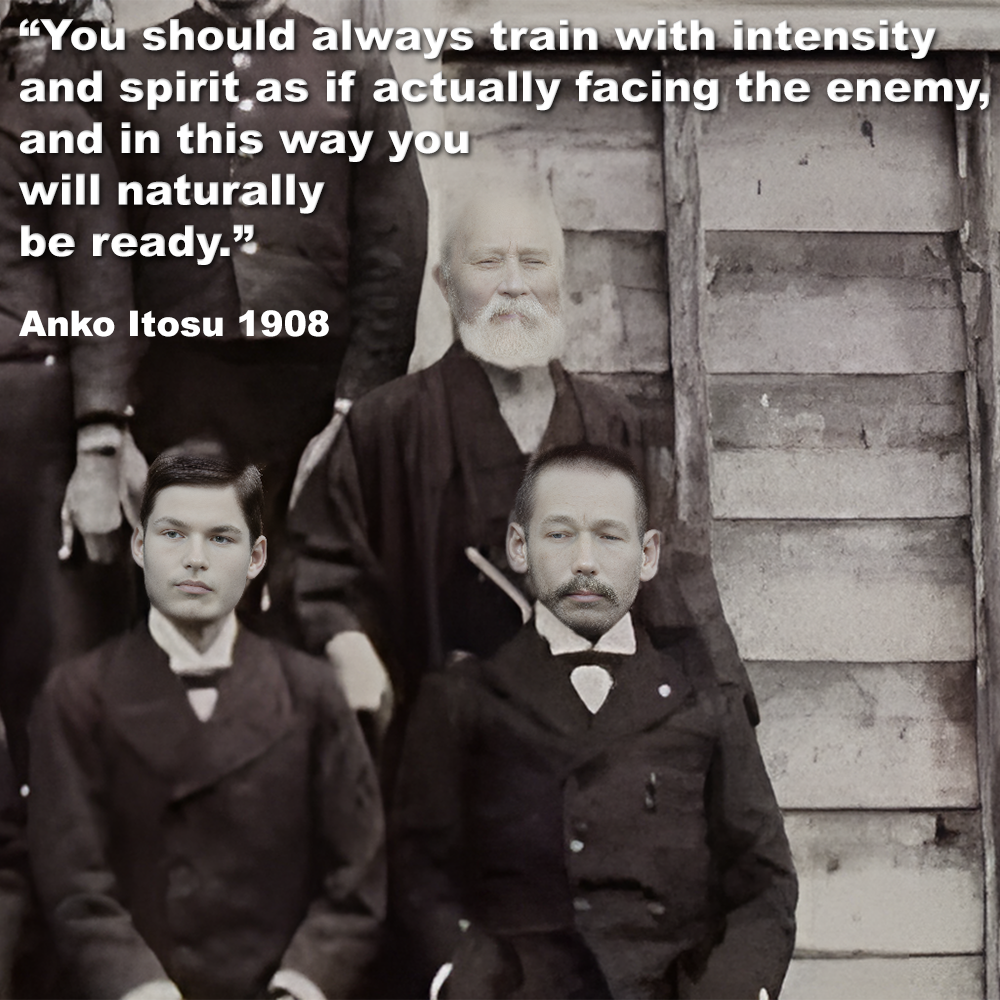
The Pinan (平安) kata series, Shodan-to-Godan (Pinan is often translated as ‘peaceful/tranquil mind’), are widely taught to students in a variety of karate styles. They are attributed to Itosu Yasutsune ‘Anko’ (1831-1915) who is said to have adapted them from older kata. However from which kata is less than certain. . Itosu introduced karate into…
Tag: Bunkai
Combative function or symbolic gesture?
I’m a strong believer in that if you are passionate about something, the martial arts or otherwise, you should also study its history. Understand the context to which something was created. . What can an individual learn from history? Through history, we can learn how past societies, systems, and ideologies were built, and operated in…
“In karate, the most important thing is kata.”
Kata are a library of self-protection techniques and principles in karate. Each kata creator encoded their specific knowledge into each movement of the kata they made. Kata are not simply a record of techniques, or a solo performance; rather each and every kata is designed to record the key principles and strategies of a complete…
The process of ‘shime’ for Sanchin kata is about cooperation and study, and not brute force.
Shime (締め) testing is a two-person drill which serves as a way of testing a practitioner’s ability to apply the strategies and principles of Sanchin kata. . The idea behind the testing is to have the practitioner placed under a load, to evaluate their structure. . The testing involves putting pressure on the practitioner’s body….
“The beauty of a move lies not in its appearance but in the thought behind it.”
Facing forward in kata and then turning to the left, or right, to meet an incoming attack (whatever that might be), makes no sense at all. Yet today this is still being taught to students. . Throughout the history of karate we have some of the creators of kata informing us….. what they are trying…
Commonality of technique.
The commonality of technique throughout all of the martial arts and styles that exist is that they all make use of biomechanics and weaknesses of human anatomy. Where the various arts differ is in the rules, the goal, and the context that they are trained for. . In competitions, tournaments and consensual fights, you have…
Are your kata original?
If you have a true interest in the martial arts, I believe it is important that practitioners have some understanding of the history of our art. . Today, many practitioners and instructors state that they are practicing and teaching the ‘original’ kata as taught by Master… (insert name). . But what is original?….. The true…
Where modern karate goes wrong…..
Where modern karate goes wrong in self-defense is where fighting comes first. . Street fighting and self-defense are two different things. Most people think about this as the same, even martial artists. They are not. In street fighting you are basically a fool that lets your ego expose you to danger. Street fighting is for…
Naihanchi (ナイハンチ) Kata
Naihanchi (ナイハンチ) . The kata Naihanchi is said to mean ‘sideways fighting’ due to the kata’s distinctive embusen (floor pattern), but is also translated as ‘internal divided conflict’, it is practiced in many styles of karate today. . Gichin Funakoshi renamed the kata Tekki (Iron Horse) in reference to his old teacher, Anko Itosu, and…
“Tournament fighting is very different to an actual confrontation.”
“Tournament fighting is very different to an actual confrontation, which often happens without warning and at close range. We do not practice ‘sparring’ in this fashion.” (End quote) – Taira Masaji 9th dan Goju Ryu . A technique might work very well against another practitioner in the dojo, using only passive resistance against you. However,…
Control an attacker, don’t give them the chance to control you.
Irimi (入り身) is a Japanese martial arts term meaning “to enter with body”. An ‘irimi’ motion is one which describes when someone enters towards another. It’s a rather simple definition but performing it, especially under stress or pressure, can be quite difficult. . Perhaps a more meaningful way of using Irimi is to understand it as…
Moving to an angle is a key principle in karate.
“At rest, the fist and the body must be able to instantly react to anything from any direction. The same applies to one’s heels — the heels must be prepared to shift the body in any direction without hesitation.” – Hironori Otsuka 10th Dan Wado-Ryu (1892-1982) from the book ‘Wado Ryu Karate’ . In actual…