
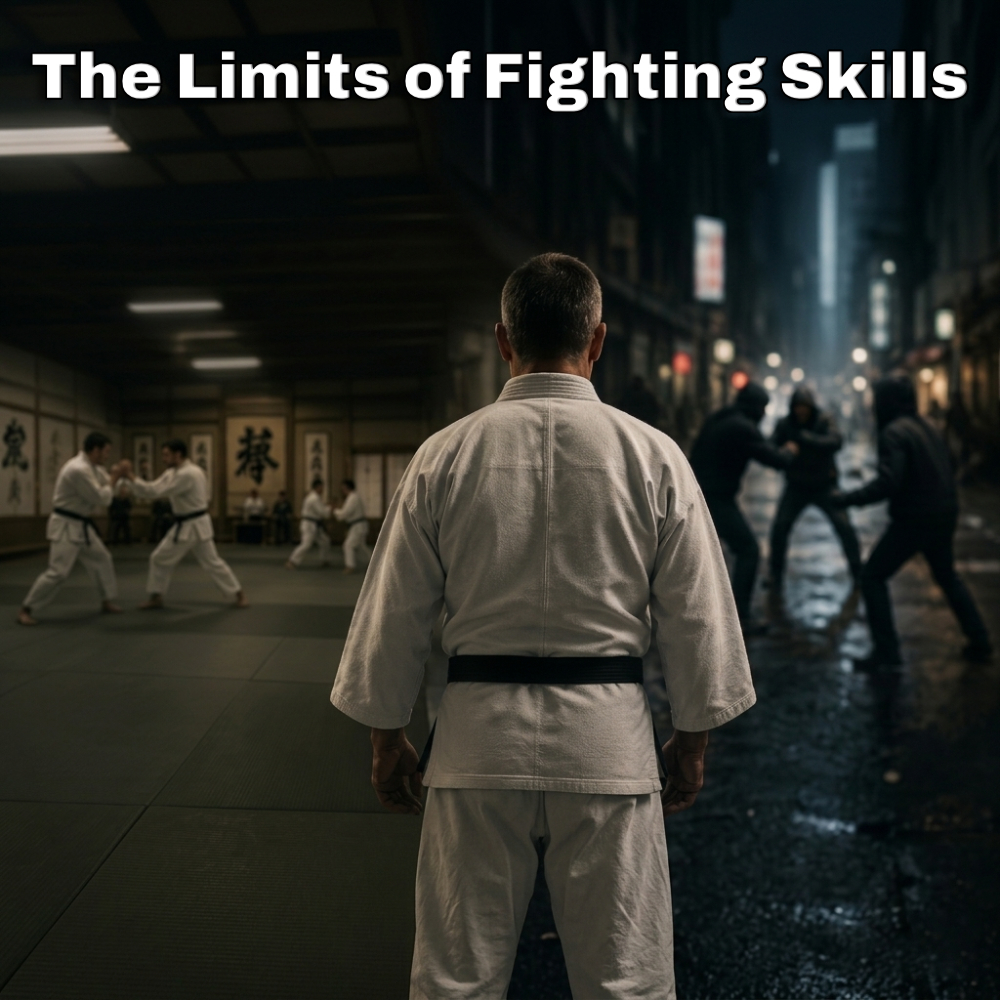
Many people today study martial arts as a hobby. They do not train to the level that develops robust and functional real-world self-defense skills. That is why the non-physical side of self-protection is so important. While many people can make physical skills work, not everyone can develop a knockout punch or a strike that will reliably hold up under extreme pressure.
This is one of the biggest failings when “fighting” becomes confused with “self-protection”. To become an able fighter takes a lot of work, preparation, conditioning, and consistent pressure testing. The physical side matters, of course it does, but if your interest is self-protection then physical skills should always be viewed as the last resort.
If all that is provided is fighting ability, then for the majority of people it’s not enough. Most people simply do not train hard enough, often enough, or realistically enough for those skills to work reliably outside the dojo in a genuine self-defense situation.
“Karate doesn’t fail people – unclear goals do.”
For many people, if the goal is self-protection, then developing a healthy attitude toward personal safety, threat awareness, threat avoidance, de-escalation, and decision-making is often far more important than simply learning to fight. Most people will be able to make those skills work, and regardless of how good a fighter somebody may be, those skills should always take priority.
While the long-range combat taught in sports karate is a legitimate skill, self-defense has very different demands. If you are not actively working on close-range skills, then a large part of your training becomes far less effective the moment you are grabbed, surprised, crowded, or dealing with multiple assailants. Convincing yourself that long-range skills automatically transfer to short range is a dangerous assumption.
In sparring and competition you have space to move around and manage distance, and that makes complete sense when the aim is to win a match. You stay outside the other person’s range while trying to reach them yourself in order to score points, achieve a knockout, or force a stoppage.
But real violence has a completely different aim. The objective is not to “win” in the sporting sense. The objective is to escape, survive, and walk away unscathed – or as minimally damaged as possible – while leaving the other person unable to continue the attack.
There are no rules, no referees, and no points for style. There are no timed rounds and no guarantees that you will have space, awareness, or preparation. In many situations there is no time for gauging distance, footwork, or stalking an opponent because events unfold too quickly and too chaotically.
Sport is sport, regardless of the discipline. It has rules, structure, and agreed conditions. Yes, fighting skills improve your abilities and they are certainly far better than having no physical ability at all.
However, one of the biggest problems today is that many people cannot – or will not – recognize the limitations within their chosen discipline. I have met far too many instructors who confuse their art’s syllabus with mastery of real-world violence. No single martial art sits above all others. Every system has strengths, every system has weaknesses, and every martial art has something valuable to offer.
But people do not square off in a real self-defense situation. Why? Because squaring off assumes a mutual agreement to fight. Real violence is an ambush.
If you were confronted by a violent habitual criminal armed with a weapon, would you stand toe-to-toe waiting for an exchange? Of course not. It’s not a competition.