
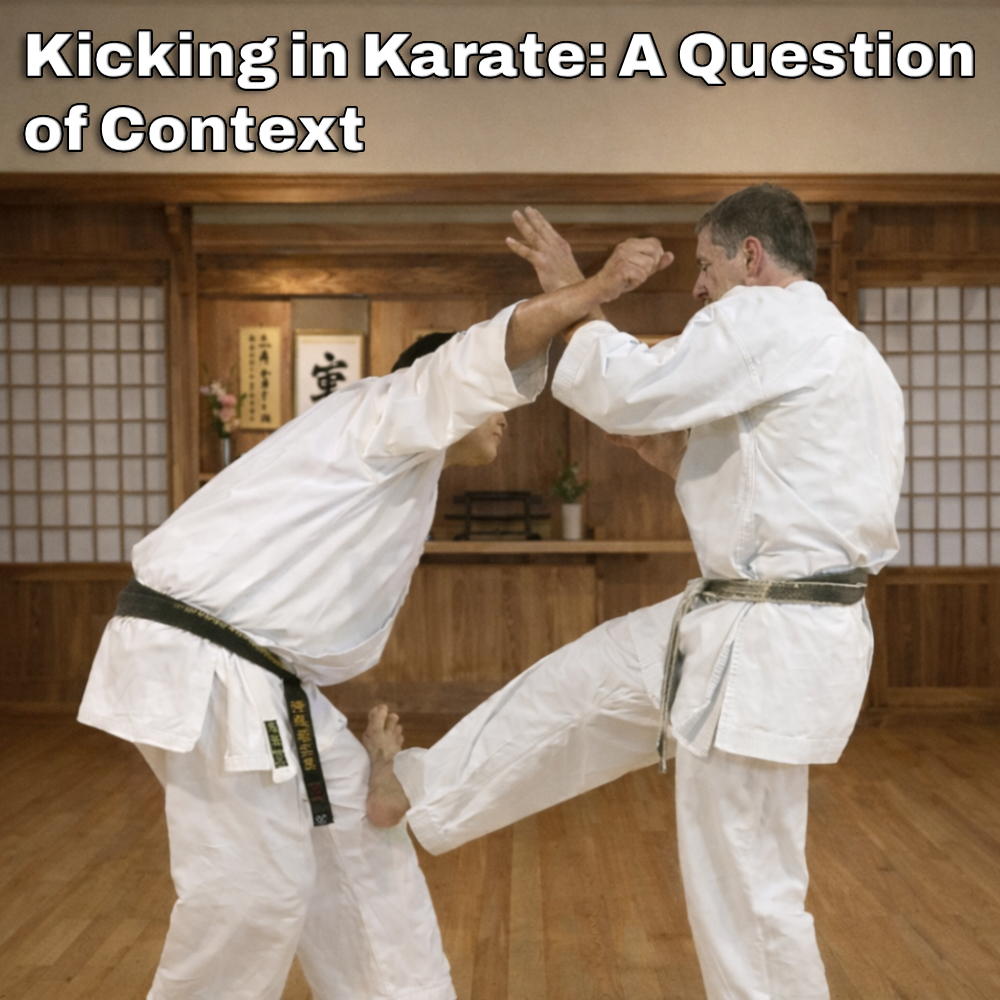
In the modern dojo, it’s common to see almost every combination include a kick somewhere within it.
That isn’t accidental. It reflects the influence of competitive environments, where kicking plays a significant role. At a high level, competitors are exceptional athletes. They have the timing, flexibility, balance, and conditioning to apply kicks in ways that most people simply can’t.
The problem is not that kicking exists.
It’s that what works in one context is often carried into another without question.
If you compare this to the techniques recorded in kata – which act as a record of earlier training methods – you’ll notice something different. Kicks are there, but they are not used anywhere near as frequently, nor in the same way.
That isn’t because people in the past didn’t understand kicking.
It’s because they understood context.
Kicking, in itself, is not ineffective. But it comes with trade-offs. The moment one foot leaves the ground, your mobility changes, your balance is compromised, and your ability to adapt under pressure is reduced. In environments where space is limited, footing is uncertain, and resistance is unpredictable, those trade-offs matter.
That’s why, in kata, kicks tend to be lower, less exaggerated, and often integrated into movement rather than isolated as distinct techniques.
In many cases, the “kick” is not even obvious. It may be part of a step, a disruption to balance, or a way of assisting what the hands are doing. The purpose is not to score, but to affect the opponent’s structure – to create kuzushi (unbalancing) so that strikes, locks, or throws become viable.
That’s a very different use of the same tool.
It’s also worth acknowledging that some people have exceptional kicking ability. They can make techniques work in ways that most others can’t, even under less-than-ideal conditions.
But that level of ability is not the norm.
And training methods shouldn’t be built around exceptions.
There are also practical considerations that are often overlooked. Footwear, for example. Historically, Okinawans were either barefoot or wearing minimal footwear. That alone changes what is realistic. Modern shoes – with grip, weight, and structure – alter balance, mobility, and the risk of injury. They don’t necessarily prevent kicking, but they do influence how and when it can be used.
Again, context.
Kicking has a place in self-protection. But it is a limited one.
Not because it lacks power, but because the environment rarely allows it to be used freely. Space is inconsistent. Surfaces are unpredictable. People don’t stand still and trade techniques.
So if kicks are used, they should be simple, direct, and low. Not because higher targets are never available, but because reliability matters more than ideal conditions.
Accuracy under pressure is never guaranteed. What matters is whether the method still works when things are not going your way.
Training value depends on whether it matches the realities a person is actually likely to face.
And that is where context decides everything.