
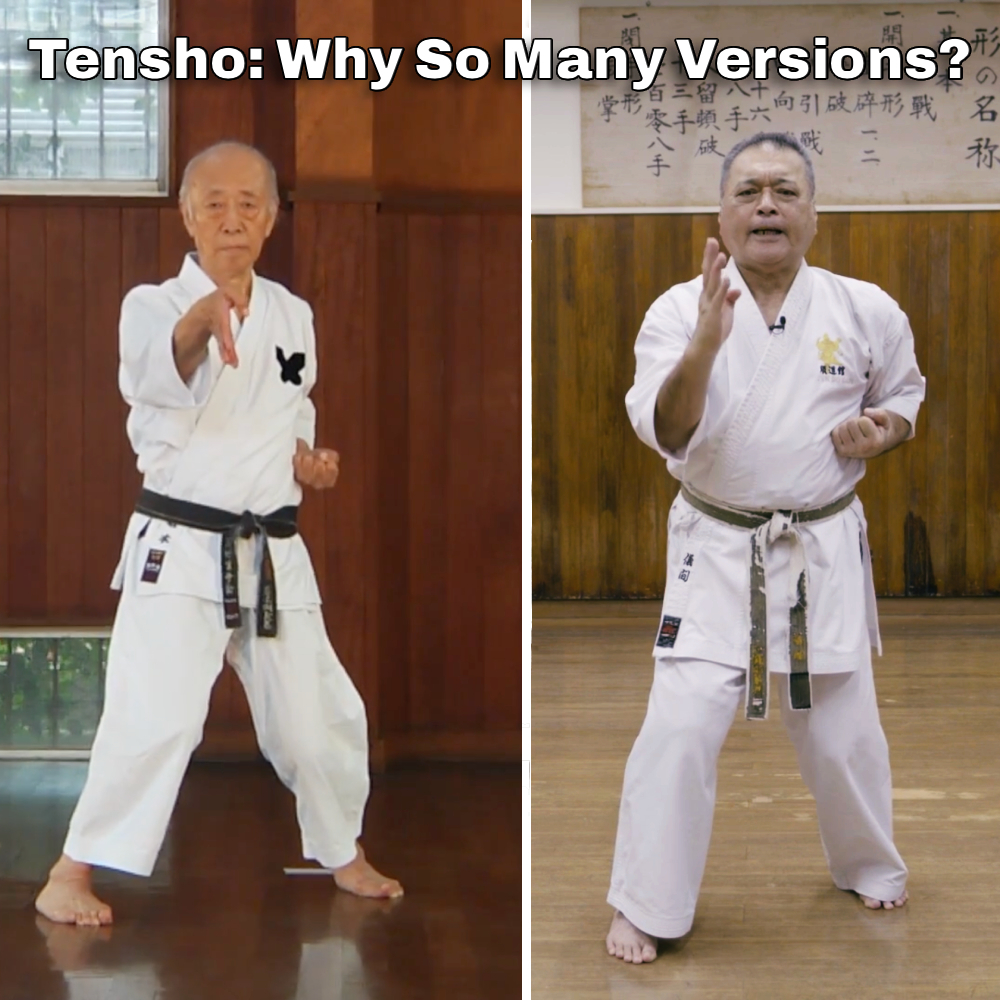
I was practicing the kata Tensho recently – actually one of my favorite kata – and it got me thinking about its many variations.
Not because it looks impressive, or because there’s a lot going on. In fact, it’s the opposite. There’s very little there on the surface. The movements are small, controlled, and repetitive. If anything, it can seem almost too simple.
And yet, it’s one of those kata that seems to have more variations than most. So many styles, so many teachers – each with their own version.
You don’t have to look very far to see that. Different hand shapes, some performed with large, exaggerated movement, others kept small and controlled, different levels of tension, different breathing patterns, even subtle differences in stance and timing. All recognizably Tensho, but not quite the same.
So why is that?
It’s easy to say “different styles, different teachers”, and leave it there. But that doesn’t really explain it. Other kata pass through different styles and still retain a fairly consistent shape. Tensho doesn’t seem to do that.
I think part of the answer is in what it actually is.
It’s not really a kata in the usual sense. It doesn’t rely on major direction changes or obvious structure to hold it together. There’s no complex embusen keeping everything in place, or a lot of different techniques.
What it does instead is place the emphasis somewhere else entirely.
Breath.
Tension and release.
Structure.
Connection.
These are not things you can simply copy by looking at someone. They have to be felt. And the moment something has to be felt, it starts to change from one person to the next.
Two people can perform the same movement and be doing something completely different internally. From the outside, it may look similar. Underneath, it isn’t.
That’s where variation begins.
Because if the kata isn’t anchored by obvious structure, then small differences don’t break it. They just become another version of it. A slight change in hand position, a different emphasis on tension, a different interpretation of breathing – none of these feel like major alterations at the time. But over years, and then generations, they add up.
There’s also the question of how it was passed on.
Karate was never standardized in the way people often imagine. There wasn’t a single version locked in and distributed out to everyone. What was passed on depended on who was teaching, who was learning, and what they understood at that time.
And that understanding is the key.
What gets transmitted is never just the movement. It’s the interpretation of that movement. Even when someone believes they are passing something on exactly as they received it, what they are really passing on is their understanding of it. That may be very close to what they were shown, but it is never completely untouched.
It can’t be.
Then there’s how things spread. Some versions travel further than others, not because they are more accurate, but because they are more widely taught. The kata that becomes “standard” is usually the one that has the largest vehicle behind it – the organization, the students, the exposure.
Other versions remain smaller, sometimes barely known outside a limited group. Not because they are less valid, but simply because they didn’t travel as far.
So instead of one fixed version, you get many.
And variation becomes inevitable.
Not because something went wrong.
But because it was never meant to be fixed in place.
Photo Credit: Iwamoto Akiyoshi (L) and Tetsu Gima (R)