
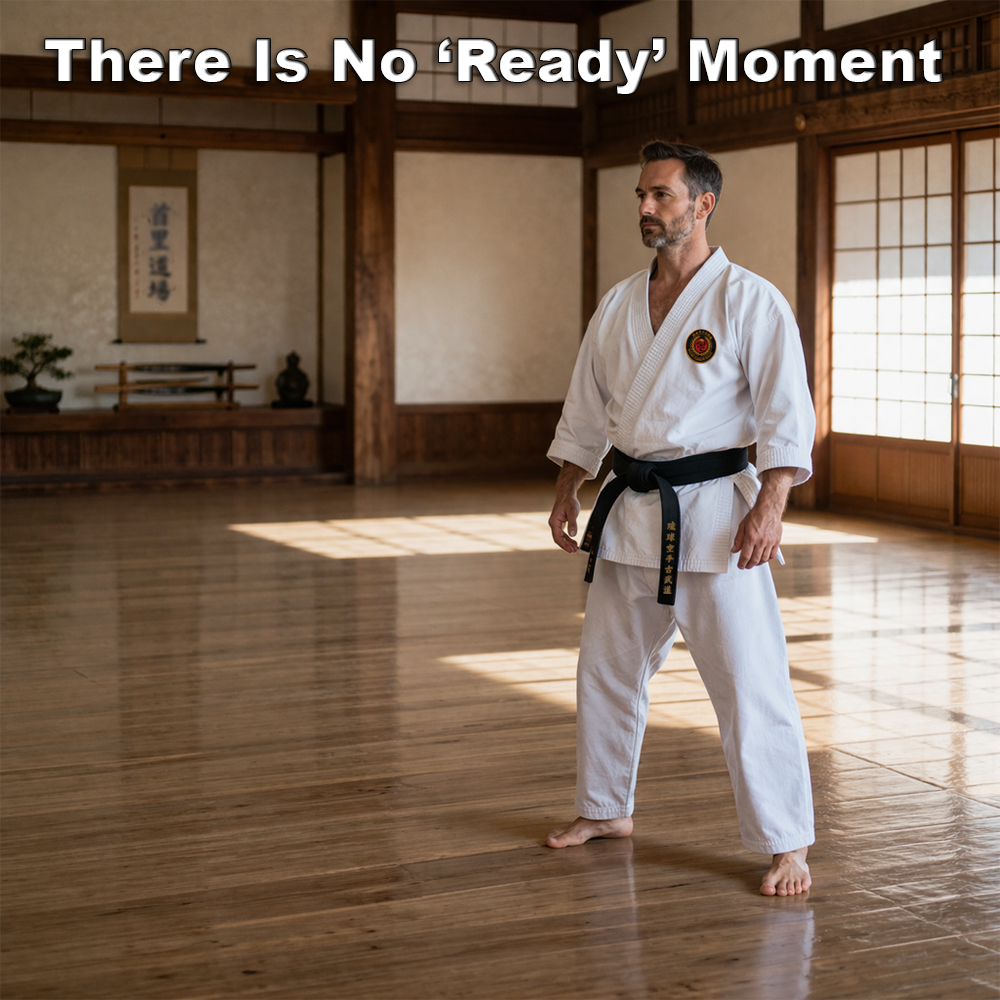
I received a comment recently about the opening of kata – the yoi position – and how it might represent awareness. The point where you recognize something isn’t right and prepare yourself.
I understand why people see it that way.
But it rests on something that doesn’t really hold up when you look at it properly.
It assumes there is a clear moment where nothing is happening, and then a moment where something begins. That you notice it, process it, and then prepare yourself.
That’s not how it works.
By the time you recognize what’s going on, you’re already in it. There isn’t a clean line where you get to step from passive to active. No pause where you gather yourself and decide that now you’re ready.
That’s where a lot of interpretations of kata start to drift. We look for a beginning because we want one. Something we can point to. Something we can control.
Kata doesn’t give us that. And neither does reality.
It’s also worth saying that what we see now has been shaped heavily by performance. In many demonstrations, the yoi position becomes a clear starting signal. It tells the audience that something is about to begin, whether that audience is one instructor in the dojo or a thousand people watching.
But that’s for presentation. It isn’t how things actually unfold.
If you treat yoi as a moment of readiness, then you’re assuming there is time to become ready. That awareness switches on just before something happens.
It doesn’t.
If awareness isn’t already there, then you’re reacting to what’s already underway.
That’s why awareness has to be there all the time. Not something you step into when you think it’s about to matter, but something that’s already present.
So rather than seeing yoi as a waiting position, or some kind of preparatory moment, it makes more sense to treat it as functional. Part of the exchange, not the start of it. Something that exists within what’s already happening.
It’s a different way of looking at it, but it fits what actually happens far better.
Most kata shows a pause at the beginning and end. You step into position, find your distance, settle your attention, and then begin.
It’s all built around the idea that you get to choose the moment.
But in reality you don’t.
And if your training relies on that pause, it will always feel slightly off when that pause isn’t there.
This links back to something I’ve written before – kata doesn’t show the setup. Not because it’s missing something, but because it was never meant to begin where we think it does.
What it shows is what’s left once things are already moving. Not the moment you become ready, but what you do when you don’t have that choice.
You don’t get to decide when it starts. Because its probably started already.