
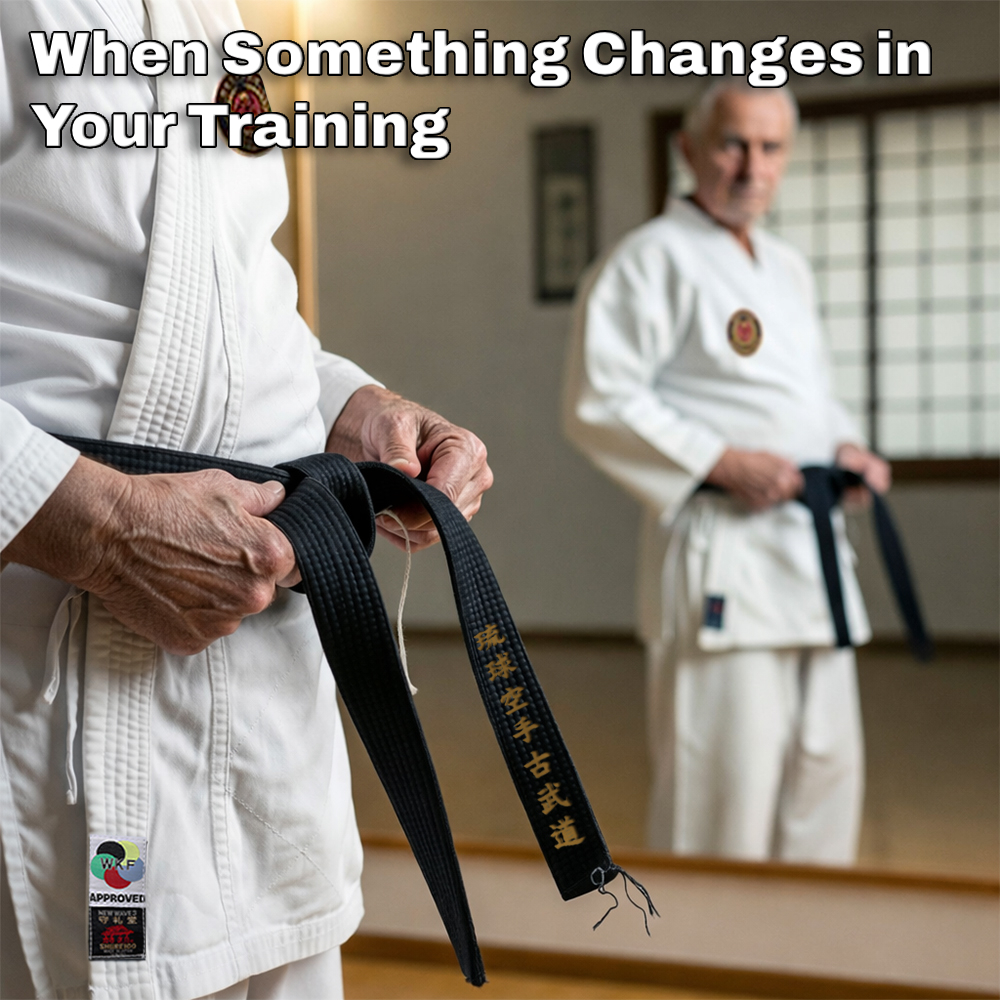
After decades in the martial arts, something changes. You’re no longer just repeating what you were taught.
Is spending decades in the martial arts – learning and teaching across several styles – enough to shape your own method?
I wonder why this is frowned upon. Much of it likely comes from the McDojo culture, where new styles appear frequently without depth or substance.
That doesn’t make it the same as what the old masters did.
There’s a difference between developing something after decades of training, testing, and understanding – and creating something prematurely, without that depth behind it.
Of course, we may not have had the same kind of hands-on experience they did in their time. But many of them trained with multiple teachers, absorbed what they were given, and eventually stepped away to express it in their own way.
Understanding lineage and tradition is valuable. It gives context. It gives meaning. But remaining too faithful to tradition can become a problem if it prevents anything from moving forward.
You need to innovate if tradition is to remain alive. Protecting tradition is not about preserving it unchanged. It’s about allowing it to continue. The part you protect and the part you develop have to move in parallel. Otherwise, a hundred years from now, nothing has changed – and that in itself becomes a kind of stagnation.
I’ve heard people say, ‘but it’s just made up’. Well yes, of course it is. Everything is, at some point. But that doesn’t mean it isn’t real.
Everyone is influenced by something beyond the boundaries of their own style. That’s inevitable. We learn from experience, from exposure, from time spent actually doing the work. And over enough years, most karateka don’t stay neatly inside the lines anyway. They begin to move in ways that reflect their understanding, not just their instruction.
That doesn’t necessarily mean they are creating a new style. It means they have internalized what they were taught.
For some, that shift may come earlier, often driven by deeper exposure, broader experience, or the environments they place themselves in. But without that depth, it’s easy to mistake early confidence for real understanding.
Often you see people with decades of training, senior grades, and good physical ability – and yet something is missing. Not because they haven’t trained hard, but because they haven’t moved beyond what they were shown. The context isn’t fully understood. The principles haven’t been absorbed deeply enough to be shaped into something functional.
If you were to gather all the accumulated martial knowledge into one place, it’s unlikely anyone today is creating something entirely new. The movements, the ideas, the principles – they’ve all been explored in some form before.
What changes is how they are understood, organized, and expressed.
New systems are not creating new techniques. They are reorganizing what already exists.
Most martial arts developed over the last couple of hundred years are adaptations of what came before. With modern training methods and a better understanding of the body, we have more tools than ever to evaluate what works and what doesn’t – at least within the context we are training for.
So yes, create. Be innovative. Not for the sake of naming something new, but as a natural result of doing the work over time.
Because at some point, if you’ve really done the work, you’re not following a system anymore. You’re expressing understanding.