Martial Arts

What Are You Waiting For?

Karate has changed – we all know that. The karate created by the pioneers on Okinawa looks very different from much of what we see today. And of course, those later pioneers were part of that shift themselves. Change didn’t happen by accident. When I watch students from other dojo trying to work out bunkai

What Are You Waiting For? Read More »

Showing Up.

When I ran a storefront dojo, it was never meant to replace full-time work. It was something we did because we enjoyed it. That didn’t stop the rent, insurance, and utilities from arriving each month – or the noticeable gaps on the mat when students didn’t turn up. Over the years, I heard many reasons

Showing Up. Read More »

Leaving Yourself Options.

In any form of martial art, action is always faster than reaction. There’s a difference between anticipating something and reacting to it. If your interest is in self-protection, anticipation is what keeps you safe. One of those principles is simple – ask yourself “what if?” When I used to teach advanced driving, we taught it all

Leaving Yourself Options. Read More »

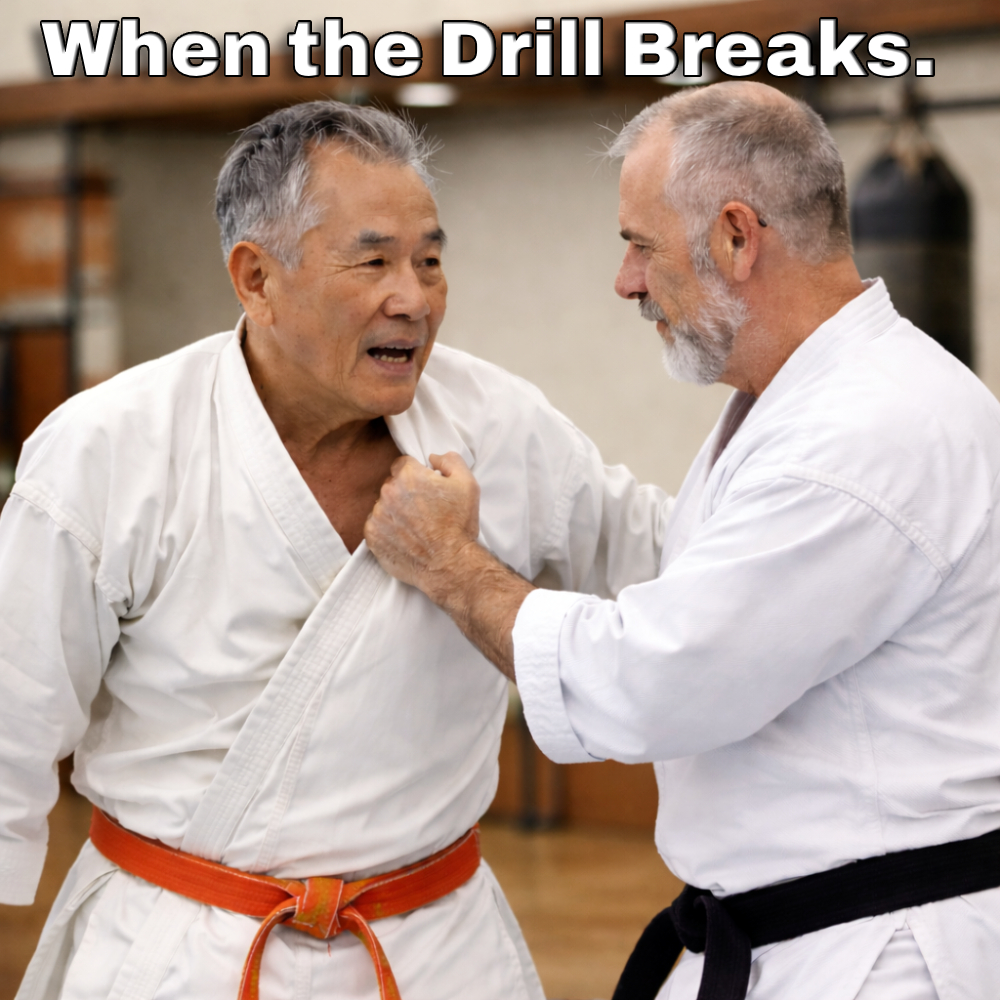
When the Drill Breaks.

Sometimes a student freezes. Not because they don’t know a technique – but because the expected sequence has disappeared. That is the moment training becomes real. In my last article, I wrote that cooperation is not the same as pressure – that structure without uncertainty becomes choreography. The natural question follows. How do we introduce uncertainty

When the Drill Breaks. Read More »

Cooperation Is Not Pressure.

In my last article, I wrote that before there were kata, there were two people working together. That order matters. But working together is not the same as working under pressure. There is a difference between training with a partner and training against uncertainty. And that difference matters. Many schools spend a great deal of time

Cooperation Is Not Pressure. Read More »

Before There Were Kata.

Kata Came Later In my previous article, I wrote that training existed first and kata came later. That order matters. Before forms were formalized, people trained together. They worked through problems with a partner. They tested movement under pressure. They adjusted and refined what was useful. Think about that for a moment. It had to be

Before There Were Kata. Read More »