
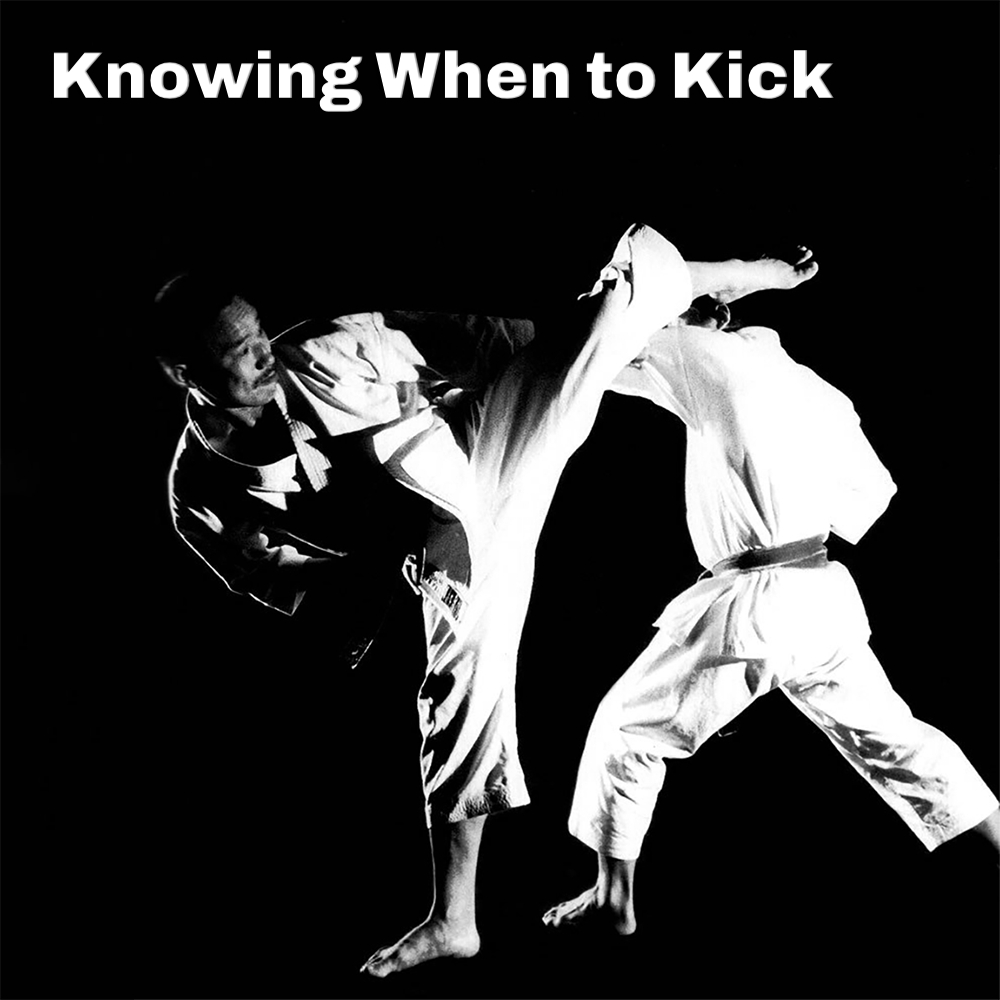
Kicks can be among the most powerful tools available in karate. A well-timed kick can disrupt balance, cause damage, create space, or give someone the opportunity to escape. But the usefulness of a kick depends on more than whether we are capable of performing it. Distance, balance, timing, environment, and the person using the kick all have a part to play.
Decades ago, when I competed in karate, ura mawashi geri, the reverse roundhouse kick, was one of the techniques I favored. I had the flexibility and confidence to use it effectively.
I no longer possess the same flexibility, and that alone is a useful reminder that our physical abilities are not fixed. A technique that suits us at one stage of life may become less practical at another.
The same is true from one person to the next. Some people are exceptional kickers. They have the speed, balance, flexibility, and timing to use techniques that others may never perform comfortably or reliably. There is nothing wrong with that. We all develop different strengths.
The more important question is whether the kick fits the situation in which it is being used.
In self-protection, many confrontations begin at close range. Someone may already be within arm’s reach, perhaps pushing, pulling, grabbing, or trying to unbalance us. At that distance, lifting one foot from the ground in order to kick immediately changes our stability, particularly when another person is already physically connected to us.
That does not mean we should never kick at close range. It means we should understand what the kick is being asked to do and choose the moment carefully.
A low kick to the shin, knee, ankle, or foot may be useful for disrupting balance, causing a reaction, or creating an opportunity to move. A kick may also become available after we have disrupted the other person’s posture or created enough space to use it safely. In those circumstances, the kick supports what we are trying to achieve rather than becoming the entire strategy.
The environment deserves consideration too. The dojo floor is usually flat, open, and predictable, while the places where real problems occur may be anything but. We may be wearing restrictive clothing or unsuitable footwear. The surface may be wet, uneven, or cluttered. Furniture, walls, other people, or confined spaces may limit how freely we can move.
None of this makes kicking unsuitable for self-protection. It simply changes which kicks are likely to remain useful.
This is where simpler movements often have an advantage. A low kick requiring little flexibility, limited space, and minimal commitment may offer more than a technically impressive kick that depends upon ideal distance and excellent balance. The value of the technique comes from how well it fits the circumstances, not from how difficult it is to perform.
Good self-protection training should not remove kicks from karate. It should place them in context. We should consider whether the distance is right, whether we can maintain our balance, what happens if the kick misses, whether we can move immediately afterwards, and whether the environment allows us to use it.
We should also consider the individual.
A young, flexible athlete and an older student may have very different options available to them. So may a smaller person and a larger one. Good teaching does not require everyone to use exactly the same movements. It recognizes individual strengths while still providing students with options they can realistically rely upon.
The goal is not to reduce karate to a small collection of safe or simple techniques. Nor is it to suggest that advanced or athletic kicks have no value.
It is to understand context.
Knowing how to perform a kick is one skill. Developing the judgment to recognize when that kick is appropriate is another.
Perhaps the real value of experience is learning the difference.