
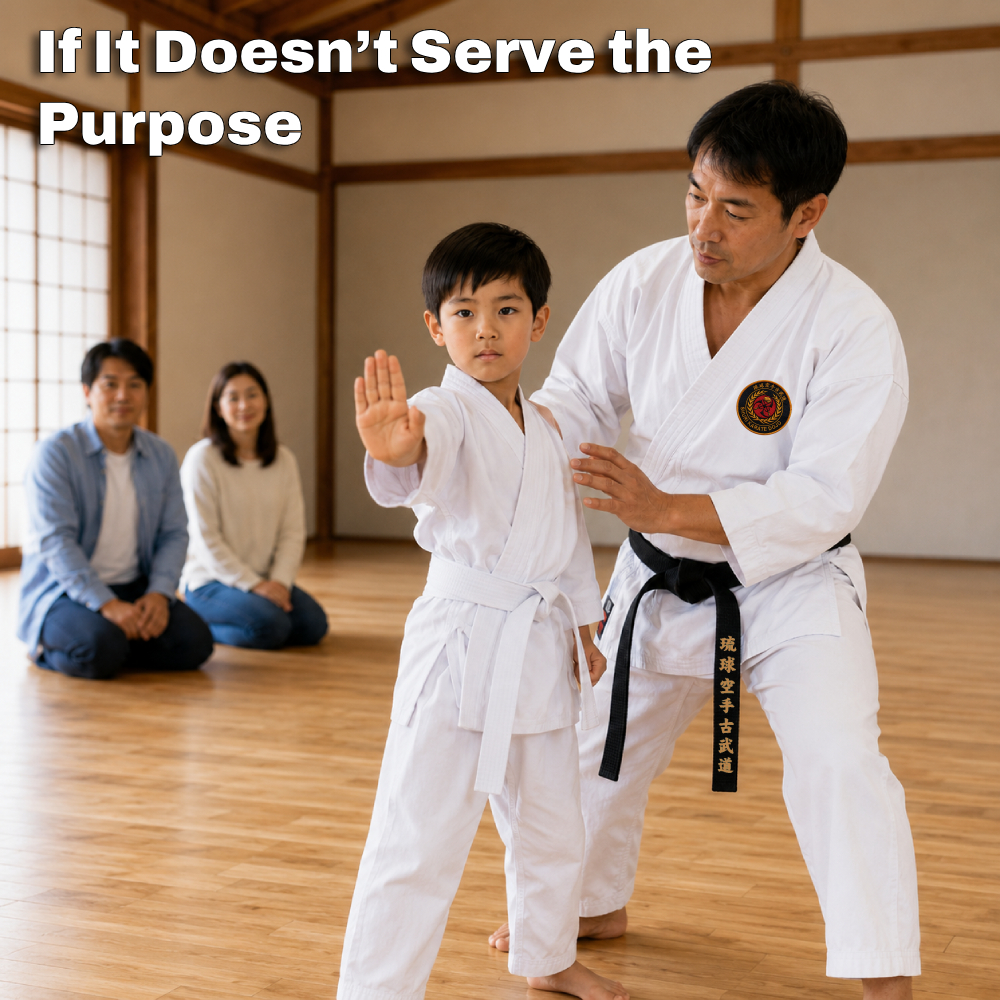
Kata, kihon, and two-person drills are all part of the language of karate.
Each has value. Each has a place. But none of them should exist in isolation, and none of them should be kept simply because they have always been there.
Karate has changed over time. It has been taught for physical education, discipline, character development, competition, recreation, and many other reasons. There is nothing wrong with that, as long as we are honest about the goal.
But if karate is being taught as self-protection, then the parts should connect. The two-person drills should reflect the problems people may actually face, and kata should preserve those lessons as a mnemonic. Kihon should develop useful movement, structure, control, and intent. Together, they should form a method of learning, not a collection of separate activities.
When that connection is missing, we need to ask a difficult question.
Why are we still teaching it?
When a parent comes to my dojo and explains that their child has been bullied, or when an adult says they want to learn how to protect themselves, it is important that we explain and understand the goals.
Much of what is advertised as self-defense still includes partner drills that, in my opinion, are little more than stylized exchanges of block, punch, kick, performed at a distance that makes little sense outside the dojo.
If the stated goal is self-protection, then the drills should be shaped by that goal. They should be based on common assaults, realistic distance, pressure, movement, disruption, and escape. They should help the student understand what violence may actually look like, not what karate sometimes wishes it looked like.
That does not mean beginners need to be thrown into chaos. It does not mean children need to be taught how to fight.
Reality-based training does not mean throwing children into frightening, aggressive, or unsafe situations.
It does not mean hard contact, adult violence scenarios, or anything reckless.
For children, reality-based training can mean awareness, boundaries, using their voice, escaping, getting help, understanding unsafe behavior, and learning simple movement through controlled drills that reflect better distance and timing.
That is not dangerous training.
That is responsible teaching.
In fact, if we are talking about children, self-protection should begin long before anything physical happens. Children need to learn that their feelings matter when something does not seem right, especially when someone tries to isolate them, pressure them, confuse them, or make them keep a secret.
They need to know they are allowed to speak up, move away, say “No,” and get help from a safe adult.
These are not lesser skills. They are real self-protection skills.
And for many children, they are far more useful than learning a choreographed fighting drill they are unlikely to use and may not be able to apply under pressure.
In many cases, it is believed that doing something physical is teaching something useful. We see movement and assume learning for the right context is taking place. We see a child perform a sequence and assume they have been given a tool.
But a drill that looks organized in the dojo can still fail the moment the situation becomes real.
That does not mean physical training has no place. Of course it does. Functional drills can begin simply, and they should. But they need to progress in the right direction. They need to move toward better timing, better distance, better decision-making, better control, and better understanding of what the drill is actually for.
The problem is not simplicity.
The problem is empty simplicity.
A beginner drill can be simple and still be realistic. A children’s lesson can be age-appropriate, controlled, and still point toward reality.
But if the drill teaches the wrong distance, the wrong timing, the wrong response, and the wrong expectation of violence, then we should not defend it just because it’s familiar.
If the goal is self-protection, then life protection has to be the foundation. Later, when appropriate, physical methods should be introduced in a way that reflects realistic distance, timing, resistance, and purpose.
The question should always be the same.
Does this serve the student and help them stay safer?
Does this prepare them for the problem we claim to be addressing?
If the answer is no, then perhaps the drill does not belong in that part of the curriculum. Or perhaps it needs to be reworked, reframed, or taught with a more honest explanation.
This is not about throwing tradition away.
It is about refusing to hide behind it.
Good karate should have shape, but it should also have function. It should develop the body, but also the judgment. It should teach movement, but also context. It should give students something more than a performance.
If we tell students, or their parents, that what we teach has something to do with self-protection, then we have a responsibility to make that claim meaningful.
Not decorative or symbolic.
Meaningful.
Because responsible teaching is not about preserving everything exactly as we received it.
It is about understanding what we received, questioning it honestly, and making sure that what we pass on still serves the purpose we claim it serves.