
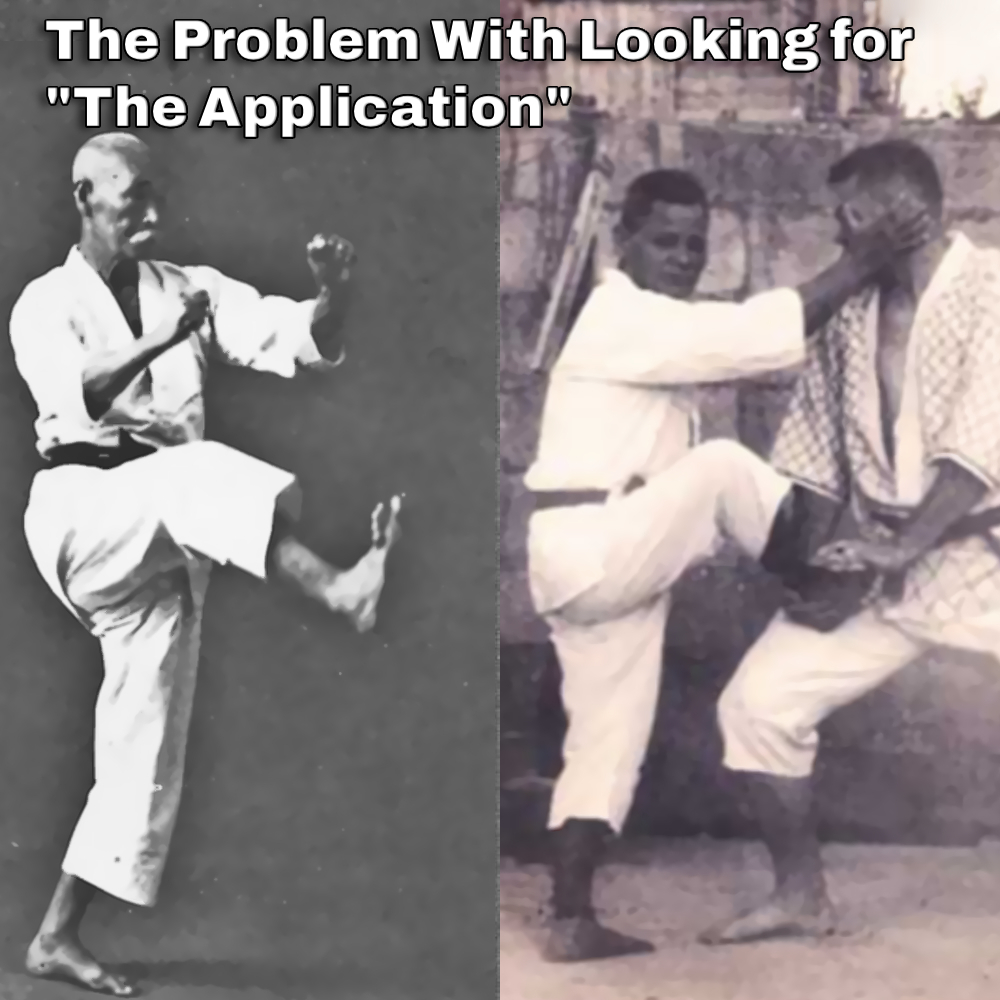
One of the most common debates in karate revolves around kata applications. Someone demonstrates a movement from a kata and then explains what they believe it represents. Another person offers a different interpretation. Before long, the discussion turns into an argument over which application is the “correct” one.
Underlying this debate is an assumption that may itself be flawed. What if the purpose of kata was never to preserve a single application in the first place?
There is little doubt that some uncertainty exists regarding the original intent behind many kata movements. The further back we go, the less direct evidence survives. Anyone claiming complete certainty about every movement in every kata should probably be viewed with some caution.
However, uncertainty does not mean that all interpretations are equally valid, nor does it mean that application is simply guesswork.
The problem often begins with the question itself.
Many practitioners look at a movement and ask, “What is this technique?”
A different question may be more useful: “What principle is this movement expressing?”
The distinction is important. A movement may not be attempting to record a specific wrist lock, strike, throw, or takedown. Instead, it may be preserving a principle of movement, body mechanics, positioning, control, disruption, or power generation.
If that is the case, then multiple applications may legitimately emerge from the same movement. A rising motion may represent lifting an opponent’s posture, clearing an obstruction, creating space, or disrupting balance. The outward movement remains the same, while the application changes according to circumstance.
The principle remains constant.
This is one reason why experienced practitioners can derive numerous functional applications from the same kata sequence without necessarily contradicting each other. They are not inventing different techniques. They are exploring different expressions of the same underlying concept.
This also explains why some bunkai feel convincing while others do not. Not every interpretation deserves equal consideration.
An application should fit the mechanics of the movement, the tactical realities of close-range civilian violence, and the context of the surrounding movements. Most importantly, it should actually work when tested against resistance.
These factors do not guarantee that an interpretation was the original intent of the kata’s creator, but they do allow us to distinguish between plausible applications and imaginative speculation.
The discussion becomes more interesting when we consider why kata may have been created in the first place.
My view is that kata were originally intended as mnemonic devices – physical records designed to help preserve and transmit fighting methods. The kata was not the lesson itself. The kata was a way of remembering the lesson.
The lesson existed in the paired practice, drills, and hands-on instruction that accompanied it.
Over time, kata also acquired additional functions. This shift became more formal in 1908 when Anko Itosu petitioned to introduce karate into Okinawan schools, presenting it as a form of physical education that improved health, circulation, and longevity. None of these developments are inherently wrong – in fact, they helped karate survive. But they do represent a later, deliberate pivot away from purely combative training.
The danger comes when we lose sight of the original purpose.
If kata began as a means of recording combative knowledge, then we should not be surprised to find practical fighting principles embedded within them. Nor should we expect every movement to have one fixed meaning.
A punch is not always a punch. A block is not always a block.
A movement is often less important than the principle it was designed to preserve.
The goal is not to discover a single, mythical application.
The goal is to master the principle so deeply that an almost unlimited number of applications become possible.