
Imagine stepping into an Okinawan karate dojo over a hundred years ago.
It probably wasn’t a dojo in the way most people think of one today. Training often took place in a garden, courtyard, or private home. Instruction was given to a small number of students, and much of what was taught was passed on directly through demonstration, repetition, and personal guidance.
What many karate practitioners don’t realize is that the technical terms we use every day came much later than many of the movements themselves.
Spend enough time on social media and you’ll see endless images showing karate techniques alongside their official names. The assumption is that if you know the label, you understand the movement.
Some of those labels are wrong, by the way, but that’s another discussion.
Even when the label is correct, however, it doesn’t necessarily tell us what the movement is doing.
That distinction is important because the names we use today arrived long after the movements themselves.
As karate spread from Okinawa to mainland Japan, things began to change. Larger classes required a more structured approach. Schools and universities needed consistency. A common language for instruction became necessary.
Technical names helped solve that problem.
They provided a way for instructors to communicate with large groups of students and helped create a level of standardization that allowed karate to spread across Japan and eventually around the world.
There is nothing wrong with that. In many ways, those labels serve an important purpose.
The problem begins when we mistake the label for the movement itself.
A technical name tells us what to call something. It does not necessarily tell us what the movement is doing.
This becomes particularly important when studying kata applications.
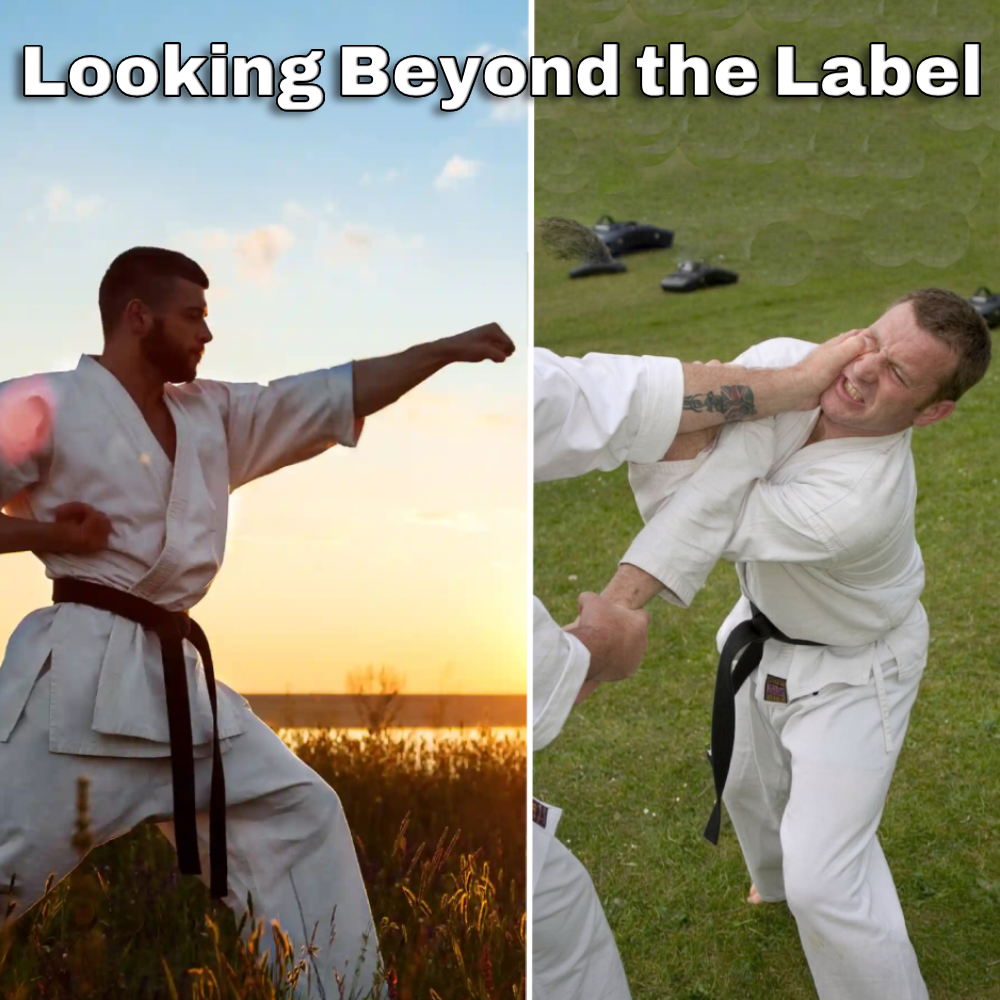
Take a movement from kata that is commonly described as a punch. Once a student hears that label, they often begin viewing the movement through a very narrow lens. The hand is closed, the arm extends, therefore it must be a punch.
But is it?
Could the same movement be used to seize an arm? Could it be part of a pulling action? Could it represent a method of controlling balance, manipulating a joint, or creating an opening for another technique?
The answer depends on context.
This isn’t about saying a punch is never a punch. It’s about recognizing that a label doesn’t always describe the full function of a movement.
If we become too attached to the label, we may stop asking those questions altogether.
This is where there is a difference between practicing karate and studying karate.
Practicing often involves repetition and copying. That has its place. But studying requires a different level of attention. It means looking at what the movement is doing, not just what it has been named.
Without that distinction, it becomes very easy to copy shape without ever understanding function.
This is one reason why different instructors can look at the same kata and see very different possibilities. The movement remains the same, but the interpretation changes because one person is focused on the name while another is focused on the underlying principle.
Names help us communicate. They do not automatically explain application.
The deeper we look into karate, the more important this distinction becomes.
A label can be useful. It can help organize information and make instruction more efficient. But labels are ultimately a convenience. They are not the destination.
The real value lies in understanding why a movement exists, what problem it’s attempting to solve, and under what circumstances it can be applied.
When practitioners begin looking beyond the terminology and examining the principles underneath, new possibilities often emerge. Movements that once appeared simple suddenly reveal additional layers of meaning.
That doesn’t mean every technique can become anything we want it to be. Context still matters. Principles still matter. Sound reasoning still matters.
But it does mean that a name should never become a limitation.
The next time you hear a technique described by its formal title, it may be worth asking a simple question:
Is that what the movement is called, or is that what the movement is actually doing?
The answer is not always the same.
And sometimes that distinction can change the way you view karate entirely.