
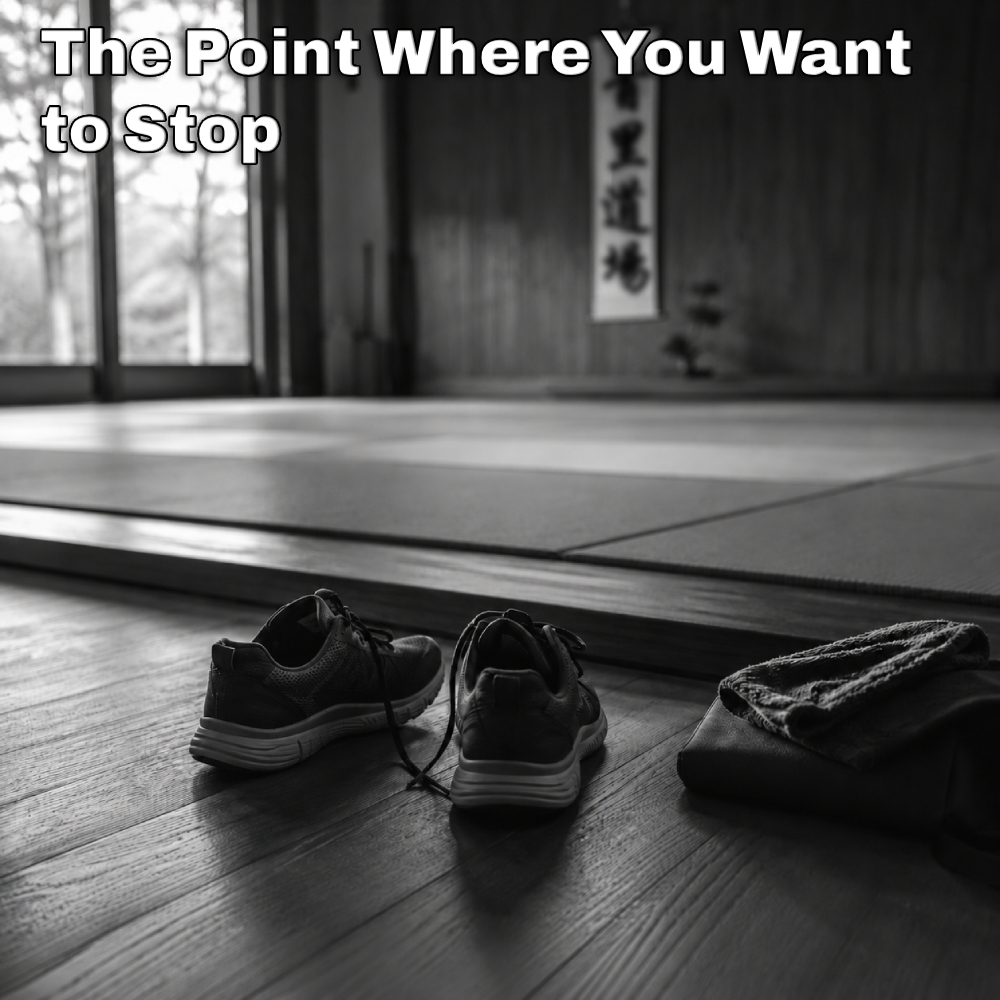
There is a point in training where the body starts to argue with the mind. Sometimes it happens during a hard session, when the repetitions are no longer sharp, the breathing is heavier than expected, and the easy answer begins to appear. Sometimes it happens before the session has even begun, when the body feels awkward, the motivation is missing, and you start looking for a reason not to begin.
I was thinking about this after seeing someone preparing for HYROX in London. A demanding event like that takes more than enthusiasm. It takes preparation, discipline, repetition, and the willingness to keep going when comfort has long since disappeared. But it also reminded me that there is a difference between pushing through discomfort and ignoring a genuine limitation.
Today, the joints in my foot reminded me that the body sometimes has its own opinion. It was easing, but still not quite right, so I had a decision to make. A younger version of me might have treated that as a challenge and tried to prove something. This time, I still ran, but I kept it slow, paid attention, and listened to what the body was telling me. That, too, is part of training. Not every limitation is an excuse, but not every act of pushing forward has to be an act of stubbornness either.
That is where the phrases “I can” and “I can’t” become more interesting. One can open a door. The other can close it. But neither phrase means very much unless we are honest about why we are using it.
There are times when refusal is just a shield. It protects us from effort, discomfort, failure, embarrassment, or the possibility of discovering that we are not as capable as we thought. We step back, but dress it up as wisdom. We tell ourselves we are being sensible, when in truth we are avoiding the work.
But there are also times when stepping back really is wisdom. A warning. A recognition that the body has limits, and that training should build us, not break us. The hard part is learning the difference.
In karate, in fitness, and in life, progress is rarely made by dramatic moments. More often, it is made by small decisions repeated over time. Turning up when you do not feel like it. Doing a little less when doing more would be foolish. Asking for help. Changing direction. Resting when rest is needed, then returning when the body is ready. And to be honest, I’m not very good at this.
That is not quitting. That is training.
Quitting is different. Quitting is when we stop simply because effort became uncomfortable. It is when we let a temporary feeling make a permanent decision. It is when we convince ourselves that the obstacle is proof we should stop, rather than something we need to understand.
Once you learn to quit, quitting can become a habit. But so can continuing. So can adapting. So can beginning again.
The real training often starts at the point where you want to stop. Not because you should always push harder, but because that is the moment where you have to be honest with yourself.
Am I stopping because I should?
Or am I stopping because I don’t want to continue?
There is a world of difference between the two.
Excellence is not simply an outcome. It’s an attitude. It’s found in the choices we make when nobody is watching. It’s found in the quiet decision to do what is appropriate, not what is easiest, and not always what flatters the ego.
Sometimes that means pushing forward. Sometimes it means stepping back. But either way, the responsibility remains ours.
Ultimately, it is up to us.