
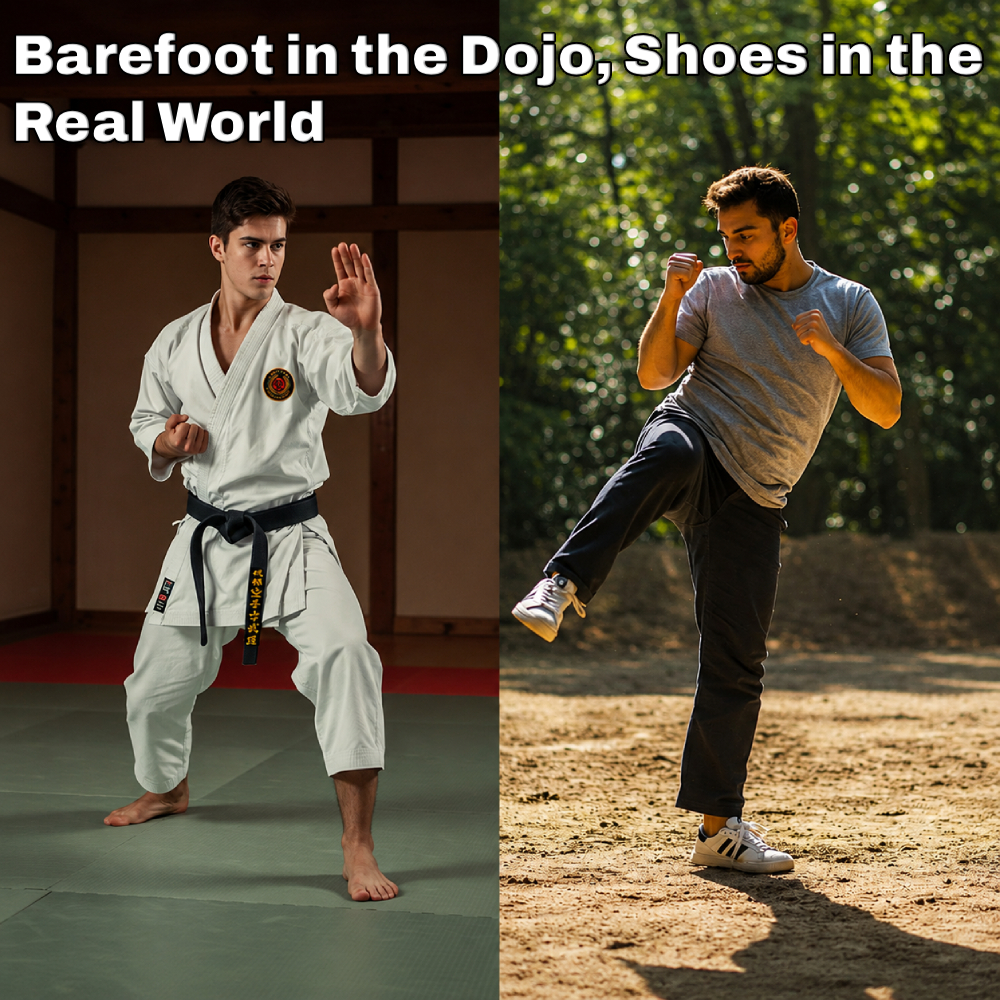
Step into a traditional karate dojo and one of the first things you will usually do is take off your shoes.
Hopefully.
Karate, like many Japanese budo, is traditionally practiced hadashi, barefoot. There are cultural reasons for this, practical reasons, and reasons connected directly to how we move, balance, and feel the ground beneath us.
In Japan, it is customary to remove shoes when entering homes, traditional buildings, and many indoor spaces. That custom naturally carries over into the dojo, where removing shoes is both a sign of respect and a way of keeping the training space clean. Traditional footwear such as geta and zori were designed to be slipped on and off easily, and in earlier times, many ordinary people in Okinawa and Japan spent far more time barefoot or in simple footwear than we do today.
That is also worth remembering when we think about bunkai. The people who developed and practiced these methods were not moving around in modern trainers on smooth dojo floors. They wore different footwear, moved over different surfaces, and lived in a different physical environment. Traditional footwear such as geta or zori could affect balance, stepping, turning, gripping, and recovery.
It does not mean every kata movement was designed around footwear, but it does remind us that application is always shaped by context.
Then there is the dojo itself. Whether the floor is tatami, polished wood, or another training surface, shoes can damage it quickly. A clean floor also matters when people are falling, kneeling, stretching, or placing their hands on the ground.
But barefoot training is not only about etiquette or preserving the floor. It also changes the way we move.
Historically, Okinawan karate was not always practiced in the kind of pristine indoor dojo many people imagine today. It was often trained outside, on dirt, sand, stone, or uneven ground. That matters, because the surface beneath us affects how we stand, move, turn, and recover our balance.
Karate was never meant to be about holding rigid stances like statues.
Stances are not fixed positions. They are moments within movement.
Training barefoot can help us feel how our weight shifts, how the feet connect to the floor, and how balance changes as we move from one position to another.
That direct contact with the ground can also improve awareness. You feel pressure through the feet. You feel when your weight is too far forward, too far back, or sitting dead in the middle. You learn how the body connects to the floor, and how movement, structure, and power are linked.
There are physical benefits too. Barefoot training can strengthen the small muscles, tendons, and stabilizers of the feet and ankles. It can improve balance, coordination, and the ability to adjust quickly. For karate, where movement often depends on subtle weight transfer rather than large athletic gestures, that is important.
But we also need to be realistic.
If our interest is self-protection, then violence does not usually happen on a clean dojo floor. It does not wait until we are barefoot, warmed up, and wearing a karate-gi. It may happen in trainers, boots, sandals, dress shoes, or whatever we happen to be wearing at the time.
That is why pragmatic karate cannot stop at tradition alone.
Barefoot training has value. It connects us to the dojo, to the floor, and to the way karate has traditionally been practiced. But if we are serious about practical application, we should also spend some time training in shoes.
Different footwear changes everything. Trainers grip differently. Boots alter balance and footwork. Dress shoes can slip. Heavy soles can affect kicking, stepping, pivoting, and recovering position. If you have never practiced in the kind of footwear you actually wear outside the dojo, the first time you discover those differences should not be during a real incident.
This does not mean we abandon barefoot training. It means we understand what it gives us, and what it does not.
As I have said many times before, understanding why we do something is key. Training barefoot connects us to tradition, improves control, and develops better movement. Training in shoes reminds us that self-protection happens in the real world, not in ideal conditions.
A well-rounded pragmatic karateka should be comfortable with both.