
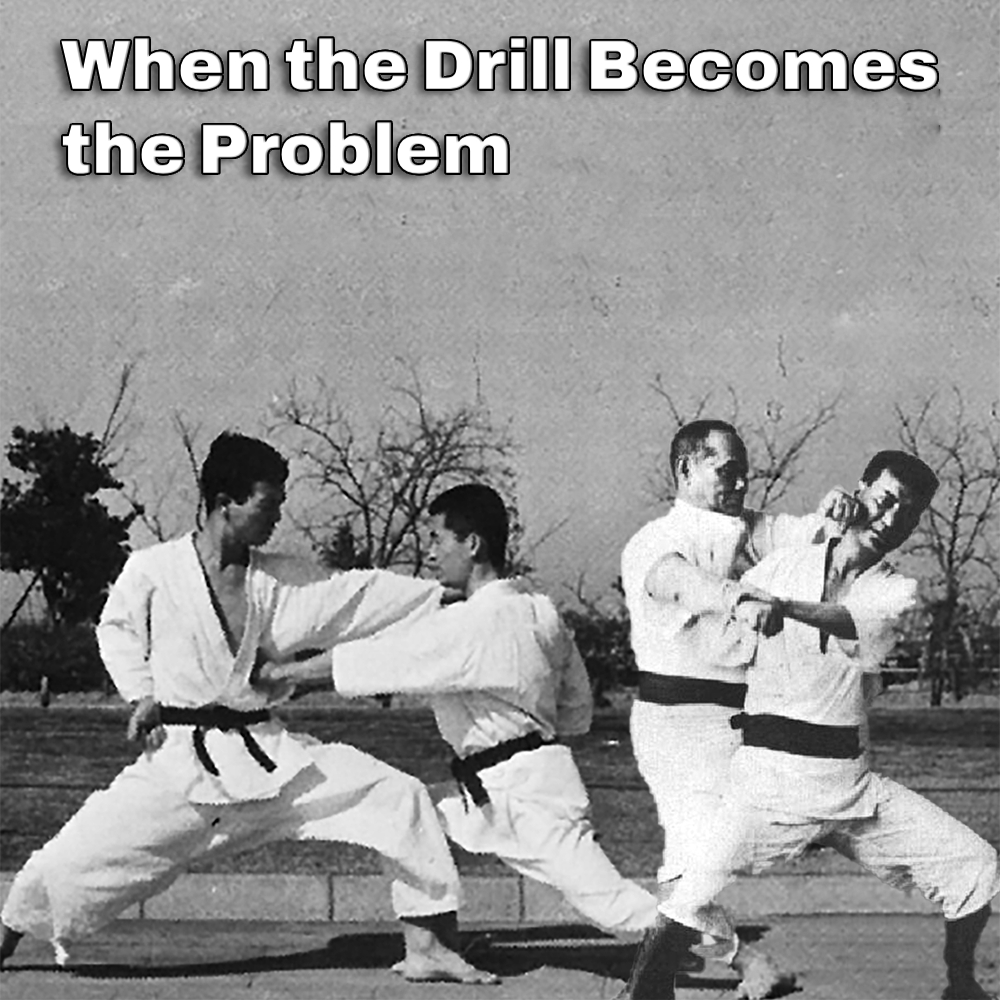
When you first learn a movement or drill, it is natural to begin from stillness. Static training gives you and your partner time to understand what is being taught. It allows you to coordinate your response, learn the shape of the movement, and begin to understand where your body needs to be.
There is nothing wrong with that. In fact, it’s necessary. But it’s only the first step.
As you become more familiar with the movement, speed, pressure, and resistance need to be added. Not recklessly. Not simply turning practice into a fight. But enough pressure that the movement has to function against someone who is no longer helping you.
For me, that part is essential. Resistance, aggression, and pressure all matter, because without them it’s very easy to believe something works simply because your partner allowed it to work.
I remember watching two of my inexperienced adult students working together on a drill. At first, they were trying to follow the shape of what had been taught. Then things started to get a little heated. They began grabbing at each other properly, pulling, pushing, resisting, and refusing to let the other person define the technique.
I watched in silence for a while to see how it would develop, and very quickly, the clean shape disappeared.
There were head and neck clinches, torn karate-gi, awkward pushing, heavy breathing, and no discernible technique at all. In the end, both of them gassed out and stopped, sweaty and emptied of energy.
Was it good karate?
No.
Was it pretty?
Definitely not.
Was it closer to reality than many people would like to admit?
Yes, I think it was.
Because real violence rarely gives us the neat lines we enjoy in the dojo. It does not usually arrive as a perfectly measured step forward with a committed punch held in place for our benefit. It is often rough, ugly, emotional, and chaotic. People grab, pull, shove, swing, cling, resist, panic, and keep moving.
Static training can teach the shape of a movement. It cannot, by itself, teach whether that movement will survive pressure.
That is one of the reasons I constantly write about context.
Karate-style stepping attacks can create bad habits when they are mistaken for practical self-defense training. At best, they teach students how to perform the drill itself. They do not prepare someone to deal with a resisting person who is trying to hurt them.
For me, the problem is the drill itself. Not because it is simple, but because it teaches a version of attack, distance, timing, and response that does not reflect the reality it is often claimed to prepare people for.
Many of these methods are essentially performances. They work in the controlled environment of the dojo, against a familiar karate-style attack, with a partner who understands the script. But real-life attacks are not scripted in that way. They are chaotic, aggressive, and unpredictable.
So the question has to be asked.
What are we actually training for?
Many instructors justify these exercises by referring to ma-ai, timing and distance. Those things are important. Of course they are. But my issue is not with timing and distance themselves. My issue is with the kind of timing and distance being taught.
If the attack is unrealistic, the distance is often unrealistic. And if the distance is unrealistic, the timing becomes unrealistic too.
That matters.
Much of karate’s older material was not primarily designed to deal with formal attacks from another martial artist in a dojo setting. It was designed for practical self-protection against more common acts of violence: forward pressure, grabbing, swinging, seizing, pulling, pushing, and sudden aggression.
Those realities are missing from many of the kumite drills practiced today.
And when those realities are missing, the applications built from those drills can become ineffective for self-defense. They may look tidy. They may preserve tradition. They may even demonstrate good coordination. But if they collapse the moment someone resists, then we have to be honest about what they are really developing.
Personally, I moved away from that kind of training in my dojo a long time ago. Not because every drill has to be wild or aggressive from the beginning, but because the direction of training has to lead somewhere practical.
The issue is not cooperation. The issue is mistaking cooperation for function.
Start static, yes.
Start slowly, yes.
Start with cooperation, yes.
But do not mistake the starting point for the destination.
There are many ways to train that allow students to progress from structure to pressure. The method can begin cleanly, then gradually include movement, resistance, aggression, disruption, and failure. In fact, failure is part of the process. It shows us where the gaps are.
That is where learning begins.
Because let’s be honest, if the “real” karate being taught falls apart the moment someone grabs, pulls, shoves, or refuses to cooperate, then perhaps it is time to rethink the approach.