
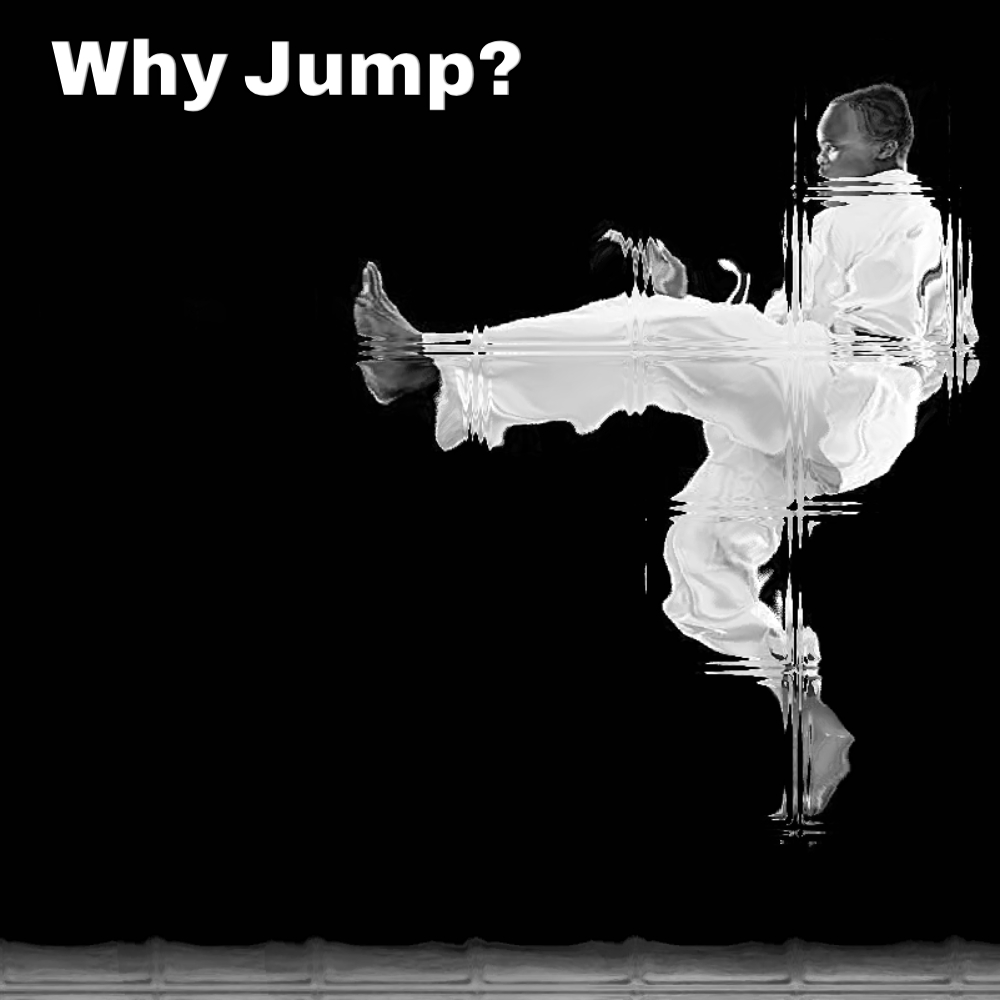
There are several kata where movements are performed as jumping, leaping, or dramatic athletic actions. Suparinpei is one example, with the jumping front kick, or mae tobi geri.
I understand why these movements look impressive. A well-performed jumping kick shows timing, coordination, strength, flexibility, and confidence. It can have value as a physical challenge, and it can look good in demonstrations, gradings, and competition.
But that does not automatically make it the original combative lesson.
For me, the question is simple: what problem does the jump solve in this context?
That last part matters. In a sporting exchange, a jump or hop may solve a real problem. It may help someone cover distance, change rhythm, create surprise, draw a reaction, set up a second attack, add body momentum, or enter on an unexpected line. In that setting, both people are engaged in a mutual fight. There is distance, timing, space to set things up, and a shared understanding of what is happening.
A jumping kick can certainly work there.
But that is not the same thing as civilian self-protection.
If we are looking at kata as a record of older civilian combative methods, then the question changes. Why would the movement require us to leave the ground? Why would a method concerned with close-range violence ask us to sacrifice balance, connection, recovery, and control? If the answer is that the jump allows us to kick higher, cover more distance, generate more impact, or feint before a second kick, I still become doubtful in this context.
In close-range violence, leaving the ground creates problems. You lose connection with the floor, reduce your ability to change direction, make recovery harder, and assume there is enough space to move. You also assume the surface is suitable, the opponent does not crash into you, grab you, or smother the movement, and that you can land safely and continue.
Those are big assumptions.
Older karate, as I understand it, is closer, messier, and more direct than a prepared exchange at distance. It’s about disrupting the opponent, taking balance, controlling limbs, damaging structure, creating an opportunity to escape, or ending the confrontation as quickly as possible. From that perspective, I struggle to see the jumping kick as the older combative meaning.
Of course, there is an important counterpoint. Many respected teachers and lineages perform these movements with a jump, and some interpret the action quite literally. That means I cannot simply dismiss the movement as meaningless or pretend it has no place in the transmitted kata. It clearly does.
Preserving a movement in kata and understanding its original combative function are not always the same thing.
A movement can be preserved, but the reason for it may not be as obvious as the visible shape suggests. Kata movements can be exaggerated, stylized, cleaned up, made more dramatic, or adapted to fit public demonstration, grading, competition, and formal practice. Once that happens, the shape can begin to overshadow the original idea. We may end up preserving the performance while forgetting the problem the movement was meant to solve.
When I look at the jumping kick in Suparinpei, I do not feel compelled to force it into a self-protection explanation as a literal jumping front kick. I would rather ask what older, more grounded action may sit underneath the shape. Could it represent a knee lift, a low kick, a stomp, a disruption to the leg or structure, or a change of position while the opponent is being controlled?
It may also be that what we now call a jump was never intended to be understood as a jump in the first place. The outward performance may have preserved a lifted body action, a shift of weight, a change of level, or a transition, while later interpretation turned that shape into a literal airborne kick.
Those questions interest me far more than trying to justify the jump itself.
There is also something we often forget: footwear. Karate is usually practiced barefoot, in a dojo, on a relatively even surface. That training environment quietly shapes how we imagine movement. A polished floor, bare feet, and a karate-gi can make certain actions seem more reasonable in practice than they may be when considered in the older social and physical context of application.
The people practicing early karate were not necessarily barefoot peasants in a field, despite the popular stories often repeated about karate’s origins. Many of the men associated with older karate came from higher-status families connected with the old Ryukyu Kingdom. They were not always farmers training secretly after a day in the fields.
So we should ask what they were wearing.
If a person is wearing geta, straw sandals, or other traditional footwear, the idea of launching into a high jumping kick becomes even harder to accept as a practical combative method. Loose footwear changes the grip on the ground, the reliability of the kick, the landing, and the consequences of slipping, losing a sandal, or landing badly.
Bare feet in a dojo can make a jumping kick look plausible. Wooden sandals, uneven ground, clothing, and close-range violence make us ask a different question.
This does not prove every detail of what the original movement was. Kata transmission is complicated, and we should be careful about pretending we can know everything with certainty. But we can still apply reason, experience, and context.
For me, the jumping kick does not pass that test very well. It looks like an expression, or a transmitted shape whose original meaning may no longer be obvious from the way it is now performed.
That is not an attack on those who perform jumping kicks. Karate contains many layers: performance, grading requirements, tradition, physical challenge, aesthetics, and personal discipline. There is nothing wrong with acknowledging those layers. The problem comes when we confuse one layer for another.
So I return to the question: what practical problem does the jump solve in this context?
Would this movement make sense at close range, on poor ground, in ordinary clothing, in the footwear of the time, against sudden violence rather than a prepared opponent at sparring distance?
If we cannot answer that clearly, perhaps the jump is not the lesson. Perhaps the older idea was something simpler, closer, lower, and more useful.
Perhaps the real question is not, “How do we make the jump work?” but “Does the jump represent the lesson, or does it preserve something beneath it?”