
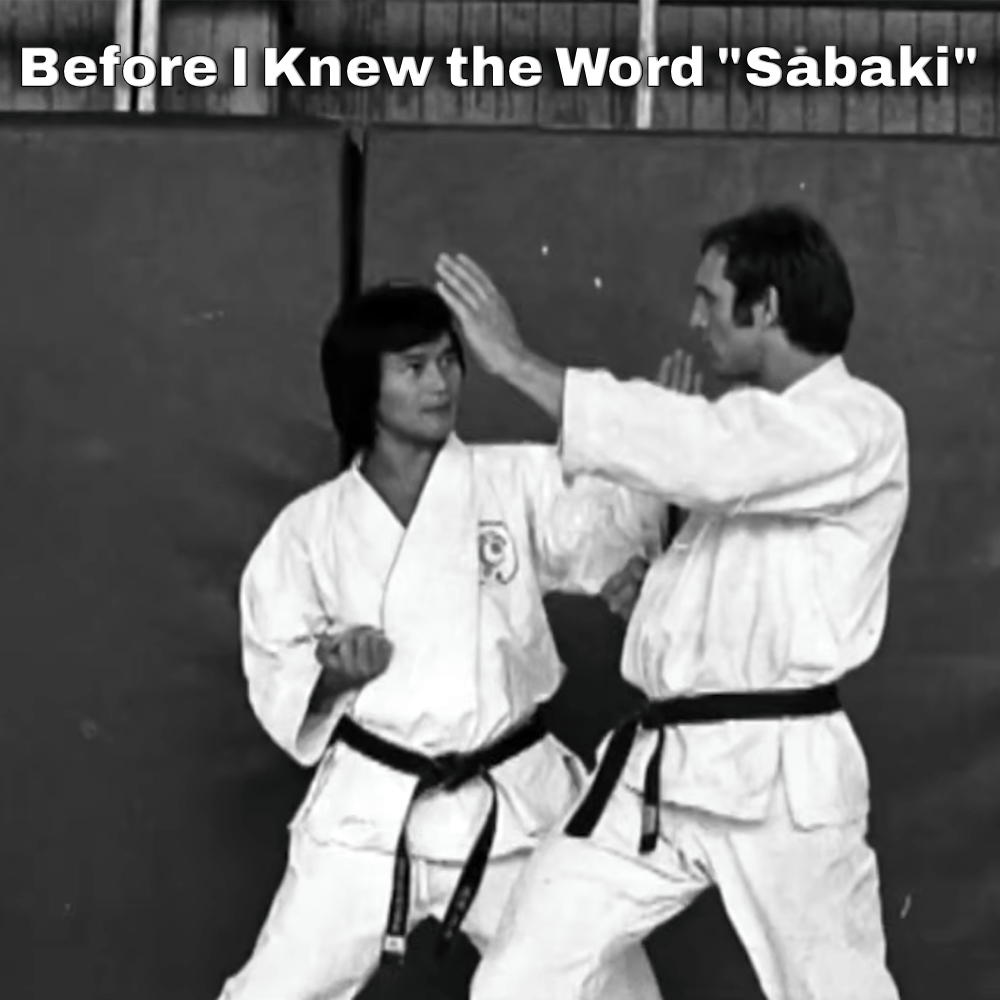
Before I knew the word sabaki, I already understood one thing:
If someone is trying to hit you, being somewhere else is usually a good place to start.
That idea wasn’t unique to karate. Coming from boxing in my youth, moving off the line of attack simply made sense. You learned quickly that standing directly in front of someone and trading force wasn’t always the smartest option.
At the time, I wouldn’t have described it in those terms. I simply accepted what I was being taught.
My earliest years in karate were spent in Wado-ryu. At the time, I didn’t have the experience to recognize what I was being shown, but Wado already contained many of the ideas I would later come to value: taisabaki, body shifting, angling, yielding rather than colliding, and using movement to manage force rather than oppose it.
Much of this was subtle, understated, and easy to overlook if you were focused on the external shape of technique rather than the underlying principle. As a young beginner, I simply didn’t have the experience to appreciate what I was being shown, but the seeds were there.
A few years later, with more experience behind me, I trained in Sankukai karate, the system developed by Nanbu Yoshinao Sensei. Many of the same ideas were present there, but they were expressed more directly through evasion, angling, circular movement, and repositioning. What I had only glimpsed in my earlier training was now becoming easier to recognize.
One of the defining principles of the system was tenshin – body evasion through angled movement. Rather than meeting force directly, the emphasis was on moving off the line of attack, creating a superior position, and countering from advantage. Circular movement, fluidity, and continuous repositioning were all practiced.
The objective was not to stop an attack through strength, but to manage it through movement.
That approach resonated with me, although at the time I couldn’t have explained why. Years later, when I encountered the broader concept of sabaki, I realized many of those lessons had already been present in my training.
At its core, sabaki describes how you move your body to manage an attack rather than collide with it. The aim is not to overpower an opponent, but to reposition yourself, redirect incoming force, and create advantage through timing, angle, and balance rather than strength.
Although the systems and terminology differed, the underlying principles shared considerable common ground. They placed a premium on positioning over collision, movement over resistance, and control over strength. In each case, success came not from stopping an attack, but from managing it.
Looking back, I appreciate how those early experiences exposed me to these ideas long before I had the knowledge or experience to fully understand them. Today, however, I can see how deeply they influenced the way I think about movement, positioning, and control.
Sabaki is not a sequence or a response.
It’s how you move to maintain control when the attack doesn’t follow a script.
Perhaps that’s why, after all these years, so much of sabaki felt familiar. Long before I knew the word, I had already encountered many of its lessons.
We often spend years searching for new ideas, only to discover that some of the most important lessons were placed in front of us from the very beginning.
Looking back, I appreciate how those early experiences exposed me to these ideas long before I was able to fully understand them.