
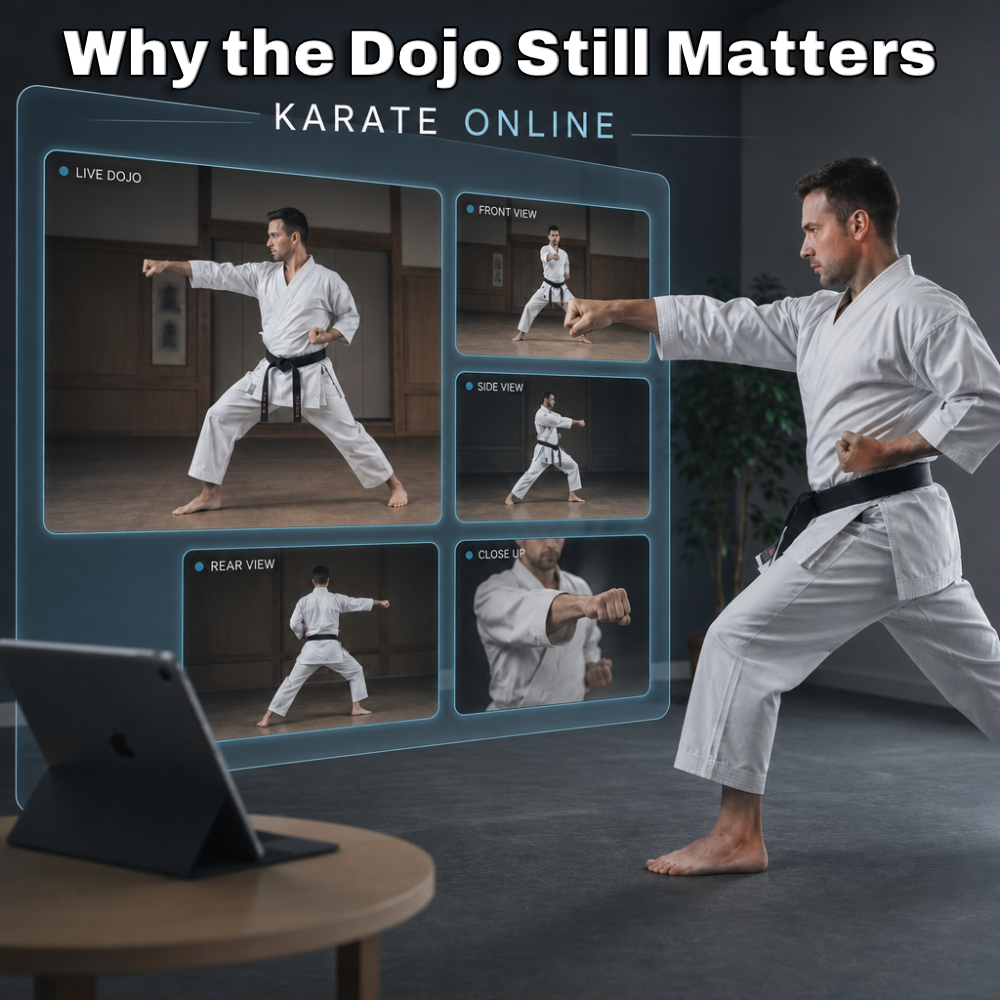
Recently, I received a message from a couple interested in training. Their circumstances are understandable. They have personal issues that making regular attendance at a dojo difficult. They asked whether online training was available and suggested they could visit in person once or twice a year to train and correct any bad habits.
It’s a situation that many people can relate to.
Life changes. Responsibilities increase. Time becomes scarce. Careers, families, health issues, and caring for loved ones often compete with our desire to train. Most martial artists will face these challenges at some point in their lives.
The question is not whether these responsibilities are important. They are.
The question is whether karate can be learned primarily through online instruction.
The answer depends on what we mean by learning.
There is no doubt that videos, books, online courses, and live-streamed classes can be valuable resources. They provide access to information that previous generations could only dream of. They can help students review material, gain different perspectives, and deepen their understanding of principles and concepts.
However, information and instruction are only part of the learning process.
Karate is ultimately a physical discipline. It involves timing, distancing, balance, posture, pressure, resistance, and interaction with another human being. These are not things that can be fully understood through observation alone.
You can watch a hundred videos on swimming, but sooner or later you have to get into the water.
The dojo provides something that no video can offer – correction.
One of the challenges in martial arts is that we are often unaware of our own mistakes. What feels correct is not always correct. What appears effective when practiced alone may fail completely when another person is involved.
Without regular feedback, errors become habits and without training partners, distancing becomes guesswork, pressure and assumptions go untested.
Without correction, progress can become an illusion.
This is not a criticism of online learning. Used correctly, it can be an excellent supplement to training. It can reinforce lessons, provide additional material for study, and help maintain continuity between classes.
But it is an adjunct to dojo training, not a replacement for it.
The dojo remains fundamental because karate was never intended to be a solo pursuit. It’s learned through interaction with instructors and fellow practitioners. It’s refined through repetition, correction, testing, and experience.
Many people today have access to more information than ever before. Yet information alone does not create skill.
Skill is developed through doing.
There are no shortcuts.
The principles remain the same as they always have. Good teachers matter. Training partners matter. Time on the floor matters. The dojo matters.
Life may sometimes prevent us from training as often as we would like, and we all have to adapt to circumstances. But adaptation should not lead us to confuse supplementary learning with the real thing.
Karate is ultimately learned through practice with other people. Technology evolves, but the essence of karate does not.
That was true fifty years ago.
It is still true today.