
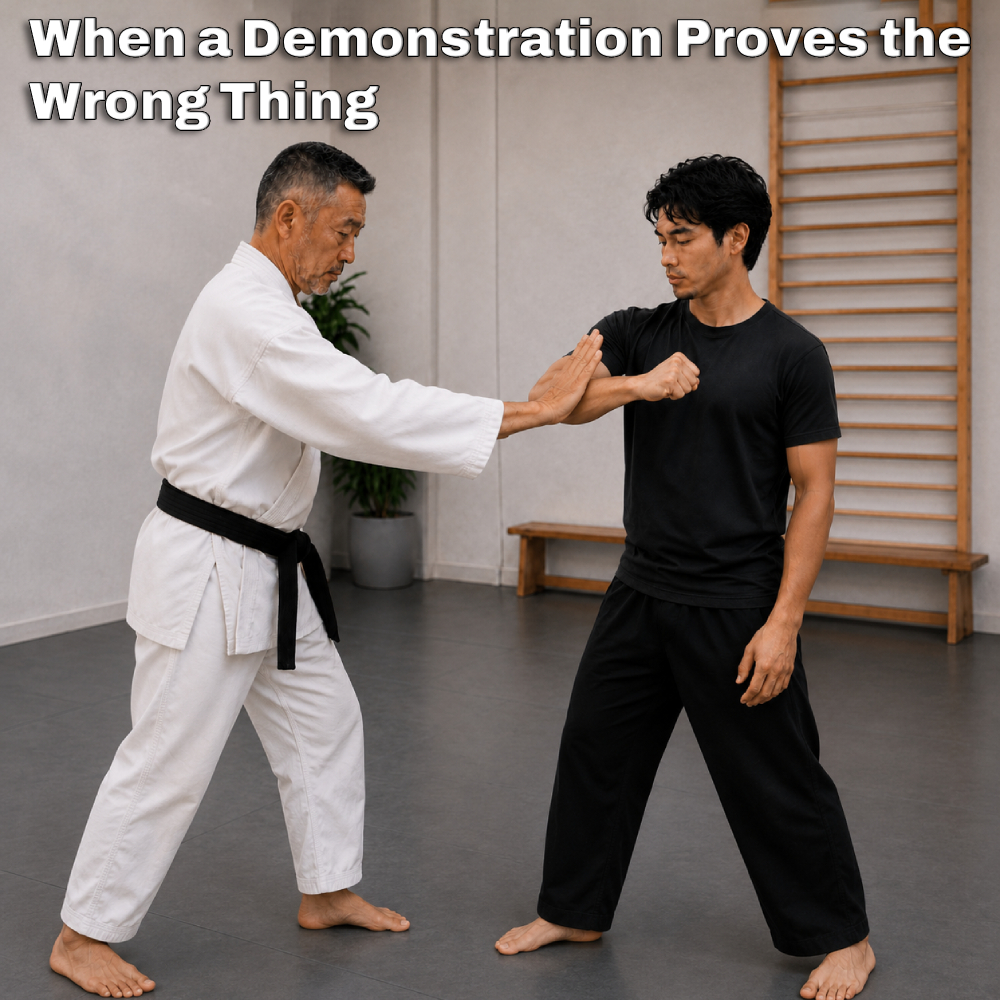
I have seen this kind of demonstration many times in karate.
A student extends an arm. The teacher pushes against it, or slaps against it with their hand, and the arm collapses. The wrist bends, the elbow gives way, the shoulder lifts, and the whole thing looks weak.
Then the teacher makes a small correction.
The arm is moved slightly. The shoulder settles, the body relaxes, and the stance becomes firmer. Sometimes the student is told to breathe out, settle down, or “connect” the arm to the body.
The pressure is applied again. This time the arm feels solid, and everyone in the room can see the difference.
And to be fair, there is usually something real happening.
A limb that is disconnected from the body is weak. A limb that is better aligned, supported by posture, and connected to the body will feel much stronger. That is not magic, and it’s not a mystery.
It is basic body mechanics.
So the demonstration may be true.
But that does not mean the conclusion is true.
That is where I think karate often gets itself into trouble.
Whether the lesson is that your arm shouldn’t operate separate from your body, that good structure matters, or that relaxation and firmness aren’t opposites, I agree. Those are valuable, foundational concepts.
Often, demonstrations like this are used to support the idea that a formal karate “block” becomes effective when the body is aligned correctly.
But when the lesson becomes, “This proves the block works”, we need to slow down.
Because what has really been tested?
We have tested a known pressure, a fixed position, a cooperative partner, and a predictable direction. We haven’t tested timing, distance, or genuine resistance. This exercise lacks a moving opponent, chaotic angles, and the sheer confusion of real violence.
It is structure tested against a controlled force.
There is value in that, but we should be honest about what it actually proves.
A movement can be strong without being a block. A position can be structurally sound without proving its combative purpose. Good alignment may support a movement, but it does not automatically explain what that movement was originally designed to do.
This is why labels can become a trap.
Take a standard “blocking” movement, sometimes called uchi-uke. Once a movement is strictly labeled a “block”, we bend our entire practice to protect that definition. If it fails against a fast, live punch, we don’t question the application. Instead, we adjust the stance to make the block stronger. We correct the shoulder, engage different muscles, and alter the breathing, all to validate a flawed premise.
But perhaps the better question isn’t, “How do we make this block work?”
Perhaps the better question is, “Was this movement really a block in the first place?”
That is a very different conversation.
Karate movements can clear limbs, control arms, strike, frame, enter, seize, disrupt posture, or create space. They can do many things. But if we begin and end with the word “block”, we may never look beyond it.
The demonstration shows connection, structure, and how the body receives pressure.
But it does not show application.
That distinction matters.
A convincing demonstration can easily make an old explanation feel true. The student feels the physical difference, the room sees the clean result, and the label remains unchallenged.
But feeling a difference is not the same as testing an idea.
Sometimes the arm really is stronger, the body really is better connected, and the demonstration really does show excellent mechanics.
And sometimes, even then, the conclusion is still wrong.