
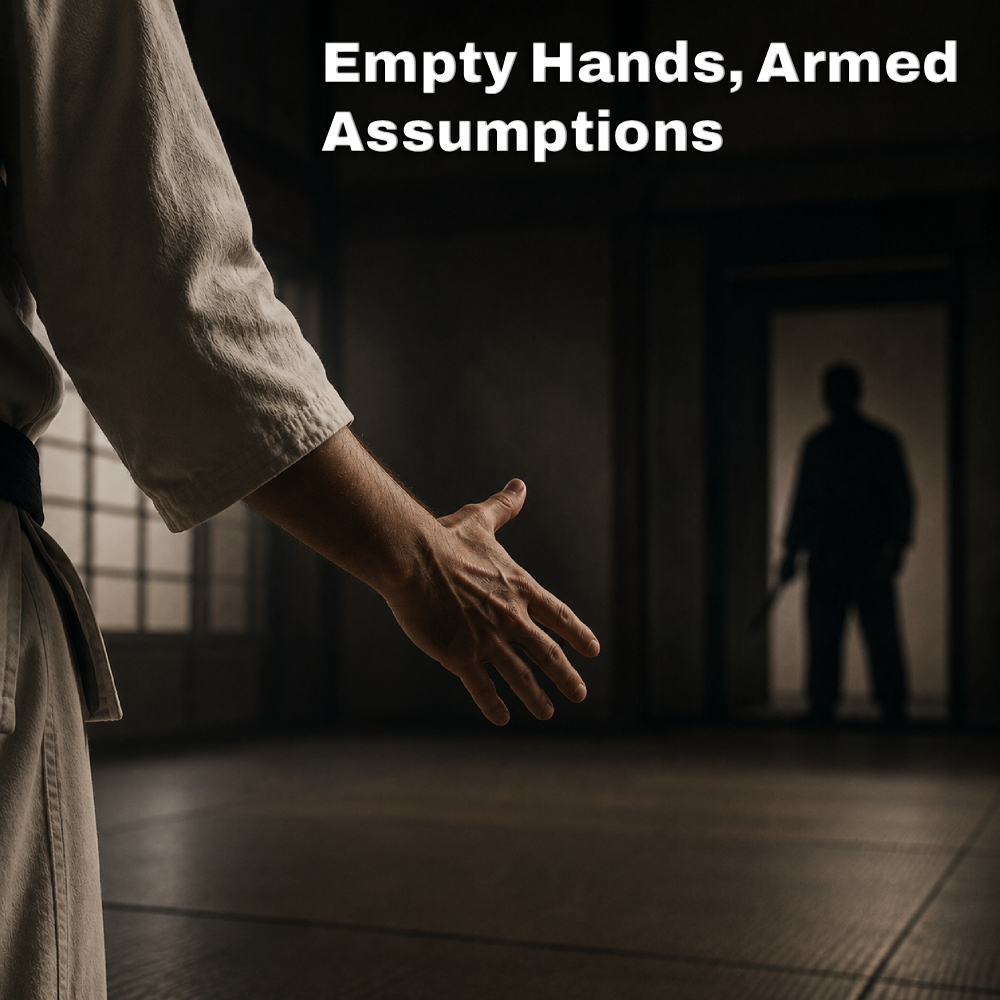
Karate is translated as “empty hand”. Karate-do, the way of the empty hand.
Most karateka know, at least in general terms, that the older characters for karate referred to “China hand”, and that the later change to “empty hand” helped reshape the art for a different time, a different audience, and a different cultural setting.
That change matters.
It did not simply alter the spelling. It helped alter the way many people came to think about the art.
The phrase “empty hand” can easily lead us toward a particular assumption: that karate is mainly about defending ourselves while unarmed, against another person who is also unarmed. Much of modern dojo practice reinforces that idea. We face another empty-handed person. We step, block, punch, kick, and counter. Even when the movements are called self-defense, the opponent is usually imagined without a weapon.
But in real violence, that is a dangerous assumption.
The fact that we may be empty-handed does not mean the person attacking us is empty-handed.
That point is often overlooked.
Many dojo advertise self-defense. Many instructors teach their students that karate contains answers for real situations. Yet a large part of what makes real violence dangerous is quietly removed from training. The possibility of a weapon is treated as a separate subject, an advanced subject, or something outside the normal study of karate.
But if we are talking about civilian self-protection, weapons cannot be treated as an afterthought.
A person who attacks you may have a knife. They may have a stick, a bottle, a tool, a gun, or anything else that gives them an advantage. They may not show it at first, only drawing it when they are already close, using it suddenly, repeatedly, and without warning.
That changes everything.
Distance, timing, entries, grabbing, all changes. The purpose of controlling a limb becomes imperative. And the risk of standing still, waiting, is too high to even consider. Trading blows with your hands held in a high guard becomes an even more dangerous option.
And perhaps most importantly, the way we read kata begins to change.
Many people may have practiced a weapon kata, or have trained with traditional weapons in a formal setting. There is nothing wrong with that. Kobudo has its own value, discipline, history, and beauty. It is part of my curriculum. But choreographed weapon practice is not the same thing as dealing with a determined person trying to hurt you with a weapon.
It is one thing to perform a sequence, it’s another thing to face someone swinging a bat with real intent.
Imagine your instructor walks out holding a heavy plastic bat.
He says, “You can punch, kick, grab, throw, or do whatever you want. I am going to hit you as hard and as fast as I can.”
Now the distance feels different.
The timing feels different.
Now your favorite block-and-counter drill does not seem so convincing.
The person with the bat does not need to stand in range and wait for your response. They can strike from outside your punching range, swing more than once. They can use one hand to strike and the other to push, grab, or stop you closing the distance. They can kick. They can hit again while you are still trying to understand what happened.
And that is with a training weapon.
Replace it with a metal bat, a blade, or an improvised object, and the problem becomes even more serious.
No one is really ready for that unless they have trained for it.
This is not to say that karate has no answers. It is to say that the answers are often hidden by the assumptions we bring to training.
If we always imagine an empty-handed attacker, we will interpret the techniques through that lens. Every movement becomes a block, a punch, a strike, or a formal response to a formal attack. Kata analysis becomes a record of empty-handed exchanges between two people who politely remain within the boundaries of dojo choreography.
But kata may be telling us something else.
Control the limb.
Move off the line.
Close the distance safely.
Unbalance the attacker.
Use both hands.
Prevent the second strike.
Shut down the weapon-bearing side.
Escape when possible.
Use whatever advantage is available.
To those who practice a more pragmatic karate, these principles should sound familiar. This is why simple block-and-counter explanations and drills may miss the mark entirely.
That does not mean every technique must be forced into a weapon-defense explanation. That would be another mistake. It does mean we should be careful before assuming that karate is only about two empty-handed people exchanging formal techniques.
The name “empty hand” may describe our condition.
It does not describe the attacker’s.
And that distinction matters.
Modern karate-do has often been shaped by education, sport, etiquette, personal development, and group practice. Those things have value. They can build discipline, patience, fitness, and more. But when we talk about self-defense, we need to be honest about what is being trained and what is being left out.
If the attacker is always empty-handed in our imagination, then our karate is being built around a safer world than the one violence actually comes from.
Weapons do not have to dominate every class, or turn training into fantasy or fear. But their possibility should affect how we think, how we interpret movement, and how we understand distance, timing, control, and escape.
Because once a weapon appears, the lesson changes very quickly.
The empty hand does not mean an empty threat.