
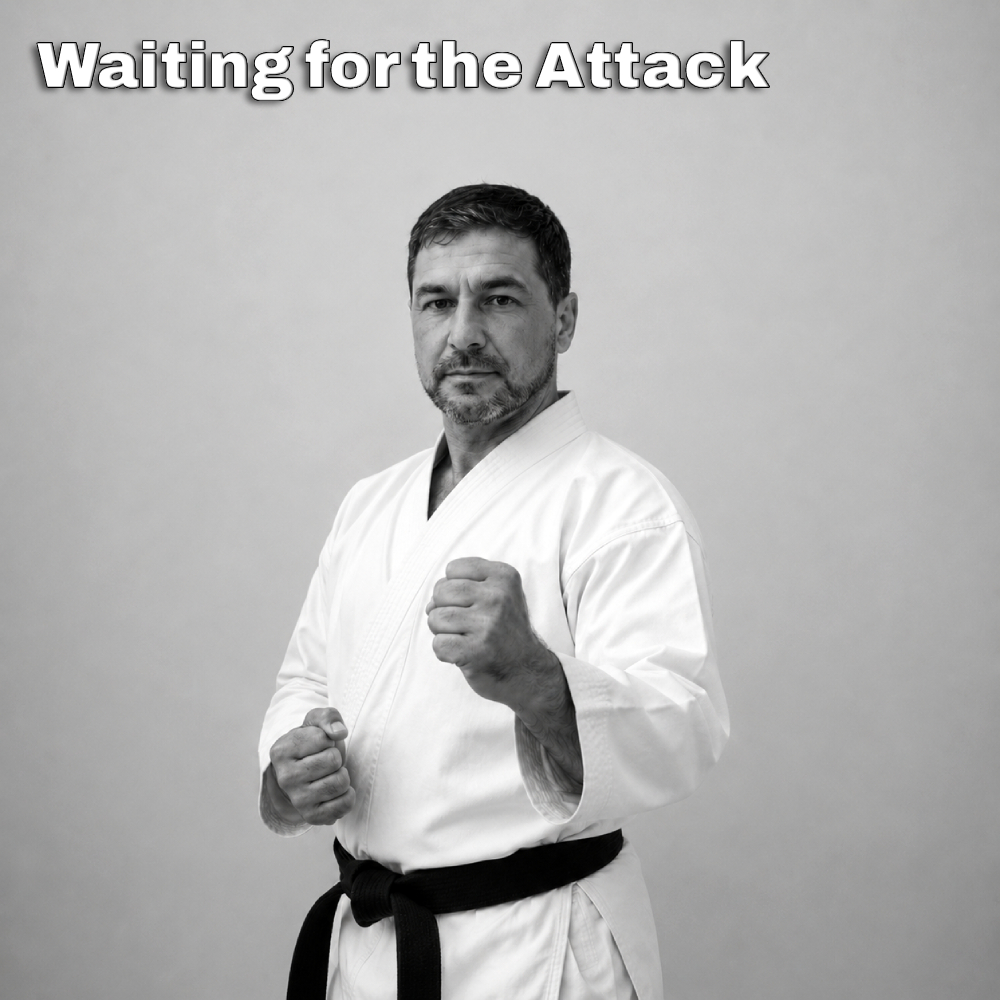
Someone once told me that if you do not wait for an attack, or at least attack and defend at the same time, then you have effectively become the attacker.
His argument was that we can never truly know the exact method of attack, so we should wait.
The exact method? Perhaps not. We may not know every detail of what is coming. We may not know whether the person will throw a right hand, grab, rush forward, reach for a weapon, or simply try to overwhelm us with aggression.
But experience teaches us that we can often see enough.
People give signals. Their posture changes. Their distance changes. Their eyes, breathing, hands, weight, tone, and intent can all begin to show before the physical attack fully appears. None of this is magic. It’s not mystical intuition. It’s experience, observation, and pattern recognition.
Of course, none of this is guaranteed. People can surprise us. Violence can be chaotic, sudden, and messy. But the fact that we cannot predict everything does not mean we should ignore the signs that are already there.
We see this in many areas of life, not just karate. A good driver sees trouble developing before the collision happens. A good fighter reads pressure, rhythm, hesitation, and intent. A good instructor can often see a student’s mistake before the movement is fully completed.
In training, we try to develop a better understanding of what may happen next. Not so we can guess perfectly, but so we can act sooner, move better, and avoid being trapped by hesitation. Sometimes that means receiving an attack. Sometimes it means moving as the attack begins. And sometimes, when the threat is clear and the danger is immediate, it may mean taking the initiative.
This is where people can become tangled in words.
Terms such as go no sen, sen no sen, and sen sen no sen are usually associated with Japanese martial traditions. Okinawan karate may not have used those exact terms in its earlier development, and it is reasonable to say that much of the language we now use became more formalized after karate moved to mainland Japan.
But the absence of a term does not mean the absence of the principle.
Older karate teachers may not have categorized timing in quite the same way. They may not have used the same labels. Instruction may have been much more direct. Move here. Step there. Strike like this. Lower your hips. Use your body. Do it again.
Yagi Akihito Sensei of Meibukan Goju-Ryu once made a similar point when discussing formal stance names. He said he had not heard the term musubi dachi in that earlier setting. They would simply say, stand with your heels together.
Uema Takeshi Sensei of Shubukan Shorin-Ryu expressed something similar. He explained that they would simply say, do this or do that, lower your hips, spread out your legs. There were not always formal names for everything.
That does not mean the movements were less meaningful. It means the teaching was often less concerned with terminology and more concerned with doing.
When karate reached mainland Japan in the early twentieth century, it adapted. It entered schools, universities, and more formal dojo environments. Language became more structured. Methods were categorized. Terminology was borrowed, adjusted, and standardized, making it easier to teach to larger groups.
But names do not make you better at karate.
You can call it sen sen no sen, or you can call it getting there first. You can call it taking the initiative, or you can call it not waiting until the damage has already begun. The name may help us discuss the idea, but the name is not the skill.
Karate is not an excuse for aggression. It’s not a license to strike someone because we feel uncomfortable, insulted, challenged, or annoyed. The moral and legal responsibility remains serious.
But neither should karate be reduced to passive waiting.
Some may immediately think of karate ni sente nashi, there is no first attack in karate. I understand that. But I do not read that as a command to become passive. To me, it is a moral warning against starting violence, not an instruction to stand still while violence unfolds.
In real violence, waiting can be dangerous. Waiting can give the other person time to close distance, build momentum, draw a weapon, take balance, or strike first. In a dojo drill, we may know the attack is coming and still have time to respond. In the real world, the first clear sign may already be too late.
This is also why the simple idea of “block and counter” is rarely the preferred method for practical self-protection. It already assumes that the other person has been allowed to launch the attack, that we have read it correctly, that we have enough time and space to stop it cleanly, and that our counter will arrive before the situation changes again.
Sometimes that may happen. But it is not something I would want to build an entire method around.
A better aim is to manage the situation earlier, move before we are overwhelmed, control the line, disrupt the attack, and take the initiative when the context demands it.
This is why context matters.
If someone is merely speaking rudely, that is not the same as an imminent assault. If someone is angry but not yet physically threatening, the answer may be distance, de-escalation, leaving, or creating a barrier.
But if the person has clearly crossed the line into immediate danger, then waiting for the attack to fully arrive may not be wisdom. It may be hesitation dressed up as principle.
Karate should not make us aggressive.
But it should not make us passive either.
Of course, karate is not to be used for starting trouble. But that does not mean we must stand still while trouble starts on us.
There is a difference between attacking someone without cause and taking action when violence is already unfolding.
The words, terms and the history can be useful. The terminology can give us a way to discuss timing, initiative, and response. But the real lesson is not in the label. It is in the practice.
In the dojo, waiting for the attack may look strong and controlled.
In the real world, it may simply mean you’re too late.