
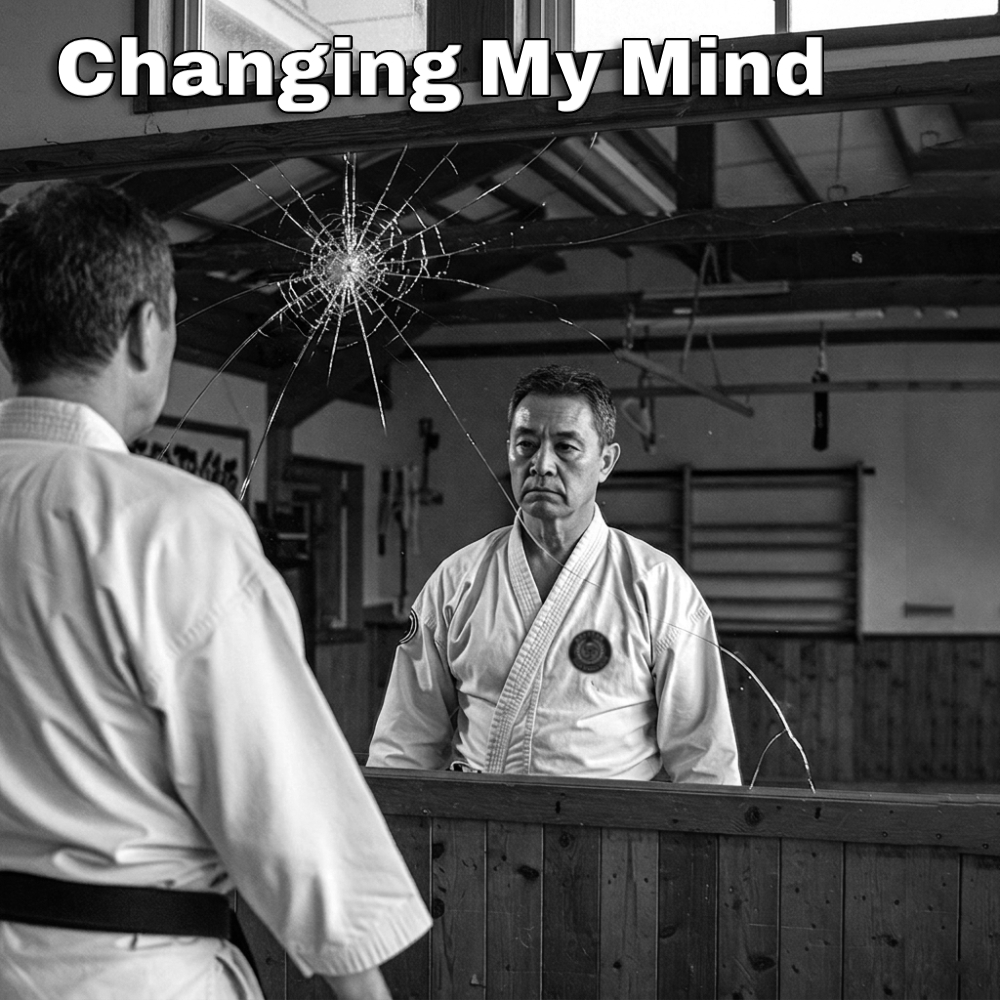
Many people assume that experience makes your views more settled.
My experience has been the opposite. The longer I have trained, the more willing I have become to revisit things I once accepted without question.
When I first started in the martial arts, I was like most beginners. I accepted what I was taught because I had neither the knowledge nor the experience to evaluate it for myself. My instructors had trained longer than I had. They possessed skills I didn’t. It was only natural to assume they understood things more deeply than I did.
In many cases they did.
But experience has a way of asking questions that cannot always be answered by tradition, rank, or repetition.
Over the years I have changed my mind about many things. I have changed my mind about kata, about drills, about distance, timing, stances, applications, and how karate was originally taught.
There was a time when I accepted some drills simply because they were part of the training. They were familiar, expected, and had been handed down, so they carried a sense of authority. But as my experience grew, I began to ask different questions. Did the distance make sense? Did the timing make sense? Did the attack resemble anything likely to happen outside the dojo? Did the movement function under pressure, or did it only work because both people already knew what was supposed to happen?
Those questions changed a lot for me. They changed how I looked at step-kumite, kata, “blocks”, stances, formal applications, and the difference between practicing a movement and understanding what that movement is for.
I think this is why many people, especially those who have trained for a long time, eventually begin looking for something more in their karate. Something deeper, more practical, more functional, and more connected to the reasons the movements existed in the first place. That search often begins when the answers we inherited no longer feel complete.
Some ideas became stronger the more I explored them. Others gradually became harder to defend. Not because somebody on the internet disagreed with them, but because my own experience kept leading me back to the same questions.
At first, changing your mind can feel uncomfortable. We invest time in our beliefs. We teach them. We repeat them. Sometimes we even build part of our identity around them. Admitting that an earlier conclusion may have been incomplete can feel like admitting failure.
That is how many assumptions become fixed. Something is learned at one stage of training, repeated for years, then passed on as if it were beyond question. Over time, familiarity can begin to feel like proof. A method, an interpretation, or even the meaning of a word becomes accepted simply because that is how someone first received it. But receiving an idea is not the same as understanding it deeply.
I no longer see changing my mind as failure.
If new information, practical experience, historical research, or honest reflection leads me to a different conclusion, I see no virtue in clinging to the old one simply because it’s familiar.
Changing your mind is not a weakness. Refusing to examine your beliefs because you are afraid they might change is far more limiting.
The martial arts are full of people searching for final answers. They want fixed interpretations, fixed methods, and fixed truths. Yet the deeper I have gone into karate, the more I have come to appreciate that many things are not nearly as fixed as they first appear.
That does not mean anything goes. It does not mean abandoning standards or accepting every new idea that comes along. It simply means remaining willing to look again, to ask questions, to test assumptions, and to re-examine conclusions that may have been accepted years ago under very different circumstances.
Perhaps one of the most useful habits I have developed over the years is not changing my mind. It is being willing to.
Because every experience provides another opportunity to learn something I may have missed before.
And the day we stop looking is often the day we stop learning.