
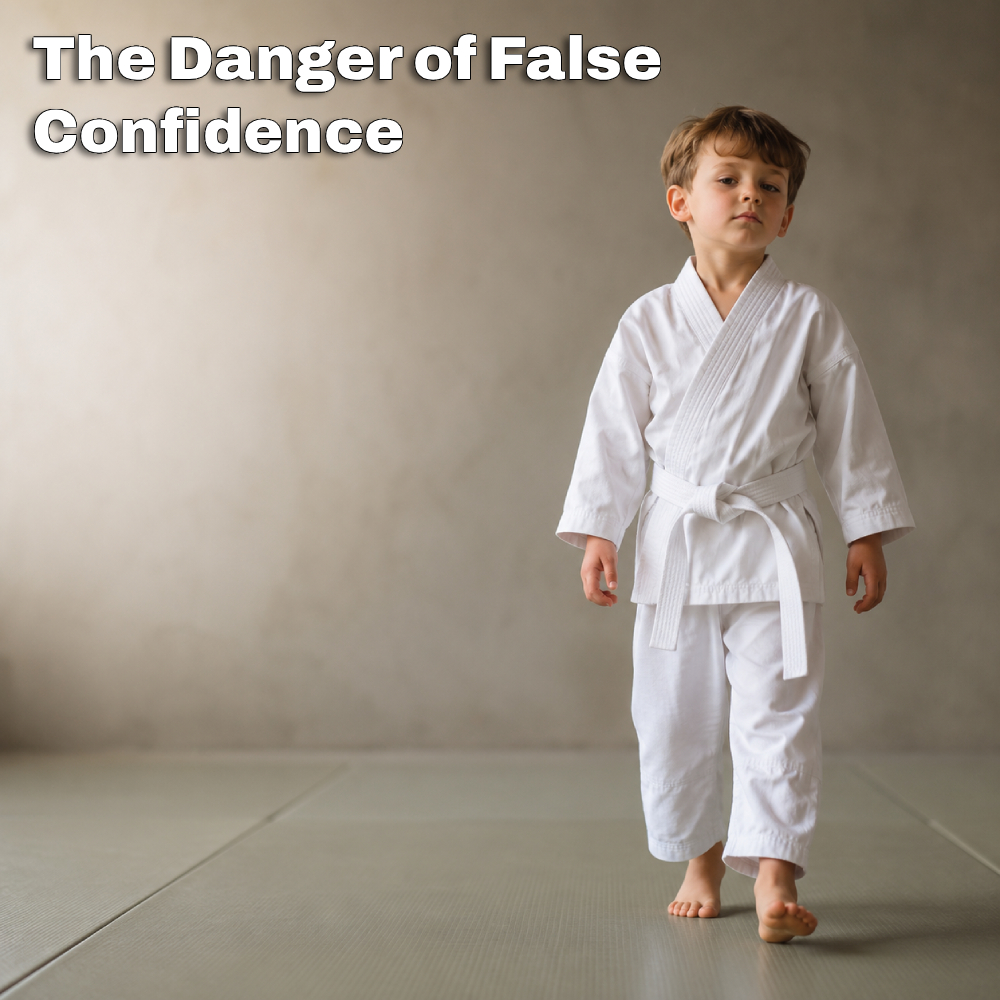
I was shown a video recently of a child being taught how to escape from an adult’s grab.
The intention may have been good.
But the method being shown was deeply flawed.
It was the kind of technique that can look convincing in a calm demonstration. The adult holds the child’s arm in a certain way. The child knows what is coming. The movement is performed at the right moment. The adult allows the escape to happen.
Inside that kind of drill, almost anything can be made to work.
But that is not reality.
A child being grabbed by an adult is not dealing with a polite training partner. They are dealing with someone who is stronger, heavier, able to tighten the grip, pull, twist, lift, drag, or change direction the moment the child begins to resist.
That changes everything.
The problem is not only that the technique is likely to fail.
The problem is that the child may now believe they have been given an answer.
A child who has been taught a weak escape may think, “I know what to do if someone grabs me.” But if the method fails immediately, they are not just dealing with the original danger. They are also dealing with the shock of discovering that the thing they trusted does not work.
That is false confidence.
And false confidence can be dangerous.
It is not enough for a technique to work when the adult is helping, or for it to look neat on video. It is certainly not enough for the child to perform the movement correctly inside a cooperative drill.
The question is whether the method has any realistic chance of helping that child when they are surprised, frightened, overpowered, and under pressure.
If the answer is no, then we have to be honest about that.
Children are not small adults. They do not have the same strength, weight, reach, coordination, emotional control, or ability to impose themselves physically. A method that might possibly work for an adult does not automatically become suitable for a child.
In fact, many techniques become worse when taught to children, because the child is asked to solve a strength problem without having the strength to do it.
That is why children’s self-protection has to begin somewhere else.
It begins with paying attention and managing distance. It begins with voice, boundaries, escape, and getting help. It begins with teaching a child that if something feels wrong, they are allowed to move, shout, run, make noise, and seek a safe adult.
These are not lesser skills.
They are the foundation.
Physical methods can be taught, of course. But they must be chosen carefully. They must be simple, gross-motor, age-appropriate, and honest about what the child can realistically do. They must be tested carefully, safely, and progressively, not against brutality, but against enough resistance to reveal whether the method has substance.
A drill that only works when the adult cooperates is not a reliable self-protection method.
It is a performance.
And when that performance is sold as self-defense, the child may be the one who pays the price.
This is where teachers and parents need to be very careful. A child may trust the adult completely. If the adult says, “This is how you escape”, the child may believe them. They may not have the experience to question the method, or to understand that the adult in the demonstration is allowing the drill to work.
So the responsibility sits with the teacher.
Not the child.
If we teach children self-protection, we have to ask harder questions.
Would this work if the adult tightened the grip, or if the child was being pulled?
Would it work if the child was scared, or made a mistake?
And perhaps most importantly, does this method teach the child to escape and get help, or does it teach them to stay engaged in a situation they cannot win?
That last question matters.
Because the goal is not for the child to defeat the adult.
The goal is to create an opportunity to get away. Every drill given to a child should end with the child making an escape, not standing still trying to fight.
That means we should be cautious about teaching children choreographed answers. We should be cautious about giving them a movement that looks good in the dojo but has little chance under pressure. And we should be especially cautious about giving them confidence that the training has not earned.
Confidence is valuable when it is built on something real.
But confidence without capability is not protection.
It is a risk.
Good teaching does not make children afraid, or throw them into adult violence. It does not overwhelm them with frightening scenarios. But it also does not give them fantasy solutions and call them safe.
There is a middle ground.
We can teach children to be aware without making them paranoid. We can teach them to use their voice without making them aggressive, and teach them to move, escape, and get help without pretending they can overpower an adult. We can teach simple physical responses without pretending those responses are magic.
That, to me, is responsible self-protection.
Not dramatic.
Responsible.
Because when we teach a child, we are not just teaching a movement.
We are teaching trust.
And if that trust is built on a method that fails the moment the adult stops cooperating, then we have not protected the child.
We have only taught them to believe in something that was never really there.