
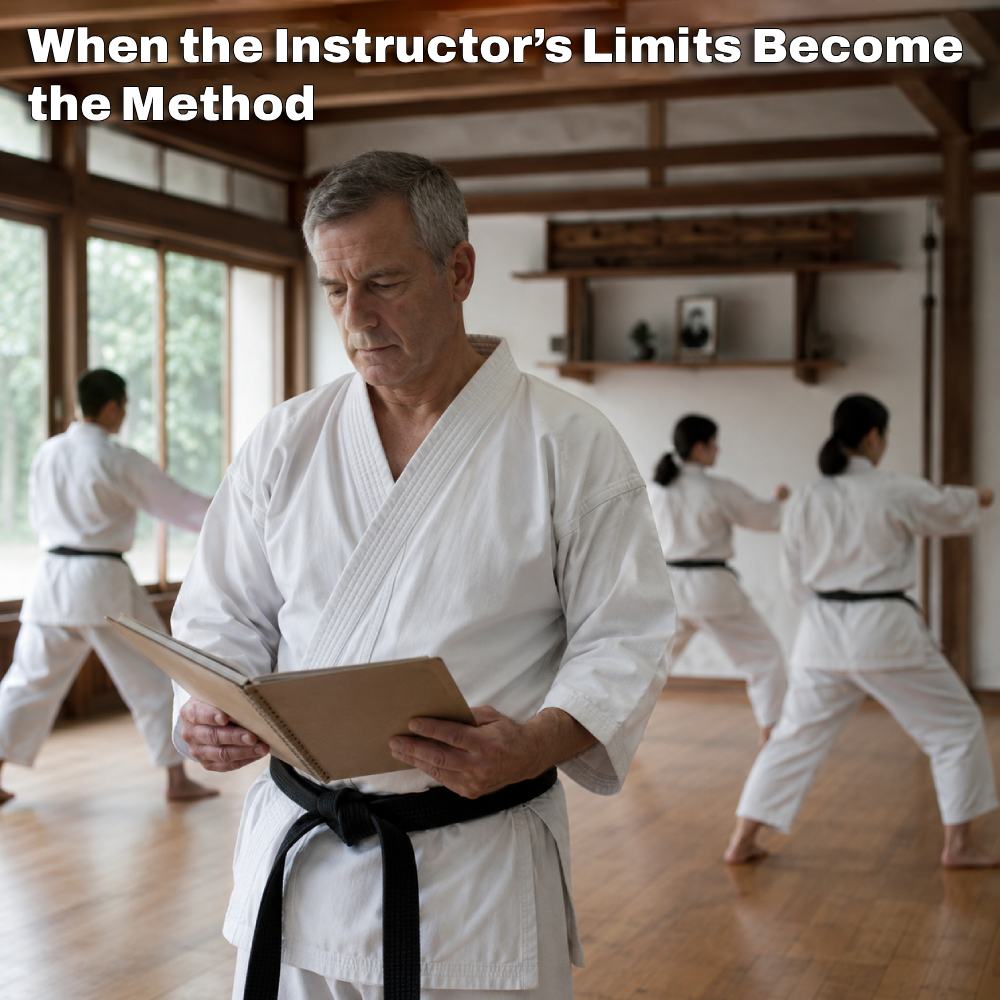
Every instructor teaches from what they know. That is unavoidable.
The problem begins when what they know becomes the boundary of what they believe self-defense is.
Not always deliberately. Not always dishonestly. But limited all the same.
My own direction has always been toward karate as a method of self-protection. I understand that karate can be practiced for many reasons, but this is the context I am speaking from here.
A teacher learns a certain way. They are taught a certain method. They spend years inside a particular view of karate, and over time that view begins to feel complete.
Then, when students seek self-defense, the teacher does not always begin by asking what self-protection actually requires.
They begin with what they know.
Whatever the background may be, fighting, competition, step-kumite drils, or kata application, it can all be made to wear the self-defense label if no one stops to ask whether it actually fits.
The method has not changed.
Only the label has.
I saw this clearly when I first came to the United States and taught at a local dojo.
The instructor spoke of his system with great confidence. It was presented as the “Cadillac of karate”, something powerful, direct, and complete.
But in practice, the self-defense being taught was really just fighting under another name.
Kata held little interest. Application was basic. The answer to most problems was to keep the hands up, use body weight, move forward, and fight harder.
For a certain kind of person, in a certain kind of situation, some of that may have value.
But it is not the whole of self-protection. And it certainly does not answer every problem a student may face.
The problem is not that fighting skills are useless.
The problem is when fighting becomes the only lens through which every problem is viewed.
And what happens when the problem is not a fight at all?
Self-protection may involve fighting, but it is not defined by fighting. Physical skill matters, of course, but so do awareness, avoidance, verbal skills, escape, positioning, decision-making, distance, intent, and knowing when not to engage.
If every answer is “keep your hands up and fight”, then many of those problems are never addressed.
This is where the instructor’s limits can quietly become the student’s curriculum.
They teach the syllabus. They repeat the drills. They use the language they were given. And because they have never been shown how to step outside that frame, the curriculum itself begins to define what they believe self-protection is.
That frame can become even tighter when the instructor is tied to a syllabus that must be followed exactly. If grades, recognition, and belonging are all built around repeating the same material in the same way, there may be little room to ask whether the method serves a different purpose.
The curriculum becomes the boundary, and anything outside it begins to feel like a departure from the art itself.
This is not the same as building a method around self-protection.
It is retrofitting.
The training and habits already exist. The preferred answers already exist. The instructor then tries to make them fit a context they may not have been designed for.
Sometimes that works.
Often, it does not.
And when it doesn’t, the student is left with a false picture of what they are being prepared for.
This is not unique to one style. It happens whenever an instructor takes the part of karate they know best and treats it as the whole answer.
Every instructor has a lens.
The danger is forgetting that it is only a lens.
Self-protection has to begin with the problem, not the instructor’s preferred answer. The situation matters. So does the student, the likely threat, the possibility of escape, and the consequences that may follow.
A child being bullied does not have the same needs as an adult facing a sudden assault. A person being grabbed does not face the same problem as someone choosing to stay in a consensual fight.
The context changes, and if the context changes, the answer should change too.
Respecting our teachers does not mean freezing their answers in place. We can value what we were given and still recognize its limits.
Sometimes the most honest thing an instructor can say is, “This is what I was taught, but it is not enough by itself.”
That is not weakness.
It is responsibility.
Because the point is not to protect our own method from questioning.
The point is to protect the student.
If what we teach is truly for self-protection, then we have to be willing to look beyond what we were taught, beyond what we prefer, and beyond what worked for us.
Otherwise, we are not really teaching the student what they need.
We are teaching them the boundaries of our own knowledge, and calling it self-defense.