
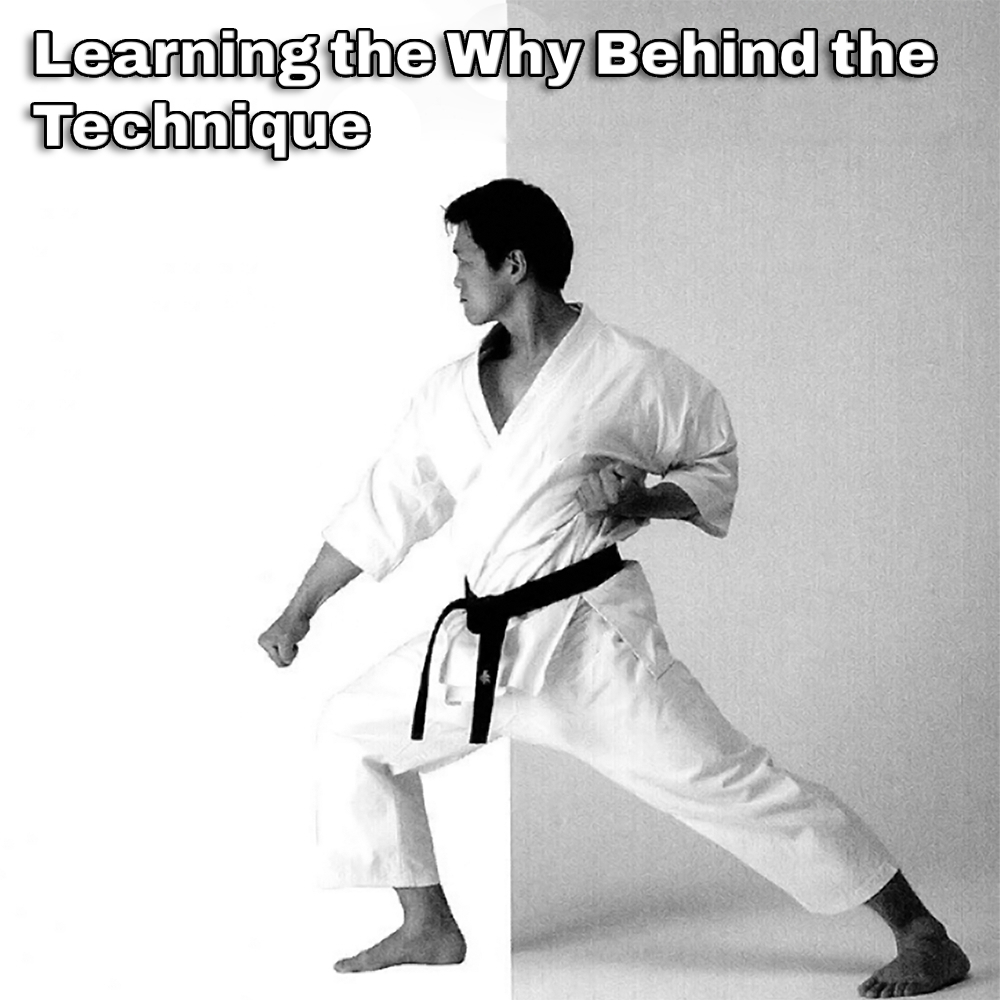
A student once watched me demonstrate a movement and remarked, “We have a long way to go”.
He was referring to how relaxed the movement appeared compared to how stiff and tense he felt when performing the same technique.
I smiled because, in a sense, he was right.
There is a long way to go.
One of the biggest misconceptions in karate is that the movements we practice are the movements we are ultimately trying to produce. They’re not.
When students first begin learning, we break everything down into individual parts. This is what your feet do. This is where your hands go. This is how your hips move. We teach techniques in stages because complex movement is easier to learn when it is broken into smaller pieces.
The problem arises when people mistake this learning process for the finished product.
Step-by-step practice is not the destination. It is simply a method of getting there.
This distinction is important because people often confuse a training method with the skill the method is intended to develop.
We see this throughout martial arts. A drill becomes the thing being measured rather than the attribute it was designed to improve. A technique becomes something to copy rather than something to understand.
The training method has value, but only if we remember its purpose.
Karate doesn’t fail people – unclear goals do.
If the goal is to develop efficient movement, then every drill, exercise, and technique should be viewed through that lens. The question is not whether the drill looks realistic or traditional. The question is what the drill is trying to develop.
Learning to ride a bicycle is not the same thing as balancing. Training wheels may help develop the skill, but nobody mistakes the training wheels for the skill itself. Yet in martial arts, practitioners often make exactly that mistake. They become attached to the exercise and lose sight of what the exercise was meant to teach.
At the beginning, movements often look mechanical because students are concentrating on remembering details. They are thinking about every part of the process separately. This is normal. In fact, it’s necessary.
However, if training never progresses beyond that stage, the result is often stiffness, tension, and movements that look rehearsed rather than functional.
Karate, at its best, is built upon efficiency.
Efficient movement is not achieved by adding more effort. It’s achieved by eliminating what is unnecessary. Excess tension, unnecessary motions, and competing movements all interfere with the body’s ability to generate and transfer force effectively.
This is where principles become important.
Many practitioners spend years collecting techniques, each with its own label, without ever fully understanding the principles those techniques are intended to teach.
A technique is a specific solution to a specific problem.
A principle is something much broader.
The same principle can be expressed through countless techniques.
We are given the “what” so we can learn the “why”.
Consider a movement such as gedan barai. Many students are taught to see it simply as a lower block. They learn where the hands start, where they finish, and how the movement should look.
But the technique is not the lesson.
The lesson may involve body rotation, force generation, limb control, angle creation, weight transfer, or any number of other underlying principles.
Once the principle is understood, it can appear in many different contexts. The student is no longer confined to reproducing a single technique exactly as it was taught.
This is why introducing principles early is so important.
When students only see individual techniques, they often become trapped by them. They focus on memorizing movements rather than understanding what those movements are trying to teach.
Understanding the principle gives meaning to the technique.
Once the principle is understood, the technique stops being a destination and becomes an example.
This is often the point at which progress accelerates. Instead of seeing dozens of separate techniques, the student begins to recognize the same underlying ideas appearing again and again in different forms.
The student who told me we had a long way to go was absolutely correct.
But the distance is not measured by how many techniques we know.
It is measured by how many of them no longer feel like techniques at all.
When movement becomes efficient, relaxed, and adaptable, the principle has finally become part of us.