
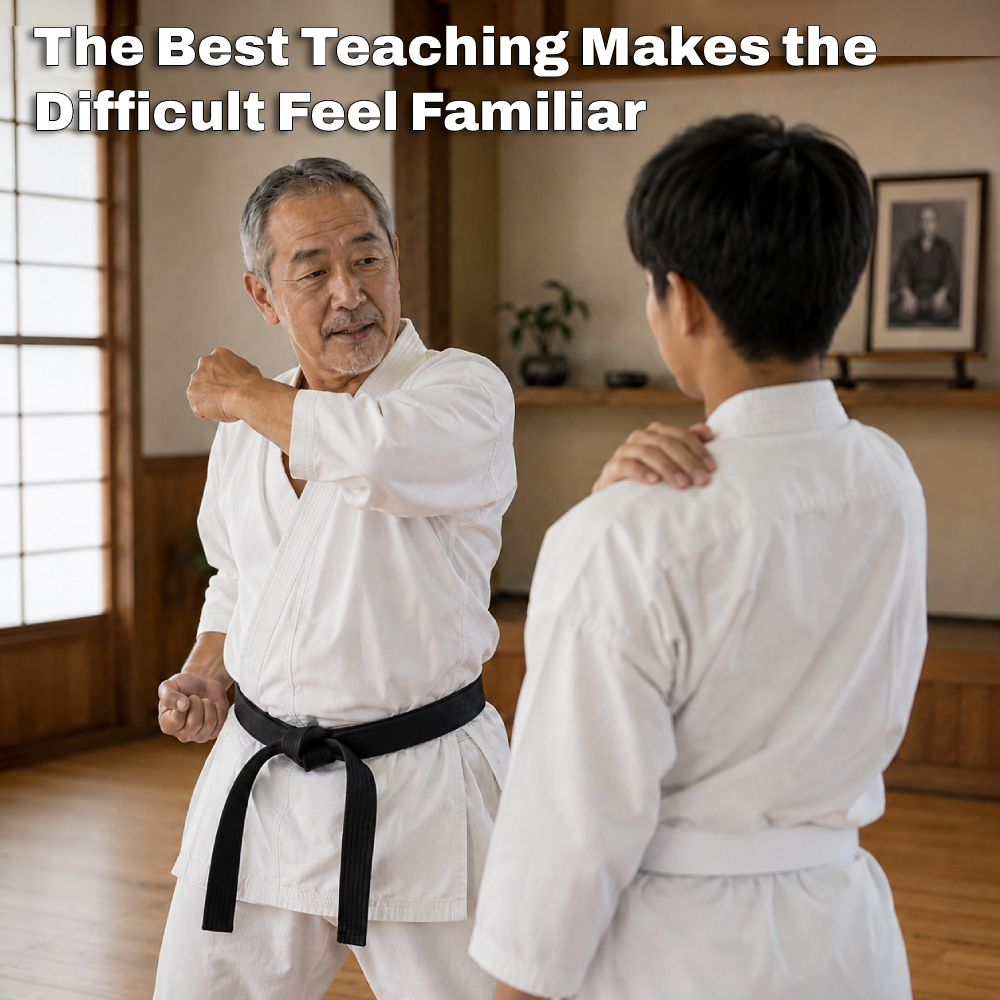
When people begin learning karate, almost everything feels unfamiliar.
The language and movements are unfamiliar. Even the way they are expected to stand, breathe, and hold their hands may feel different from anything they have done before.
An instructor can make that unfamiliarity seem even greater by beginning with technical terminology and detailed explanations.
Or they can begin with something the student already understands.
Years ago, when I taught self-protection courses in the UK, I often worked with people who had little or no martial arts experience. Among them were police officers, doctors, nurses, and others working in public service.
They did not need to become karate practitioners.
They needed to understand useful movements quickly, remember them, and be able to reproduce them under pressure.
As an example, when teaching a short side elbow strike, I would sometimes ask students to imagine quickly brushing a mosquito from the opposite shoulder.
It was an ordinary action they could recognize immediately. Instead of trying to construct an unfamiliar technique from a series of instructions, they already had a general sense of the movement.
From there, the action could be refined. The body could turn with it, the elbow could follow the correct path, and the student could begin to understand how the movement might be used.
I could have begun with its Japanese name and explained the position of the arm, the rotation of the body, the path of the elbow, and the finer technical details.
But those details would not necessarily have helped them find the movement.
The action was not being simplified because the students were incapable of learning something more technical. It was being connected to something their bodies already understood.
That connection gave us somewhere to begin.
The terminology and finer details could come later. First, the student needed to feel the movement and understand its purpose.
Good teaching often means finding a bridge between what the student already knows and what they are trying to learn.
Karate contains many movements that feel unnatural when they are presented in isolation. Students may try to remember every detail at once.
The result is often a movement that looks stiff and hesitant because the student is trying to assemble it from separate instructions.
Sometimes it is more helpful to give them an action they recognize.
Push a heavy door or pull something towards you. Swat a fly off a table or lift an object from the floor. Move someone aside as you pass through a narrow space.
These are not replacements for instruction. They are starting points.
They give the student a familiar sensation around which the technical details can gradually be organized.
There is a tendency in martial arts to assume that complexity is evidence of knowledge.
The more terminology we use, the more detail we provide, and the more difficult we make the movement appear, the more advanced the instruction may seem.
But teaching is not a demonstration of how much the instructor knows.
It is the process of helping someone else understand.
An instructor may possess a great deal of technical knowledge, but that knowledge only becomes useful when it can be communicated in a way the student can absorb.
That requires more than knowing the technique.
It requires watching the student.
Some people learn by seeing the movement. Others need to feel it. Some need a practical example before the mechanics make sense. Others want to understand the reason first and only then begin working on the action.
The same explanation will not reach everyone.
Good instructors learn to approach the same idea from several directions. They change the words, the example, or the way the movement is introduced until the student recognizes something they can use.
That moment of recognition is one of the most satisfying parts of teaching.
A movement that seemed difficult suddenly becomes manageable. The student stops trying to imitate a shape and begins to understand the action behind it.
This does not mean that technical detail is unnecessary.
Detail matters. Precision matters. Terminology can help students communicate and understand the tradition they are studying.
But timing matters too.
The first explanation does not have to contain everything the instructor knows.
It only has to open the door.
Once the student can perform the movement with some confidence, the instructor can refine it. The posture can be adjusted. The body mechanics can be improved. The timing, structure, and application can be explored more deeply.
Understanding grows in layers.
The familiar example may eventually be left behind, but it has already served its purpose. It allowed the student to enter unfamiliar territory without feeling completely lost.
Experience as an instructor should not simply give us more information to pass on.
It should help us recognize what information the student needs now, what can wait, and what language will make the subject clearer.
Sometimes the clearest way to teach an unfamiliar movement is to show the student that, in some form, they already know how to do it.