
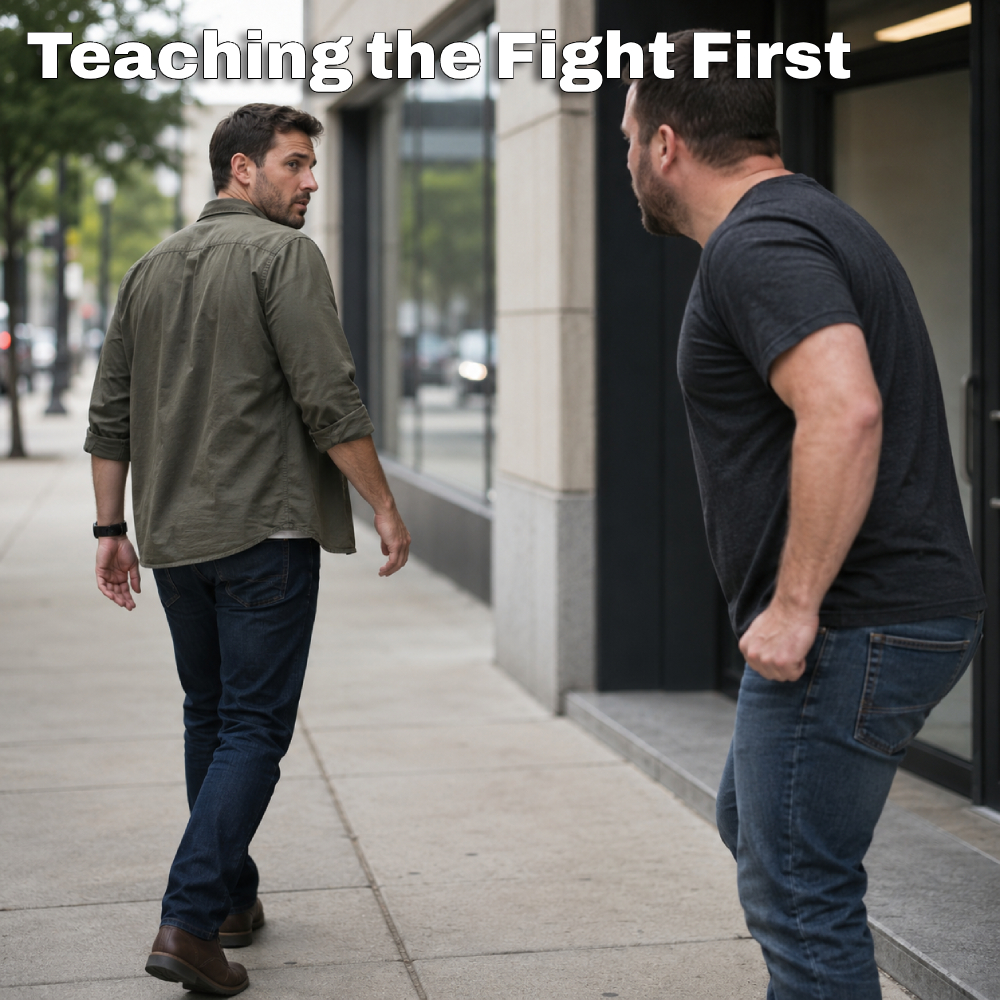
Self-defense.
Everyone teaches it, right?
It’s written on the flyers, displayed on the dojo door, printed on the business cards, and included in the advertising. It is one of the main reasons many people walk into a martial arts school in the first place.
But what if I told you that you might not be practicing self-defense at all?
You may be learning how to punch, block, kick, escape from a grab, or counter an attack. You may be practicing physical techniques against a training partner and calling those techniques self-defense.
But that does not necessarily mean you are learning how to protect yourself.
The physical confrontation is not the beginning of the problem. It is often much closer to the end.
A student walks into the dojo and is immediately taught how to respond once the physical confrontation has begun. From the very beginning, the emphasis is placed on the attack and the response.
The fight comes first.
But genuine self-protection begins much earlier than that.
Before the punch is thrown, before the grab is made, and before someone is backed into a corner or knocked to the ground, there are usually other things happening. There may be a change in behavior, a shift in tone, someone moving closer, a boundary being tested, or an exit becoming blocked. Fear may already be taking hold while the person is still trying to understand what is happening.
These moments matter because awareness, positioning, recognizing intent, and knowing when to speak, move, or get away are all part of self-protection. Yet much of this is absent from the way the subject is commonly taught.
Instead, the student is taken directly to the attack. Someone throws a punch and they block it. Someone grabs their wrist and they escape. Someone steps forward and they counter. The physical exchange is treated as though it is the beginning of the problem, while everything that led to it is largely ignored.
Part of the reason is that physical techniques are easier to teach. They are visible, they can be demonstrated and repeated, and they can be placed into a syllabus and tested at a grading. Awareness, judgment, fear management, verbal boundaries, avoidance, and decision-making are harder to package in the same way. They are less dramatic and don’t always look like martial arts, but that does not make them less important.
Another reason is inheritance.
Most instructors teach what they were taught. Their instructor began with punches, blocks, kicks, grabs, and counters, so they do the same. The instructor before them probably did too. The method is passed from one generation to the next until it begins to feel complete simply because it has always been there.
An instructor may be highly skilled within that framework and still have little experience teaching what happens before violence begins. They may never have been taught how people behave when they are frightened, how aggression develops, or how distance, exits, obstacles, verbal engagement, and surprise can shape an encounter. If the physical exchange was all they were ever shown, then the physical exchange is likely to be all they teach.
There is another problem. Even when the physical response is taught, it is often taught in a way that depends on warning. The attacker stands at a convenient distance. The defender knows something is about to happen. The attack is clearly recognizable. A punch comes forward, the defender waits, identifies it, blocks it, and then counters.
That pattern becomes deeply embedded:
Wait for the attack.
Block.
Counter.
But surprise is one of the defining features of real violence. The attacker may already be close. The first movement may not be recognized as an attack. The defender may be distracted, seated, trapped, carrying something, protecting someone else, or still trying to understand what is happening. There may be no clear starting point, no formal distance, and no pause between intention and action.
The very thing the student has been trained to do, wait for the attack, may be the thing that leaves them unprepared when the attack comes.
This does not mean they are unskilled. They may have trained for years and may perform techniques strongly and accurately. But they have been prepared for a recognizable attack under familiar conditions. They have not necessarily been prepared to manage the confusion that comes before it, or the shock that comes with it.
Fear also needs to be part of the training. People should understand that being afraid does not mean they are weak or incapable. Fear is a natural response to danger, and it can affect breathing, vision, movement, memory, and decision-making. The aim is not to pretend it will disappear, but to recognize it, accept it, and learn how to keep functioning while it is present. A person who has never considered how fear may affect them can be overwhelmed by the experience, even if they know the physical techniques.
This is why teaching self-protection as a collection of physical techniques is not enough.
The physical part matters. There may come a point when there is no option but to act. But the student should understand that this is only one part of a much larger subject. They should learn to notice changes in behavior, understand distance and positioning, recognize the value of exits, and practice using their voice. They should also understand that escape is often success, because the goal is not to win a fight but to avoid being seriously harmed.
And when physical action becomes necessary, they should not be trained only to wait passively for a clean attack to arrive. They should understand initiative, interruption, and the possibility that movement may need to begin before the attack is fully formed. They should also understand that sometimes they will be surprised, and that training must prepare them to recover from that surprise rather than pretending it will not happen.
Self-protection should not begin with the punch. It should begin with the person, their awareness, their judgment, their fear, their circumstances, and their ability to recognize danger and make decisions while there is still time to make them.
The fight may be part of self-protection.
But it should never be the first thing we teach.